In February 2025, the greenhouse gas emissions monitoring, reporting and verification system – or MRV for short – returned to Ukrainian business life following a hiatus of several years caused by the full-scale invasion. And with it came the return of mandatory monitoring plans, emissions calculations, numerous spreadsheets and the risk of receiving comments when there is almost no time left to rectify the situation.
In practice, for many businesses, attempting to navigate this process on their own often turns into a maze of regulations, technical calculations and forms, where a single mistake can lead to a whole host of subsequent problems.
As a result, a separate market for services has already developed around the MRV. Some companies help businesses set up a monitoring system and prepare a report, whilst others are tasked with independently verifying it.
Today, EcoPolitic will tell you about the key players in this sector: what services they offer and what to look out for when choosing a contractor.
Why services relating to the MRV have become particularly relevant
Ukraine launched its greenhouse gas monitoring, reporting and verification system back in 2021. It was intended to ensure accurate accounting of industrial greenhouse gas emissions and to serve as the foundation for a future national emissions trading scheme.
But the following year, a full-scale war broke out. For the period 2021–2023, compliance with the MRV's requirements effectively became voluntary. Some companies ceased or scaled back their operations, some found themselves in the occupied territories, whilst others simply postponed their climate reporting until better times.
In February 2025, Law No. 4187-IX came into force, reinstating the mandatory MRV system. Operators were permitted not to submit reports for 2021–2023, whilst reports for 2024 could be submitted by the end of 2025.
So, the hiatus lasting several years has come to an end. For industrial enterprises, this meant that they had to not only calculate their emissions, but also register their installations, draw up a monitoring plan, organise data collection, prepare an operator’s report and have it independently verified.
The reinstatement of the MRV coincided with several other processes: the full-scale launch of the European CBAM from the start of 2026, the development of the Ukrainian emissions trading scheme (ETS), and the alignment of domestic climate legislation with EU rules. Consequently, the availability of high-quality emissions data is, right before our very eyes, transforming from a formal environmental requirement into a factor determining access to European markets and funding.
What a business needs to do under the MRV
First and foremost, it is important to understand that reporting to the MRV is not a one-off task of completing paperwork, but an ongoing process that continues throughout the year.
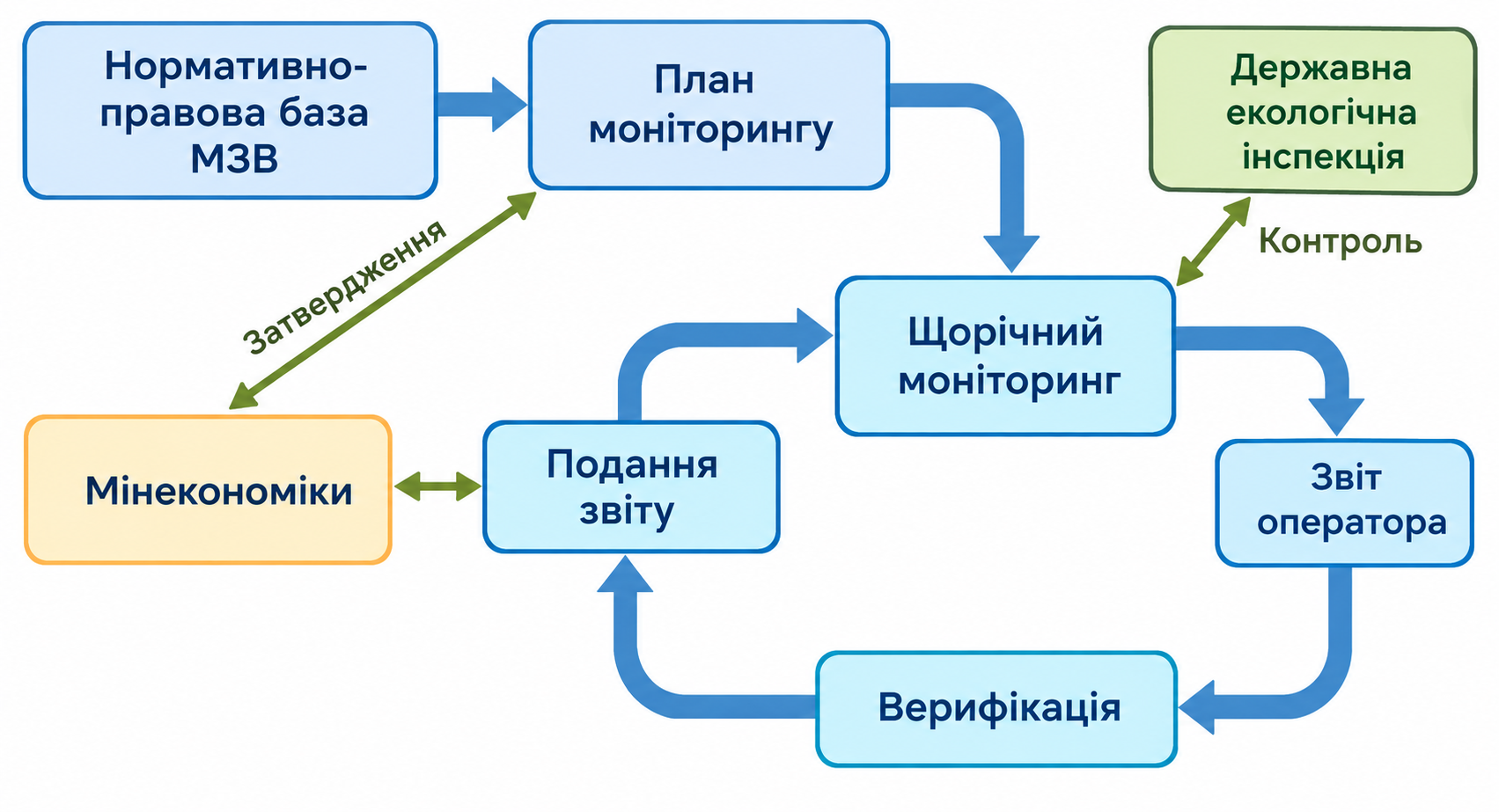
- Firstly, it is necessary to determine whether a particular installation falls within the scope of the legislation. If so, the operator must register it in the MRV Unified Register.
- The company then draws up and submits for approval a monitoring plan, in which it identifies emission sources, material flows, calculation methods and the procedure for monitoring the information.
- Once the plan has been approved, the operator collects and stores data on fuel and raw material consumption, production volumes and other indicators required to determine emission levels throughout the reporting period.
- Based on this data, the company prepares the operator’s annual report. However, it cannot be submitted directly to the ministry: the document must first be checked by an independent, accredited verifier.
Only once a positive conclusion has been reached is the operator’s report for the previous year, together with the verification report, submitted to the competent authority by 31 March of the current year at the latest. Consequently, errors made during the monitoring phase may only come to light many months later — during the final audit.
Who can prepare an operator’s greenhouse gas emissions report?
By law, the report is drawn up by the facility operator. The company may entrust the technical preparation of the document to its own environmental officer, another relevant member of staff, or an external consultant specialising in environmental protection.
A consultant may collect and verify the raw data, carry out the calculations and complete the form. However, the operator remains responsible for the accuracy of the information submitted to the competent authority. You can delegate the work to a contractor, but not the responsibility.
Where the system is faltering: problems with MRVpublic administration
It would be incorrect to say that the monitoring, reporting and verification system in Ukraine does not work at all. The Ministry registers installations, approves monitoring plans and accepts reports, whilst the National Centre for Greenhouse Gas Emissions Accounting analyses the documents and provides recommendations.
However, the ministry responsible for the system and the business sector still face several serious challenges.
-
-
The consequences of a hiatus lasting several years. The voluntary scheme in place from 2021 to 2023 disrupted the continuity of data and reporting practices. For objective reasons, some organisations did not maintain their monitoring systems, did not update their documentation, and did not build up experience of undergoing verification.
-
Institutional reorganisation. Following the abolition of the separate Ministry of the Environment in 2025, its functions were transferred to the Ministry of the Economy, the Environment and Agriculture, and a year later to the Ministry of the Economy and the Environment. Such reorganisations always pose risks to procedures that depend on the continuous processing of applications, plans and reports, particularly following yet another round of staff cuts within the department.
-
Complex requirements without a clear roadmap. Laws, regulations, standard forms and guidance can be found on government websites. However, for a business dealing with MRV for the first time, these do not always add up to a clear step-by-step process. It takes quite a long time to find the necessary information, and it is extremely difficult to understand all the intricacies of the calculations without an experienced specialist.
-
A restricted verification market. Not just any environmental consultancy can verify a company’s annual report; only an organisation with the relevant valid accreditation may do so. The current list of companies holding valid accreditation certificates can be found on the website of the National Accreditation Agency of Ukraine (NAAU) under the heading ‘Verification Bodies (DSTU EN ISO/IEC 17029:2020, DSTU EN ISO 14065:2022)’ . As of 21 September, the list contains only 10 companies with valid certificates. We have provided a list of these companies below.
-
Consultant and verifier: who exactly should you hire?
This is where the confusion begins. Some companies promise their clients a ‘full range of MRV services’ or a ‘turnkey MRV solution’. It sounds convenient: hand over the documents to a single contractor and receive the finished product. But it doesn’t work like that, because under the current rules and logic, the same company cannot both prepare the report and independently verify it.
There are therefore two fundamentally different roles within the MFA system.
A consultant may:
-
to determine whether the requirements of MRV apply to the company;
-
help with registering the installation;
-
draw up a monitoring plan;
-
establish procedures for data collection and monitoring;
-
calculate emissions;
-
prepare the operator’s report;
-
to assist the company during the verification process.
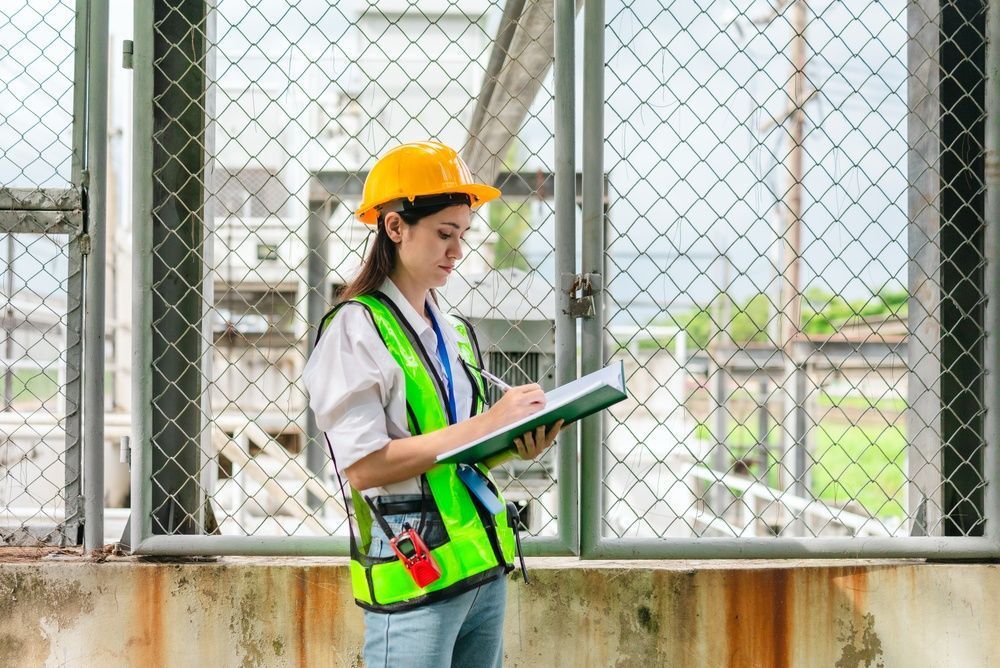
The verifier does not prepare the report on behalf of the organisation. Its role is to independently verify whether the data contained in the report is complete and accurate, whether it complies with the monitoring plan, and whether the report is free from material misstatements.
Based on the results of the check, the verifier issues a verification report to the operator, stating whether the outcome is satisfactory or unsatisfactory.
We would like to emphasise once again that such an inspection cannot be carried out by just any environmental specialist or auditor, but only by a legal entity with valid accreditation and the relevant area of expertise.
So, a brief explanation of how a Ministry of Foreign Affairs (MFA) consultant differs from a verifier is as follows: a consultant helps a company set up a monitoring system and prepare an operator’s report, whilst a verifier independently checks the document once it has been prepared and issues an official opinion on whether it can be deemed satisfactory. No special MRV accreditation is required for consultancy work, whereas verification may only be carried out by an accredited legal entity.
How to avoid conflicts of interest
The verifier must be independent. They cannot first help a company set up a monitoring system and prepare a report, and then go on to assess the quality of their own work. Because that is no longer an independent audit, but self-assessment with a predictable outcome.
If a consultant offers a ‘turnkey’ service, it is worth clarifying exactly what they mean by this. It is perfectly normal for a company to prepare all the documentation and then arrange for a separate accredited verifier to carry out the verification. It is not normal, however, when the consultant and the ‘independent’ verifier turn out to be the same legal entity, effectively assessing itself.
What is included in the services for preparing an MRV report
The scope of services depends on the status of the company’s documentation. Basic support may include determining whether a facility falls within the scope of the MRV system, registering it, developing or updating a monitoring plan, assessing risks and uncertainties, preparing written procedures, verifying raw data, calculating emissions and compiling the operator’s report.

An extended package typically includes regular data monitoring throughout the year, staff training, the preparation of materials for the audit, communication with the independent verifier, the resolution of findings, and the preparation of an improvement report. It is therefore advisable to compare proposals not only on the basis of price, but also on the basis of the precise scope of work.
Companies that assist with MRV reporting
EcoPolitika has analysed publicly available proposals from Ukrainian companies claiming to provide services in the field of emissions trading: from registering installations and drawing up monitoring plans to preparing operators’ reports and conducting independent audits of these reports.
We have deliberately not ranked them, as there is no comprehensive publicly available information on the number of reports prepared by each company, the proportion of verifications successfully passed, the cost of the work, or feedback from industrial clients, which would be needed to compile an objective ranking.
The information on services is based on open data provided by the companies themselves.
| Компанія | Консультант | Акредитований верифікатор |
|---|---|---|
| "Центр Екології та Розвитку Нових технологій" | Так | Ні |
| ESL | Так | Ні |
| SEC Ecology | Так | Ні |
| Бюро "ЕКО-СТРІМ" | Так | Так |
| Науково-дослідний центр "КТФ" | Так | Так |
| "Експертно-технічний центр промислової екології" | Ні | Так |
| Verum Carbon | Ні | Так |
| Бюро Верітас Україна | Ні | Так |
| НП "Експерт Груп" | Ні | Так |
| “Біомаса-Карбон” | Так | Ні |
| "Технічні та управлінські послуги" | Ні | Так |
| "Товариство технічного нагляду Діекс" | Ні | Так |
| "Спецтехсервіс-Юг" | Ні | Так |
| "Фелікс Арт-А" | Ні | Так |
How to choose a company to prepare your accounts
A smart-looking website, the words ‘European standards’ and a green leaf on the logo are no guarantee that the consultant understands the specific technological processes at your company.
The environmental impact assessments for a cement works, a steelworks, a boiler house and a nitric acid producer differ significantly. Each sector has its own emission sources, material flows, calculation methods and risks.
Therefore, before choosing a contractor to help you develop a monitoring plan and draw up an annual report, ask them the following questions:
1. How many plans and reports has the company already prepared?
The phrase ‘we have considerable experience’ sounds impressive, but it’s completely uninformative. It’s better to look at the company’s figures:
- how many monitoring plans have been drawn up;
- how many operator reports have been prepared;
- how many documents have been verified;
- were there any rejections or significant comments;
- how the company helped to resolve them.
If confidentiality prevents the names of clients from being disclosed, the consultant may provide anonymised examples.
2. Do you have experience specifically in your sector?
A general understanding of climate legislation is good. Knowledge of a specific production process is much better.
The contractor must understand where emissions occur at the plant, what data can be obtained from the existing equipment, what laboratory tests are required, and where discrepancies most frequently arise. Otherwise, the company will end up paying for its own process engineers to spend several months explaining to the consultant how the production process works.
3. Who will actually carry out the work
A commercial proposal may be presented by an experienced expert, whilst the tables and calculations will ultimately end up with a specialist who only opened the Foreign Ministry’s resolution for the first time last week.
It is worth asking in advance for the team to be introduced, finding out about their experience and identifying the specialist who will be responsible for the project.
4. What exactly is included in the price
We need to clarify whether the proposal includes:
-
travel to the installation site;
-
the collection and verification of raw data;
-
drawing up a monitoring plan;
-
the drafting of written procedures;
-
calculation of uncertainty;
-
preparation of the operator’s report;
-
making corrections;
-
follow-up on the Ministry’s comments;
-
communication with the verifier;
-
the preparation of a report on improvements.
Otherwise, the ‘affordable MFA package’ may start to become more expensive with every new sheet and additional table.
5. How will independent verification be ensured?
You need to install:
-
which legal entity will carry out the inspection;
-
whether it holds valid accreditation;
-
whether the scope of accreditation covers the operations of a specific installation;
-
whether there is a conflict of interest between the consultant and the verifier;
-
who will coordinate this work.
How can I check the accreditation of an MRV verifier? Look up the company in the NAAU’s register of accredited conformity assessment bodies under the ‘Verification Bodies’ category. Check not only that the company’s name appears on the list, but also the status and validity period of its certificate.
Next, open the accreditation scope. This should include the type of activity to which your organisation’s facility belongs. For example, accreditation solely for fuel combustion does not entitle a company to verify reports relating to cement or metallurgical production.
It is advisable to double-check the certificate and the scope of accreditation immediately before signing the contract, as their status may have changed.
6. What will the company receive upon completion of the project?
A qualified adviser provides you with more than just an annual report. Your business should have:
-
a clear data collection system;
-
the relevant staff members have been appointed;
-
operational control procedures;
-
document templates;
-
a list of evidence for future verification;
-
an understanding of what needs to be done during the next financial year.
After all, the MZV is not a one-off procedure. A new report will have to be prepared every year.
How much does it cost to prepare a MRV report?
There is no standard fee for preparing such reports in Ukraine. Consultants and verifiers determine the cost on a case-by-case basis after analysing the client’s requirements and the scope of work involved.
The price is influenced by the number of installations and material flows, the complexity of the technological processes, the quality of the source data, the need for on-site visits, the development or updating of a monitoring plan, and the extent of support required during verification.
It is therefore advisable to ask the contractor not for an abstract ‘report price’, but for a detailed quotation. This should itemise the preparation of documentation, independent verification, site visits, rectification of comments and other additional work.
The MRV is no longer just a formality
Whilst Ukraine is still preparing to launch its own National Carbon Market, businesses may view the MZV as just another environmental report for the state. However, it is precisely the data that businesses are collecting today that will be used in future to determine obligations under the National Carbon Market and the Carbon Border Adjustment Mechanism (CBAM), to assess carbon efficiency, and to plan for decarbonisation.
They are already attracting the attention of banks, investors, European counterparties and customers who are calculating the carbon footprint of their supply chains.
Therefore, the consultant’s main task is not simply to ‘produce a report’. A high-quality contractor must leave behind a clear and reproducible system: with defined data sources, designated staff, control procedures and a paper trail that will stand up to independent scrutiny.
Because in the world of carbon regulation, figures plucked out of thin air can end up costing a company dearly.