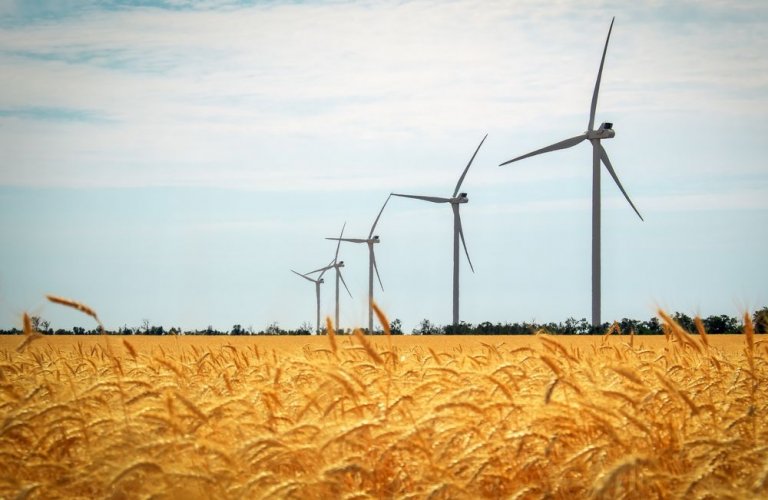
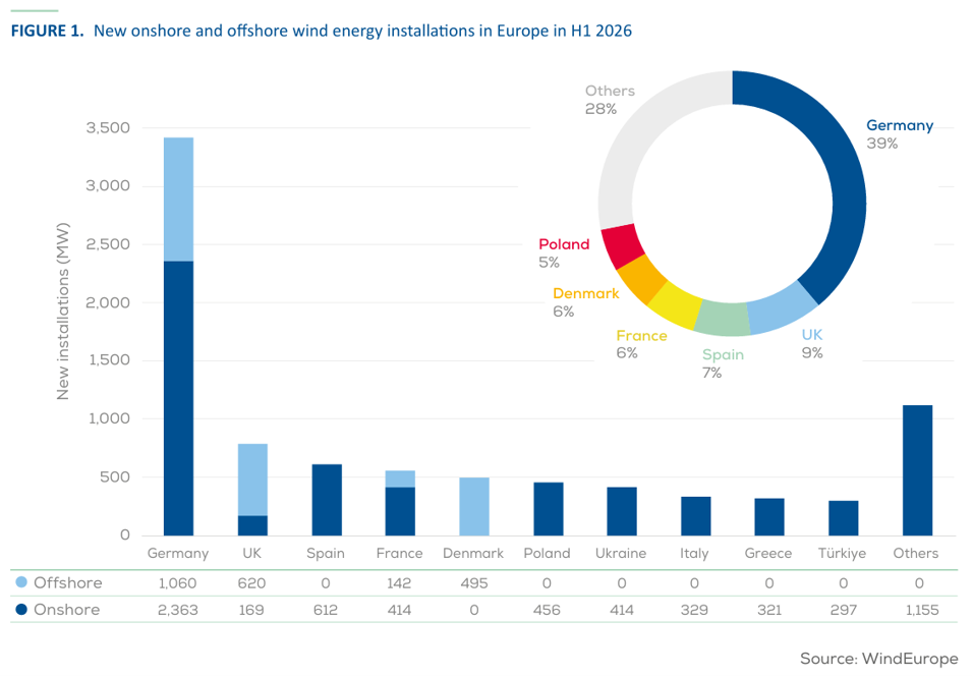
This year is set to be a record-breaking one for wind energy in Europe. In the first half of the year alone, countries installed 8.8 GW of new wind power capacity — 30 per cent more than in the same period of the previous year, 2025. Incidentally, despite the full-scale war, Ukraine has made it into the top ten, having commissioned over 400 MW of generating capacity in six months.
This is evidenced by data from the September report by WindEurope, the European wind energy association.
The new wind power capacity is sufficient to supply energy to around 7 million households. To generate the same amount of electricity each year, it would be necessary to import liquefied natural gas equivalent to the capacity of 25 tankers.
Germany installed the most new capacity — 3.4 GW. The UK, Spain, France, Denmark and Poland are also among the leaders. Onshore wind turbines accounted for around 74 per cent of the total.
Source: WindEurope
Expected results
WindEurope forecasts that 24 GW of new capacity will be installed in Europe by the end of the year.
"The wind energy sector is at the start of an expected phase of capacity expansion, leading up to a stable annual installation rate of 30 GW in the 2030s," the association notes.
There is currently over 311 GW of wind power capacity in Europe: 270.5 GW onshore and 40.9 GW offshore.
At this rate, European wind power capacity could reach 436 GW by 2030, of which 342 GW will be in EU countries. This generation will meet 27 per cent of energy demand.
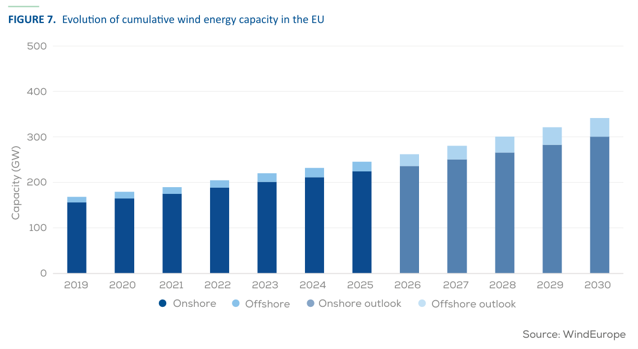
Source: WindEurope
Barriers to growth
Despite the generally optimistic picture, the sector faces a number of challenges. First and foremost is bureaucracy, specifically the licensing system.
Germany is a notable example. There, the introduction of effective permitting rules has helped secure approvals for the construction of 9 GW of onshore wind power. In contrast, in France, Spain, the United Kingdom, Ireland and Italy, the number of permits granted has fallen.
"Just when we need wind power most to boost Europe’s economic resilience, the volume of permits in key markets is falling. Government decisions on permits, auctions, grids and electrification in the coming months will either drive this momentum or derail it," emphasised Tinne van der Straten, Chief Executive of WindEurope.
The industry association insists that, for the sector to develop further, governments must implement EU regulations to ensure that high-quality projects do not get bogged down in red tape. The remaining steps are to unblock investment, eliminate the waiting list for grid connection and put an end to experiments with auction design.
WindEurope advises governments to set specific national renewable energy targets for 2040 and to fund the electrification of industry using revenue from the Emissions Trading Scheme (ETS).
According to the Ukrainian Ministry of Energy, the total capacity of wind turbines stands at 1.115 GW. The Mykolaiv and Odesa regions are among the leaders. Over 37 per cent of this capacity was commissioned in the first half of 2026 alone, comprising 70 turbines with a total capacity of 414.8 MW.