Work to clean up Lake Kyrylivske and the Syretsky Stream in Kyiv has been ongoing for almost two months. Experts’ calculations show that the comprehensive measures have had a significant effect — the volume of fuel and lubricants that entered the water bodies following the enemy shelling on 2 July has been reduced by a factor of 33.
This was reported by the Kyiv City State Administration.
At the start of this local environmental disaster, 350 cubic metres of petroleum products were recorded on the water’s surface. By the end of August, this figure had fallen to 10.5 cubic metres.
“We are not stopping the work — it is important to clean the water bodies as thoroughly as possible and prevent the pollution from spreading. Specialists from the municipal enterprise ‘Pleso’ continue to work on site and monitor the situation,” said Valentin Mondriyevskyi, Deputy Head of the Kyiv City State Administration.
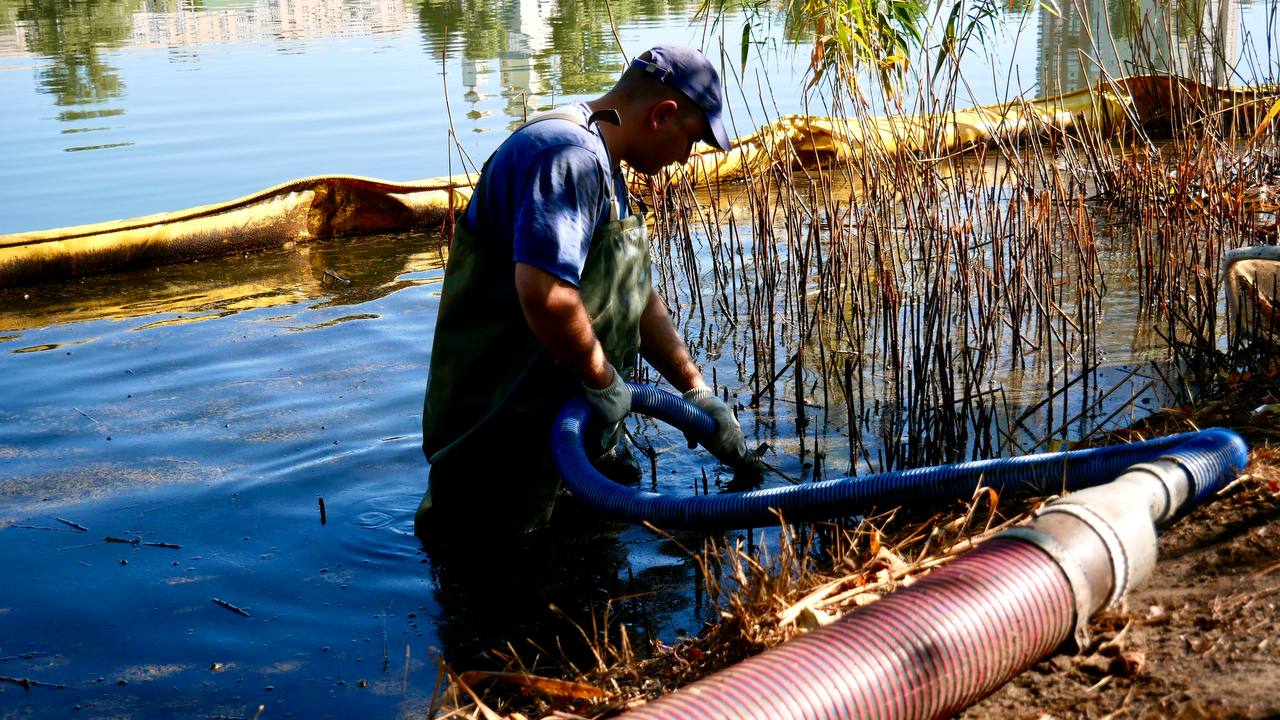
The Kyiv City State Administration added that a further 10 tonnes of contaminated waste had been removed for disposal. They also reported on other measures. In particular, in the western part of the Kyrylivskyi Stream, contaminated emulsion was pumped out from two localised areas. For further clean-up, the sorbent ‘Ekolan-M’ was applied there, and the boom barriers were removed.
Source: Kyiv City State Administration
The sorbent boom on the Syretsky Stream has been replaced. Previously, the biological agent ‘Trevitan’ was used there, after which the condition of the water body improved. According to data from the Ministry of Economy, this specialised biological agent was applied directly to the stream, as it is through this stream that petroleum products enter the lake. The ministry emphasised that the product is non-toxic to flora and fauna, as confirmed by a report from the State Service for Food Safety and Consumer Protection.
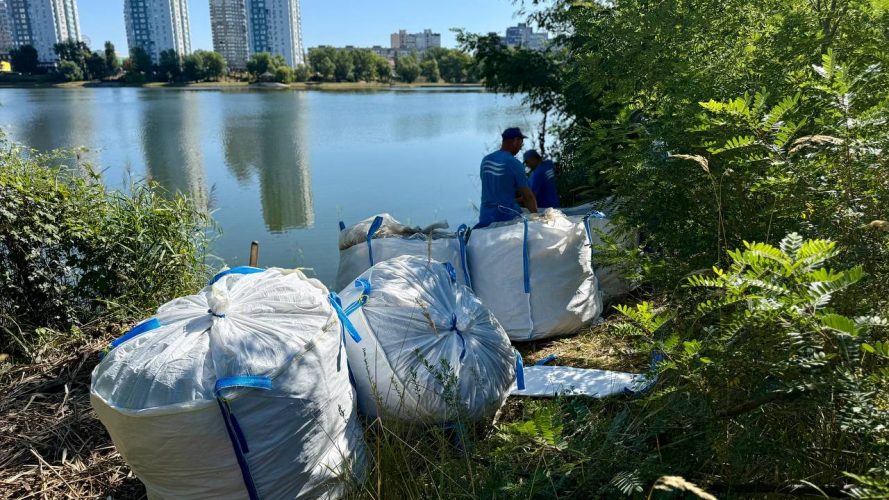
As well as water treatment, work is also continuing on the shore. There, they are continuing to cut back the contaminated reeds. These are being collected for subsequent disposal. Vegetation has already been cut and collected from 1,950 metres of the shoreline.
The administration emphasises that its aim is not merely to remove visible pollution. The key priority is the subsequent restoration of water bodies. A set of measures designed to help the ecosystem is currently being developed. The Institute of Hydrobiology of the National Academy of Sciences of Ukraine is involved in this work. At the same time, experts are constantly monitoring the condition of water bodies.
EcoPolitics previously reported that, immediately after the spill was detected, specialists from the State Emergency Service deployed special boom barriers on the water bodies to contain the pollution. By 5 July, there was talk of an oil slick covering an area of 20.6 thousand m². Emergency services collected 317 cubic metres of the contaminant from the surface, but on 22 July it emerged that there had been new, albeit minor, leaks of petroleum products.