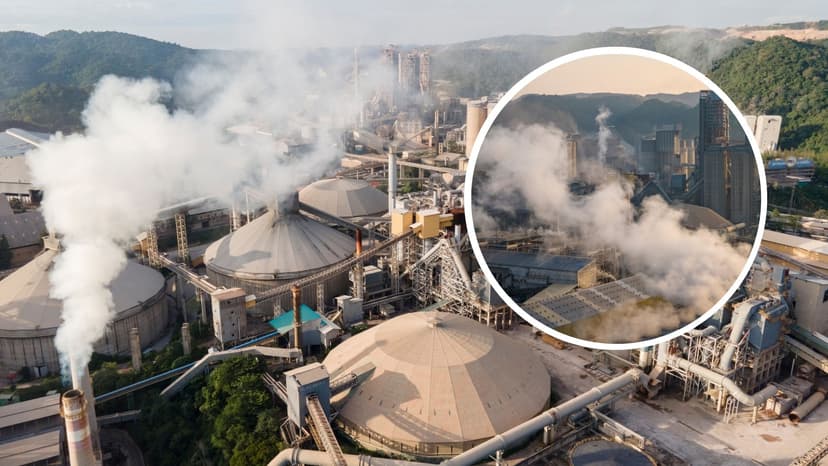
Modern civilisation cannot develop without cement – the construction of houses, buildings, roads, bridges and factories depends directly on this industry. However, it is this very industry that accounts for 5–8 per cent of global carbon emissions. But a new approach from ETH Zurich in Switzerland has the potential to transform cement plants into facilities that can, in fact, capture carbon from the atmosphere.
This technology was featured in the publication Interesting Engineering.
Environmental integration
Research by Swiss scientists has revealed that cement production technology can be easily integrated with direct air capture (DAC) technology for CO2. This applies not only to a plant’s direct emissions, but also to the compound already present in the atmosphere.
Source of pollution
This refers to a system based on the calcium cycle. It uses limestone, which is also the basic raw material for cement production.
Yes, cement production contributes to indirect emissions through the use of energy from fossil fuels. At the same time, limestone itself emits CO2 into the air when heated. In this way, it forms quicklime and carbon dioxide. In other words, simply replacing fossil fuels with renewable energy will not solve the problem.
However, ETH Zurich proposes turning the industry’s main environmental drawback into an advantage. The technology aims to combine cement production with a process that captures additional CO₂ directly from the atmosphere.
The essence of the process
The key technology is set to be direct air capture (DAC) of CO2. Research by ETH Zurich examines a DAC process known as calcium cycling, which has a particularly interesting link to cement production.
Researchers propose heating limestone to produce quicklime. However, rather than releasing carbon dioxide, the process could capture and collect it. Water can then be added to the quicklime to form slaked lime.
"Slaked lime is capable of absorbing CO₂ from the surrounding air. Ultimately, it is converted back into limestone, which can then be reintroduced into the cement production process. In fact, this calcium-based material can act as a reusable carrier for atmospheric CO₂," the study states.
In other words, the more carbon sequestration cycles lime undergoes, the more carbon it removes from the atmosphere.
In addition, ETH Zurich offers a method for compressing captured carbon dioxide for storage in permanent underground reservoirs.
Researchers’ calculations show that the electrification of cement kilns and direct CO₂ capture could reduce the climate impact of cement production by up to 78 per cent by 2050.
EcoPolitic reported that the world’s largest offshore substation has come into operation in China. It is capable of transmitting around 6 TWh of electricity each year, converting it from power generated by offshore wind farms.