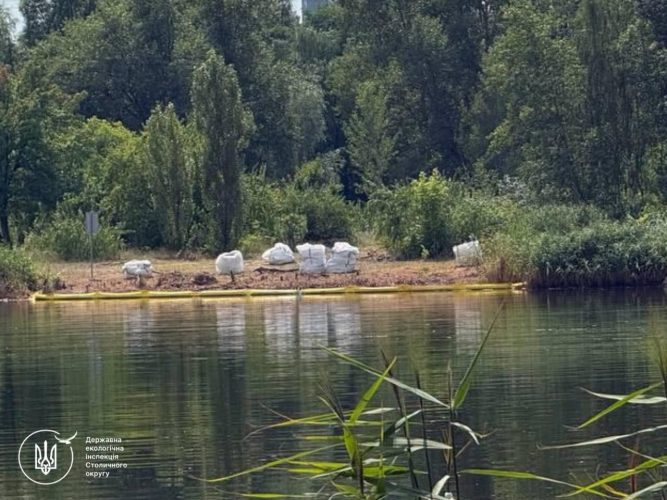
A leak of fuel and lubricants into the Opechen water system in Kyiv occurred back on July 2 after the Russian attack. As of the evening of Thursday, August 6, municipal workers were still cleaning Lake Kyrylivske. However, the main focus of work is on the Syrets stream, as it is the path through which pollutants entered the lake.
This was reported by the Department of Environmental Protection and Climate Change Adaptation of the Kyiv City State Administration.
Risk of recontamination
The authorities consider cleaning the Syrets stream one of the most important processes for the complete elimination of the consequences of this local environmental disaster, primarily because of the risk of secondary contamination. Remnants of oil-containing emulsion can re-enter the water area with rainfall.
Scope of work
So far, pollutants are still being retained in the upper aquatic vegetation and in the coastal soil. Therefore, specialists from KP "Pleso" are working proactively:
- contaminated plants are being mowed and removed. This is how they cleaned 1,160 m of the Syrets stream bank along the section from Bohatyrska St. to the point where it flows into Lake Kyrylivske. Cleanup was also performed further upstream towards the pollution source;
- the cleaned areas are treated with a sorbent. They are using the substance "Ekolan-M", which is designed to bind residual petroleum products;
- repeated neutralisation. On the north side of the lake, about 1.5 km of shoreline was again treated with sorbent to address residual mowed vegetation.
Efforts are being made to keep the situation in the water bodies under control. Ongoing environmental monitoring and water sampling are performed to assess recovery progress.
“Comprehensive work to eliminate the consequences of contamination continues daily. 'Pleso' is continuing the cleaning of shoreline and water areas, carrying out environmental monitoring, and implementing measures aimed at the full restoration of the Kyrylivske Lake and Syrets stream ecosystems,” the Department of Environmental Protection emphasised.
EcoPolitic reported that immediately after the fuel and lubricant leak, experts from the State Emergency Service of Ukraine (SESU) deployed special boom barriers. This was intended to prevent the oil slick from entering other water bodies of the network.
As of July 5, the contaminated area amounted to 20,600 m2. Rescuers used skimmers to collect the top contaminated water layer.
On July 17, the State Emergency Service of Ukraine (SESU) announced the completion of petroleum product recovery from the water surface. A total of 317 m3 of contaminated substance was removed from the lake.
However, on July 22, the State Environmental Inspection of the Capital Region reported that during an inspection, new, although minor, oil leaks were discovered.