The European Union is actively preparing to review the bloc’s key climate mechanism – the EU Emissions Trading Scheme (EU ETS). MEPs are pushing for a reduction in the targets for cutting CO₂ emissions and a delay in the phasing out of free allowances. Businesses are calling for more of the revenue generated by the EU ETS to be invested directly in modernising the sectors that pay these taxes. At the same time, climate change is already here. Following a heatwave, Europe is ravaged by forest fires, whilst energy costs for cooling buildings are rising exponentially.
EcoPolitic offers an overview of the main news from the EU.
Support for industry at the expense of emissions reduction targets
Whilst the European Union is preparing to review its EU ETS emissions trading scheme, the European Parliament’s largest political group is pushing for a relaxation of tax and climate pressures on industry.
According to Reuters, the European People’s Party stated in an internal document that “adjustments are needed to protect the competitiveness of industry”.
Politicians, including those from the party of European Commission President Ursula von der Leyen, are prepared to compromise on the pace of greenhouse gas emission reductions by 2030. The current plan is to reduce emissions by at least 4.3 per cent per year, rising to 4.4 per cent from 2028. The draft document insists that these rates should be at least 1 per cent lower.
It also proposes adjusting the date for phasing out free emission allowances under the EU ETS. MEPs are calling for the gradual phase-out of free allowances to be suspended should other measures to safeguard the competitiveness of EU industry against imports prove ineffective.
The statement insists that the governments which have received the lion’s share of EU ETS revenues must invest the bulk of these funds in the decarbonisation of their own industries. Particular emphasis should be placed on sectors with the highest carbon costs.
Shipowners Demand Their Contribution to the EU ETS Be Directed to Industry Support
For the first time, calculations have been made regarding how much carbon revenue the shipping sector brings to the European Union. According to the results of a study by the European Community Shipowners’ Associations (ECSA), they pay €9 billion annually within the EU ETS. Even under a scenario with the lowest carbon price per tonne, the sum still reaches €7.65 billion.

Source: shutterstock
However, shipowners are dissatisfied with how the EU and its member states utilize these funds. Referring to a European Commission report, ECSA notes that only about 5% of revenues within the trading system are spent directly on the energy transition by states.
At the same time, at least €40 billion a year is required for the green transformation of the sector. For example, greener marine fuels are, on average, four times more expensive than conventional ones. While 44% of the world’s vessels running on eco-fuel belong to European businesses, Europe itself produces only 10% of clean fuel – and just 5% of that is intended for maritime use.
The ECSA has therefore called for EU ETS revenues to be reinvested in the availability of clean fuel and clean technology projects to support the green transition of the shipping industry.
The impact of heat on energy consumption
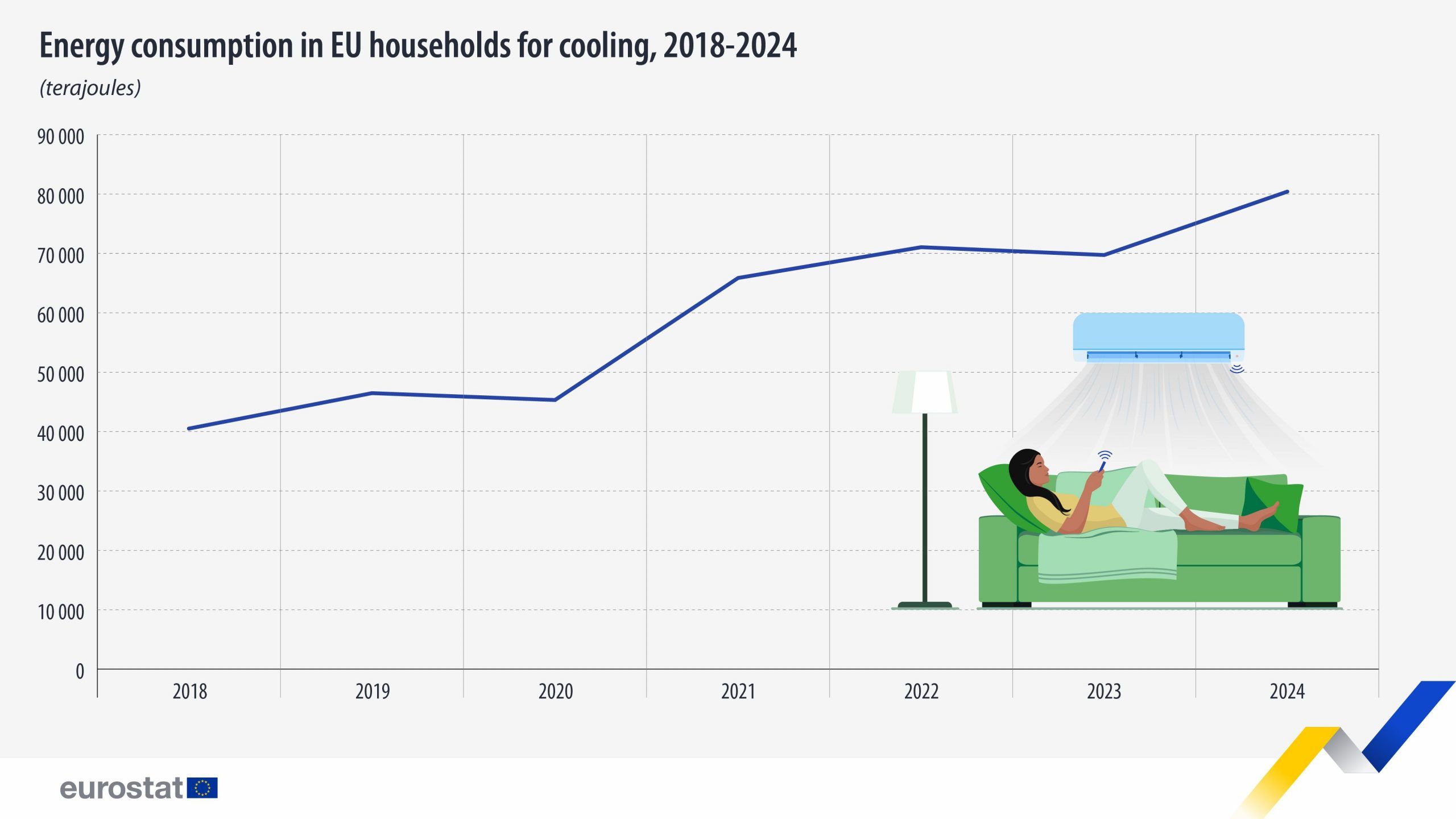
Due to climate change, energy consumption for air conditioning in the EU has doubled in just six years.
According to Eurostat, during 2024, households in the European Union spent 80.4 thousand TJ of energy to power air conditioners.
For comparison, in 2018, 40.5 thousand TJ was used for the same purpose. Throughout all six years, consumption increased, except for the years 2020 and 2023, which saw minor annual declines of 2.5% and 1.9% respectively.
Source: Eurostat
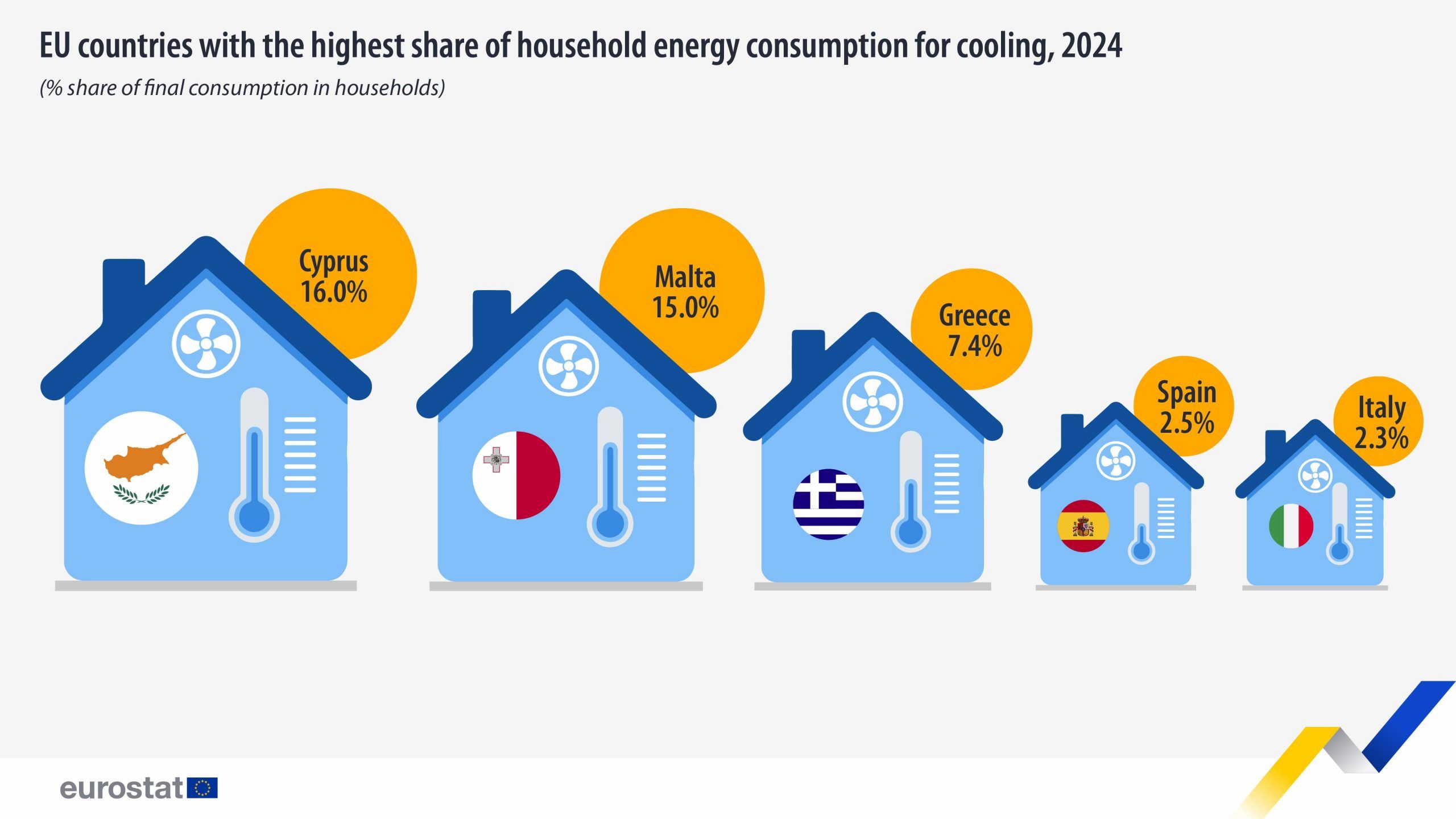
The countries spending the most on air conditioning are those in southern Europe – Italy (26.3 thousand TJ), Spain (14.3 thousand TJ), and Greece (11.9 thousand TJ).
At the same time, the share of air conditioning in total household energy consumption is highest in Cyprus and Malta – 16% and 15% respectively.
Source: Eurostat
Climate change has intensified the wildfire threat
The temperature shock from the wave of extreme heat in Europe has been exacerbated by large-scale forest fires ravaging thousands of hectares of land.
According to the international monitoring platform IQAir, as of July 8, more than 20 thousand hectares of forests were burning. This scale is primarily attributed to the June heat. The most affected areas are in southern Europe – Italy, Spain, France, Portugal, Greece, and Croatia.
Hundreds of firefighters have been deployed to battle the blazes, with some regions announcing evacuations. For example, in the south of France, more than 10,000 people had to be evacuated. Four firefighting aircraft were sent from Cyprus and Sweden. About 4,600 hectares of land near the foothills of the French Pyrenees have burned.
Heat and its effects are prompting changes to workplace standards. Trade unions are pushing to review working conditions, as their data suggests that around 230 people die annually from heat stress at work. Worker advocates are demanding the right to breaks due to overheating, adjustments to working hours, and unrestricted access to water and shade.
The devastating impacts of climate change are forcing major investment firms to reconsider their approach to projects. Bloomberg reports that the number of references to such risks in the reports of the 12 largest asset management companies has nearly doubled in a year.