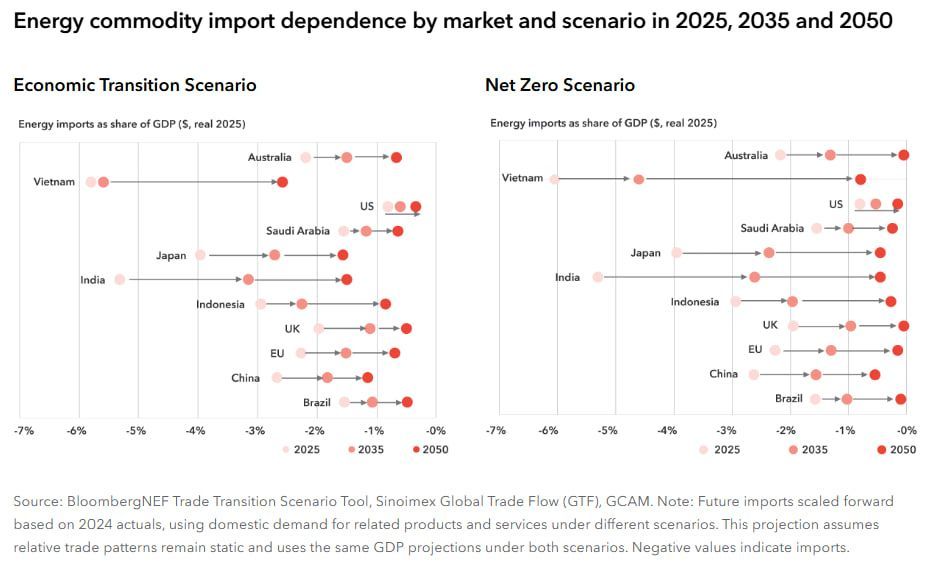
Reducing dependence on imported oil, coal and gas is a common feature of both the baseline scenario for global energy development and the ideal climate scenario, which would help to limit global temperature rise to 2°C.
This is by data from BloombergNEF’s New Energy Outlook 2025 report.
In their analysis, the authors examined the impact of renewable energy sources, electric vehicles and energy innovations on the energy sector and the decarbonisation of the planet.
The key objective: independence from fossil fuels
Energy security is now high on the agenda for many countries. Experts emphasise that the main prerequisite for reducing price volatility and economic risks is large-scale electrification using renewable energy.
This will help reduce dependence on fossil fuels. In 2025, the EU and China spent between 2.3 and 2.7 per cent of their GDP on fossil fuel imports, whilst Vietnam, Japan, India and Indonesia spent between 3 and 6 per cent.
Source: BloombergNEF
Even under the baseline scenario, the development of renewable energy sources significantly enhances energy security in countries. Achieving zero emissions further strengthens the resilience of the energy sector.
“We are living through yet another crisis, but unlike previous decades, today countries have real options for response. Now we have viable technologies that can be deployed at scale and with speed, generally at lower system costs than the fossil-fuel-based solutions that were previously the primary choice,” stated David Hostert, Chief Economist at BloombergNEF.
The role of electrification
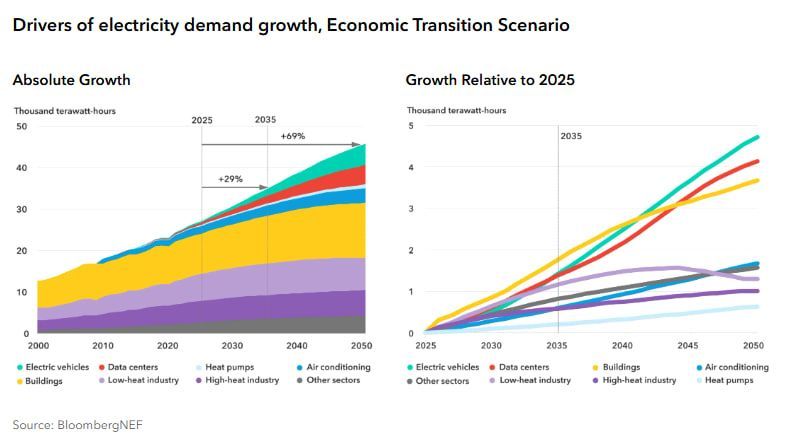
In both BloombergNEF scenarios, electrification is the key driver of transformation. Over the coming decades, electricity will be the most sought-after energy carrier, meeting two-thirds of new demand.
The main drivers of consumption are industry, electric transport, as well as data centers, which, due to the development of artificial intelligence technologies, are demanding ever more energy. The global capacity of data centers in 2025 has already reached 84 GW, consuming 1.9% of global electricity. By 2050, this share will rise to 3.6%.
Source: BloombergNEF
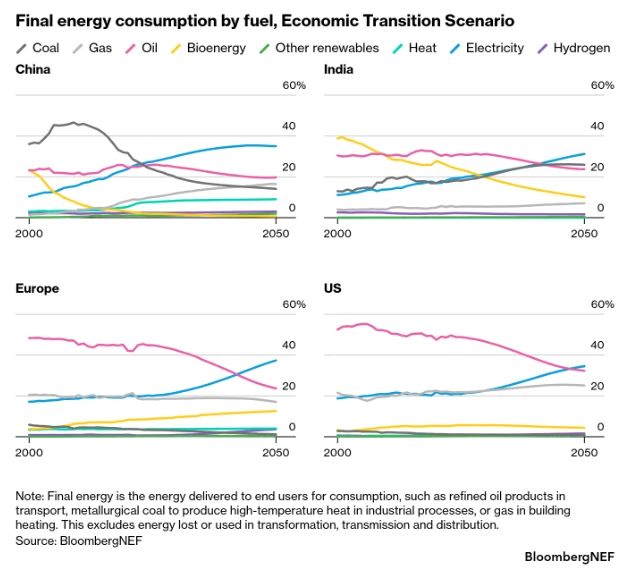
The transition to electricity depends on the region. In Europe, it will become dominant by 2043, and in the United States by 2047. In India, electricity will overtake oil and coal in 2041.
Source: BloombergNEF
To meet this additional demand, not only must generation be increased, but the infrastructure must also be transformed and more flexible electricity market mechanisms established.
In particular, energy storage systems must be developed. According to BloombergNEF forecasts, their capacity will increase 17-fold by 2035, reaching 3.8 TW compared to 225 GW in 2025.
EcoPolitic previously reported that thanks to the development of the solar energy sector, during the war in Iran, Europe is saving €136 million daily.