The plan to phase out fossil fuels by 2050 calls for the electrification of at least half of global final energy consumption and an increase in total investment in energy grids to $29 trillion.
These figures are cited in a report by the International Renewable Energy Agency (IRENA). It was developed as part of the “Roadmap for the Transition from Fossil Fuels” initiative.
Analysts noted that the global energy transition is entering a new phase. It is influenced by:
- geopolitical uncertainty;
- growing demand for electricity;
- structural changes in the global energy landscape.
The report’s authors emphasize that the challenge is no longer merely to set targets, but to develop comprehensive implementation strategies capable of accelerating the transition away from fossil fuels while simultaneously strengthening energy security, resilience, and ensuring sustainable development.
Experts have revised their scenario for limiting global warming to 1.5 °C.
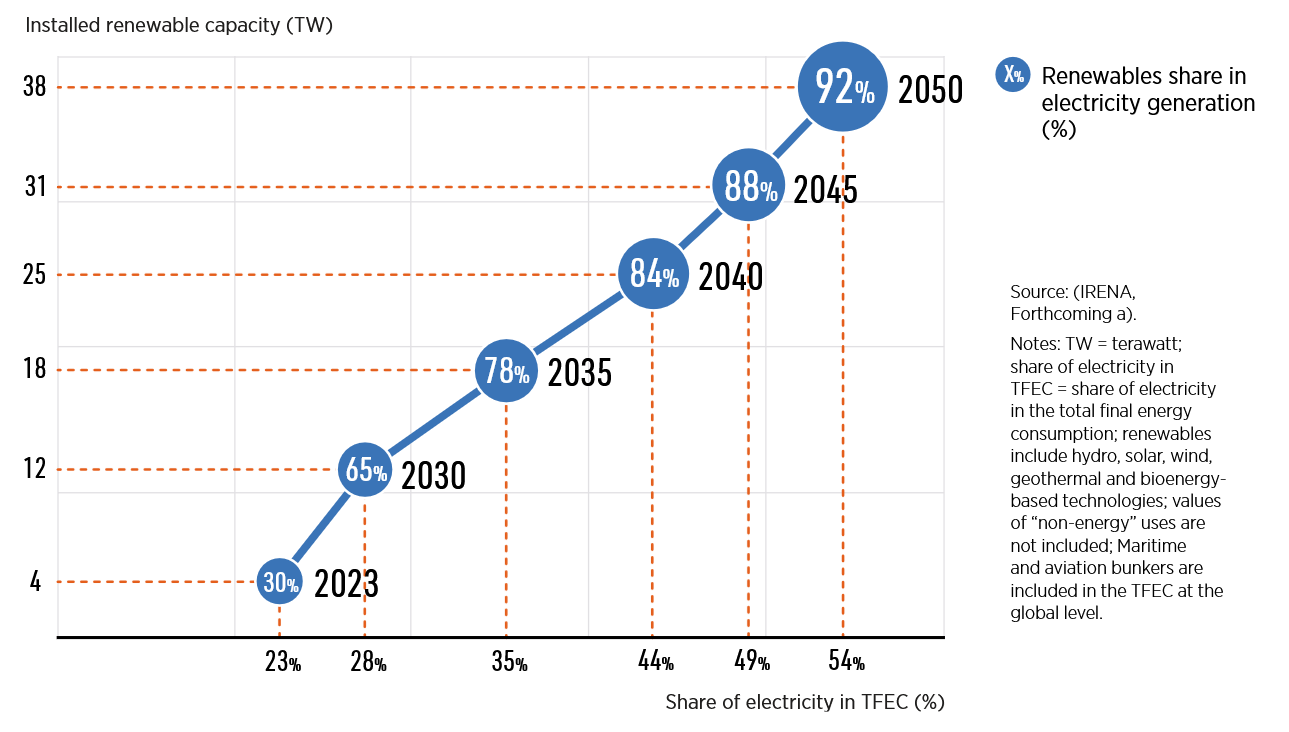
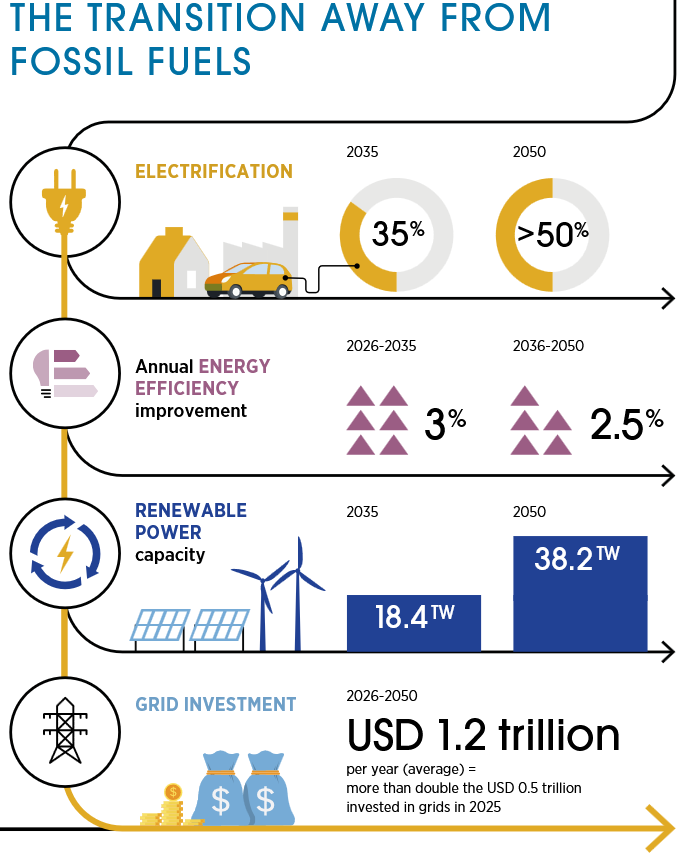
Energy transition until 2050 under the revised “1.5 °C” scenario, 2023–2050. Source: irena.org
Below are the key points highlighted in the report.
Source: irena.org
Electrification and green fuel
The share of electricity in global final energy consumption will rise from the current approximately 23% to 35% by 2035, and over 50% by 2050. Electricity will become the main global energy carrier.
Electrification, supported by the deployment of renewable energy sources (RES), grid enhancements, and improved energy efficiency, is a “win-win” option that simultaneously reduces emissions, strengthens energy security, increases accessibility, and supports “green” industrialization and competitiveness.
At the same time, environmentally friendly fuels such as biofuels, hydrogen, and their derivatives remain necessary for sectors where decarbonization is especially challenging, including aviation, shipping, and certain branches of industry.
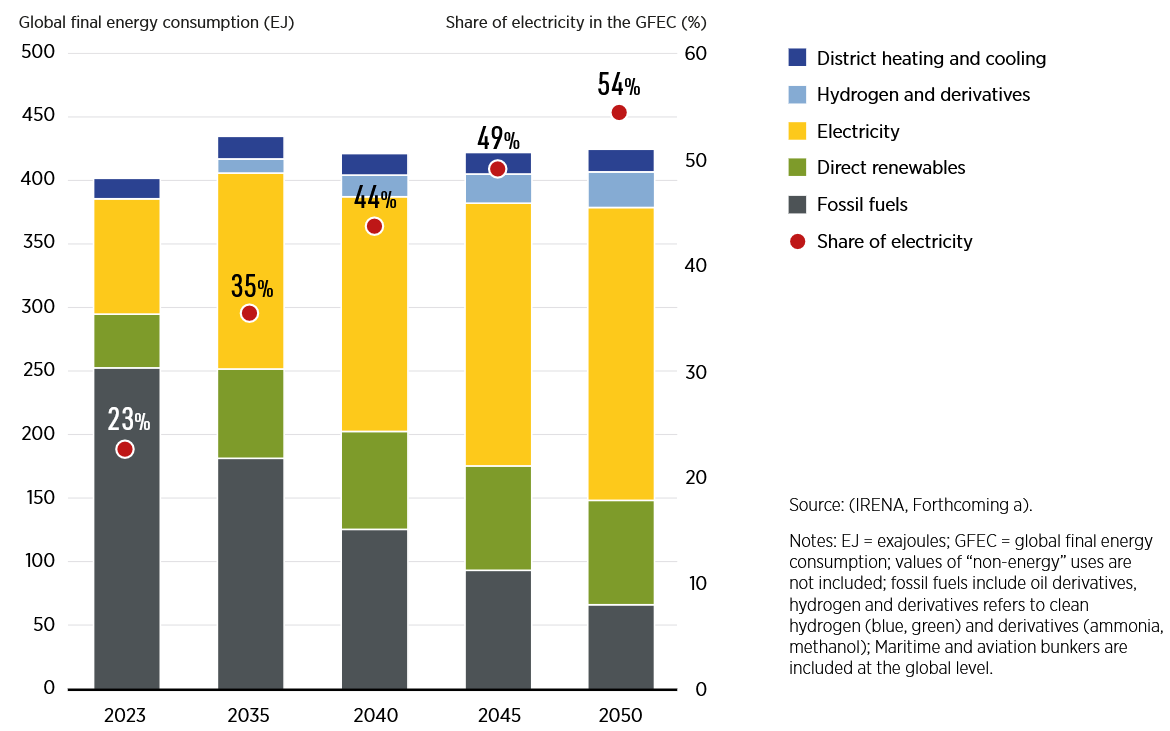
Dynamics of global final energy consumption (left axis) and the electrification rate worldwide (in %) (right axis) under the revised “1.5 °C” scenario, by types of energy carriers, 2023–2050. Source: irena.org
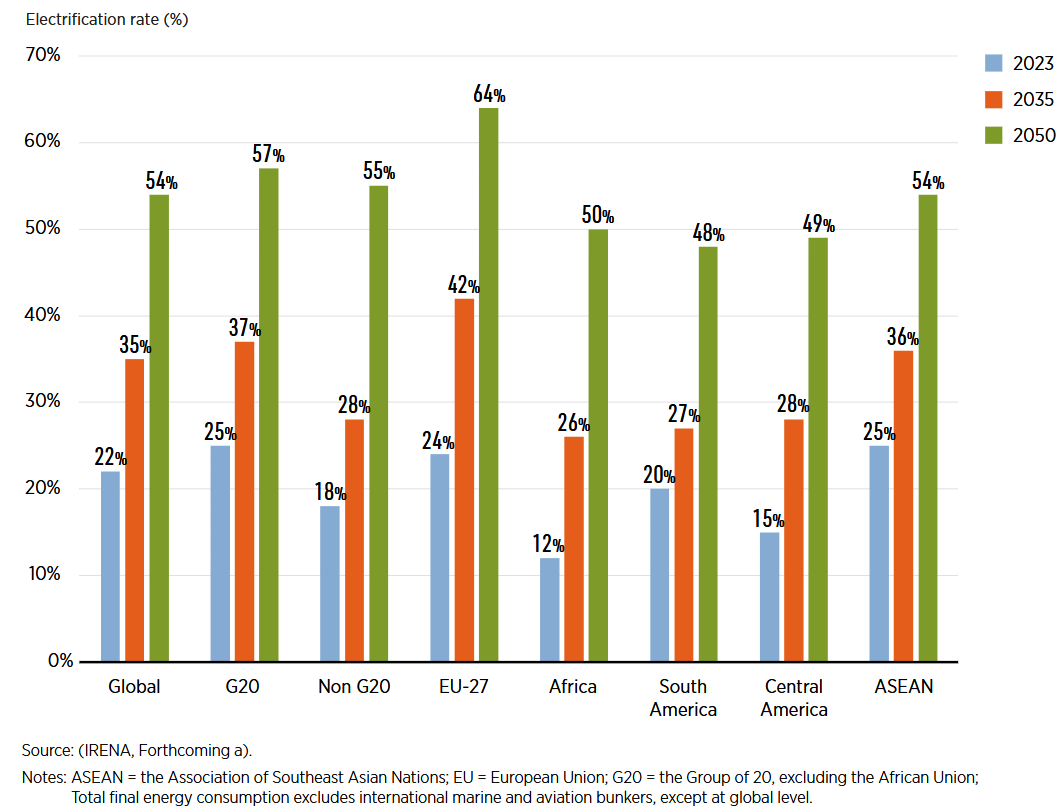
Experts also examined the share of electrification by region for 2023–2050:
Source: irena.org
Infrastructure
The authors of the report emphasize that infrastructure is becoming one of the defining challenges of the transition. Rapid electrification and the integration of renewable energy sources will require significant expansion of power grids, energy storage facilities, and system flexibility, as well as closer integration of systems and strategic planning for the gradual phase-out of fossil fuels.
To ensure coordinated implementation, analysts suggest setting a global electrification target of 35% by 2035, complemented by a corresponding goal to double grid development and investment by 2035, to guarantee infrastructure expansion and system transformation.
Financing
To enable this rapid electrification, average annual global investment in power grids should increase from $0.5 trillion in 2025 to approximately $1 trillion per year during 2026–2035, and $1.2 trillion in 2036–2050, in order to achieve a cumulative investment of $29 trillion.
This should be complemented by a similarly rapid increase in global installed energy storage capacity, from 416 GW in 2025 to 2,530 GW by 2035 and 6,859 GW by 2050.
The expansion of power grids must be accompanied by greater demand-side flexibility, with daily flexibility rising from 7% in 2019 to over 13% by 2035 and to 30% by 2050.
This transition requires national and regional development plans, resource availability, and development priorities. Although electricity will become the principal energy carrier in all sectors under the “1.5 °C” scenario, sustainable fuels will still be required for decarbonizing end-use sectors, especially in regions with competitive resources.
Recently, EcoPolitic reported that, according to United Nations climate secretary Simon Stiell, the world is accelerating its switch to clean energy due to the war in Iran. It is noted that in the European Union, demand for home solar power plants has sharply increased. Globally, sales of electric vehicles are also rising. China has announced plans to strengthen its energy system, primarily through hydropower and nuclear energy.