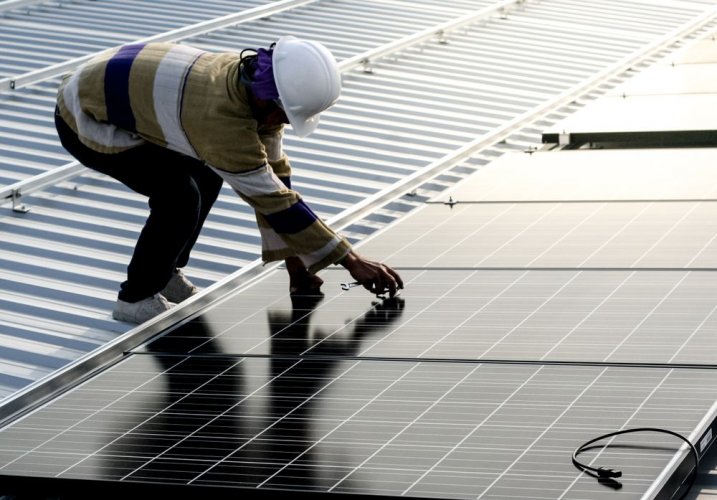
The grim experience of prolonged blackouts and rumors of rising electricity prices are prompting Ukrainians to seek alternatives. One of the most popular options is a home solar power system.
EcoPolitic has compiled several key tips to consider when installing a home solar power system.
How much energy do you need?
First, you need to determine how much electricity your household needs.
The easiest way is to check your consumption figures on your electricity bills or in the billing section on your utility provider’s website. Another method is more labor-intensive—you’ll have to calculate the total consumption of all electrical appliances in your apartment or house.
Once you have the monthly figure, you need to calculate the daily consumption, and then you’ll know the key number for selecting equipment—how many kWh of energy you consume. Additionally, we recommend adding about 20% to account for losses due to cable transmission and battery operation.
How many panels do you need?
When calculating the number of panels, you must consider not only your energy consumption, but also the solar insolation in your region and at the specific location where the equipment can be installed.
For example, if you need 8 kWh of energy and the sun shines on your panels for 4 hours a day, then 2 kW of panel capacity will be sufficient. Incidentally, this capacity is measured in watts (W).
Be sure to account for the fact that solar generation is unstable. You receive energy only when sunlight is hitting the photovoltaic cells. So, if you want to have electricity for the entire day, consider an energy storage system. The battery’s capacity should match your daily consumption.
Where can you install the panels and auxiliary equipment?
When you know the required panel capacity, you can analyze market options. At this stage, the size of the panels capable of generating the required energy becomes important. On average, you need 5 m2 of space to generate 1 kW of capacity.
With the physical characteristics of the equipment in mind, you can estimate where to install them – on the roof, balcony, wall, or in the yard. It’s easier to do this in a private house, but in an apartment, you have to deal with general restrictions. For example, the roof is considered common property, so using it for personal needs without neighbors' permission may not be simple. The balcony is typically too small to cover all an apartment’s energy needs.
Panels are optimally installed facing south at an angle of 35–45 degrees, although this value can vary slightly depending on the site’s latitude. Avoid locations where trees or buildings can cast shadows on the panels.
What else should you consider?
Self-generation involves more than just panels. When calculating the total cost, be sure to consider installation with all required structures and fastenings, an inverter for converting current, and a battery if you opt for an energy storage solution.
The power generation efficiency of panels depends on their type. Monocrystalline panels provide the highest generation – approximately 25%. However, they have a significant drawback: if they are shaded, they stop working. Polycrystalline panels typically have a dark blue color. They deliver only about 18% efficiency, but they are capable of generating energy even under diffused light.
The surface of the panels should also be kept as clean as possible. In winter, snow should be removed using a special brush, and throughout the year they should be periodically cleaned of dust and bird droppings.