On Sunday, April 26, the European Union saw a sharp drop in electricity prices. This phenomenon was observed in most countries in continental Europe, with the lowest prices recorded in Hungary, Slovakia, and the Czech Republic.
This was reported by ExPro Consulting.
Analysts point to two main reasons for the extreme drop in prices on spot markets: high renewable energy generation combined with low demand.
The drop in numbers
As of 2:00 p.m., the top five countries with the lowest prices were:
- Hungary – -500 €/MWh;
- Slovakia – -449 €/MWh;
- Czech Republic – -489.28 €/MWh;
- Germany – -480.01 €/MWh;
- France – -478.80 €/MWh.
Across the continent, prices were mostly in the range of -200 – -400 €/MWh.
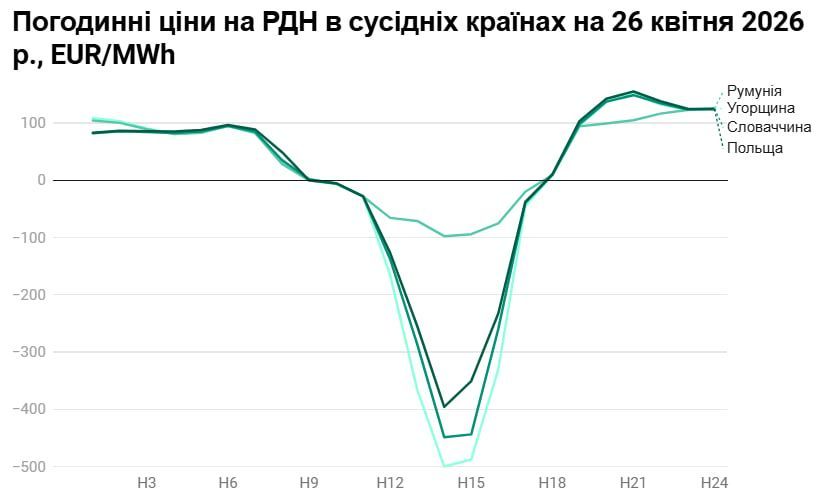
Source: ExPro Consulting
Main causes and risks to the power grid
The price collapsed due to a surplus of energy on the market. On one hand, solar power plants achieved high generation levels; on the other hand, demand for electricity was low because it was a weekend.
Overall, Europe is experiencing an energy imbalance. Renewable energy production is constantly growing, while the current system is still unable to store and efficiently redistribute it.
Among additional factors, experts mention structural limitations of the energy system:
- insufficient development of energy storage systems;
- limited export capacity due to overloaded cross-border interconnections;
- insufficient flexibility of conventional generation, for which rapid shutdown is extremely problematic.
This leads to a paradox: energy producers are forced to reduce their bids to minimum levels and in fact pay to inject energy into the system. Technically, stopping generation is difficult, and in addition this leads to financial losses.
EcoPolitic previously reported that negative energy prices have become a challenge for Europe’s green generation. Their plan to combat this trend is to develop energy storage systems.
Meanwhile, for Ukraine, energy storage facilities are a new element in the energy system. In 2023, they did not yet exist, but now experts report an installed energy storage capacity of 600 GW.