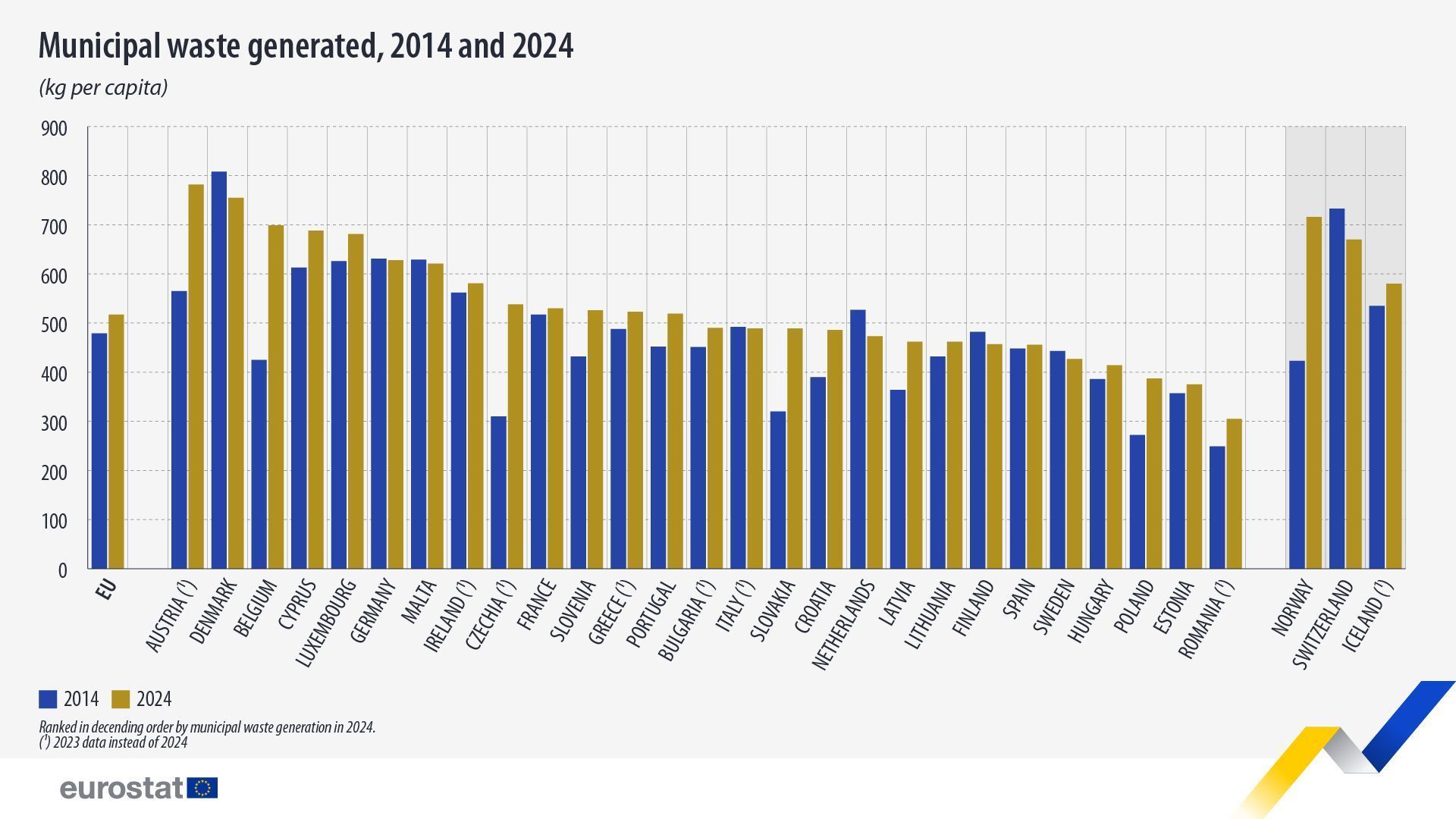
The amount of household waste per capita continues to rise in the European Union. While it stood at 511 kg in 2013, by 2024 it had reached 517 kg—an increase of 6 kg. Over the course of ten years, the amount of waste per person has increased by 38 kg (8%).
This is according to Eurostat data.
Regional differences
The amount of waste per capita between the top and bottom rankings differs by more than 2.5 times, indicating significant regional differences in waste generation.
The top countries for waste generation per capita are:
- Austria – 782 kg;
- Denmark – 755 kg;
- Belgium – 699 kg.
Countries with the lowest amount of waste per person:
- Romania – 305 kg;
- Estonia – 375 kg;
- Poland – 387 kg.
Source: Eurostat
In 20 European Union countries, the quantity of household waste per person has increased since 2014. Belgium saw the largest rise-an additional 274 kg. Next in this dubious ranking are the Czech Republic with 228 kg more and Austria with a 217 kg increase.
However, several countries managed to reduce their waste volumes. The Netherlands managed to cut this figure by 54 kg, Denmark by 43 kg, and Finland by 25 kg.
Recycling volumes remain insufficient
In the European Union, the average rate of household waste recycling in 2024 amounted to 248 kg per person, constituting 48.1% of the total waste generated.
This indicator showed some growth, albeit slight, since in 2023 the EU recycled 48% of its waste-246 kg per person. Compared to 2014 data, the figures have improved: back then, 43% of waste was recycled, or 208 kg per person.
EcoPolitic has previously reported on the situation with waste in Ukraine in its coverage.
Meanwhile, the only full-scale waste recycling plant is on the verge of closure.