The competitiveness of European businesses is highly dependent on the expansion of trade unions, debureaucratization, and the formation of a common market. However, one of the foundations on which the ability of EU companies to compete in the global market is based is cheap and clean energy.
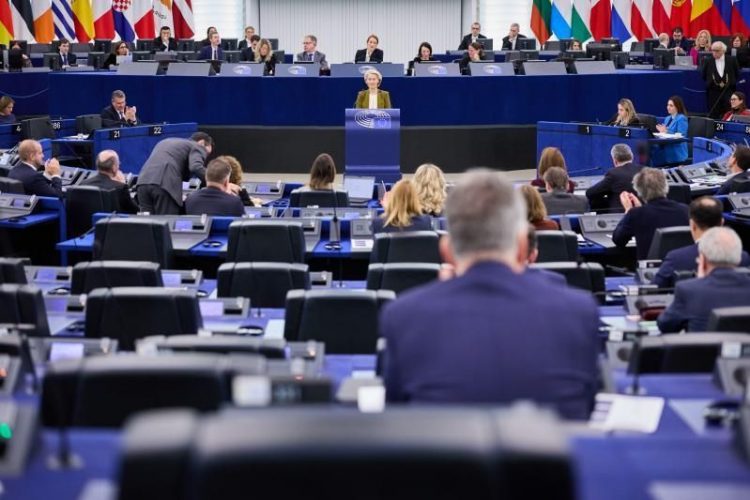
This was stated by European Commission President Ursula von der Leyen in her speech during the European Parliament debate.
Economic benefits
The President of the European Commission cites eloquent figures that undoubtedly support the introduction of clean energy. In 2025, the cost of 1 MWh of energy generated from fossil gas was over €100. Meanwhile, energy produced by the nuclear sector cost only €50-60. But solar generation can provide industry with the cheapest energy: last year, the cost of 1 MWh was estimated at €34.
"Low-carbon energy is not only produced domestically and clean. It gives us more independence, more security, and reduces costs," Ursula von der Leyen emphasized.
Prospects for a common "clean" network
The EU is constantly increasing investment in the development of the renewable energy sector. In 2025, this allowed it to cross a historic threshold—for the first time, solar and wind power generation exceeded the total capacity of energy produced from all types of fossil fuels.
The formation of a single Energy Union is fundamental to the EU's energy security, von der Leyen stresses. But this requires, first and foremost, a common infrastructure. To this end, the bloc has adopted the European Networks package. It is intended to speed up the procedure for obtaining permits to launch cross-border energy highways.
The first project within the European Networks was launched in January 2025. We are talking about Energiø Bornholm. The project will create an energy bridge between Germany and Denmark, which will gain shared access to 3 GW of energy. It will be produced by wind turbines installed on the coast of the island of Bornholm.
"This will transform the Baltic wind from a national resource into a common European energy source. The goal is simple. Clean energy must flow freely throughout our Union," said the President of the European Commission.
According to Eurostat, in 2024, 47.5% of the EU's energy
"Low-carbon energy is not only produced domestically and clean. It gives us more independence, more security, and reduces costs," Ursula von der Leyen emphasized.
Prospects for a common "clean" network
The EU is constantly increasing investment in the development of the renewable energy sector. In 2025, this allowed it to cross a historic threshold—for the first time, solar and wind power generation exceeded the total capacity of energy produced from all types of fossil fuels.
The formation of a single Energy Union is fundamental to the EU's energy security, von der Leyen stresses. But this requires, first and foremost, a common infrastructure. To this end, the bloc has adopted the European Networks package. It is intended to speed up the procedure for obtaining permits to launch cross-border energy highways.
The first project within the European Networks was launched in January 2025. We are talking about Energiø Bornholm. The project will create an energy bridge between Germany and Denmark, which will gain shared access to 3 GW of energy. It will be produced by wind turbines installed on the coast of the island of Bornholm.
"This will transform the Baltic wind from a national resource into a common European energy source. The goal is simple. Clean energy must flow freely throughout our Union," said the President of the European Commission.
According to Eurostat, in 2024, 47.5% of the EU's energy came from wind, solar, and hydro power. As reported by EcoPolitics, in Austria, Sweden, and Denmark, clean energy accounted for more than 75% of total consumption.
At the same time, the G7 countries are lagging far behind China, Brazil, and India in the development of clean energy generation. The total volume of new clean energy generation capacity of all G7 countries is three times less than the new capacity of China alone.
, solar, and hydro power. As reported by EcoPolitics, in Austria, Sweden, and Denmark, clean energy accounted for more than 75% of total consumption.
At the same time, the G7 countries are lagging far behind China, Brazil, and India in the development of clean energy generation. The total volume of new clean energy generation capacity of all G7 countries is three times less than the new capacity of China alone.