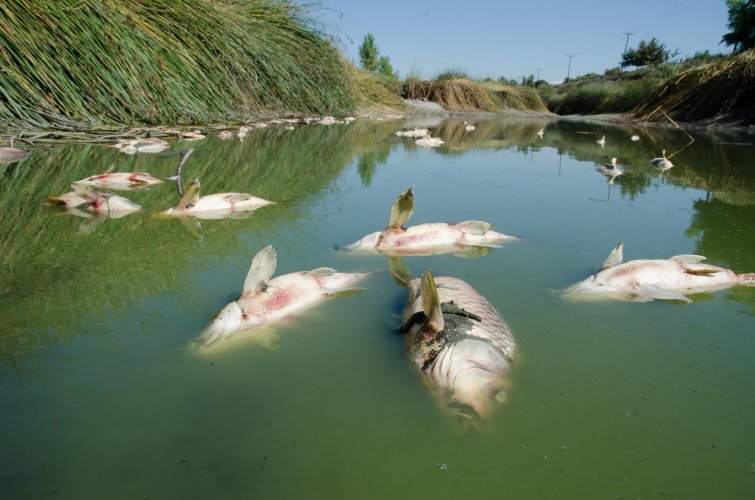
Specialists of the State Environmental Inspectorate (DEI) of the Southwestern District published the results of an analysis of water samples in places of fish death in the Hadzhibey estuary. According to them, the oxygen in the water is almost half the norm, and the excess of nitrogen and nitrates is recorded several times.
This was reported in the DEI.
On July 17, eco-inspectors took water samples at the places of fish death near the villages of Bulgarka and Otradovo, Odessa region.
After laboratory tests, they found an excess of the maximum permissible concentrations (MPC) of pollutants and basic water indicators.
Near the village of Bulgarian, the surface water of the Hadzhibey estuary had the following indicators:
- suspended solids: 2.4 times higher than the reference (background) point;
- ammonium nitrogen: exceeding the MPC by 7.2 times;
- Nitrates: 1.9 times exceeding the MPC;
- dissolved oxygen: 2.4 mg O2/dm3, which is 1.7 times lower than the limit value;
- hydrogen sulfide: detected in a concentration of 0.612 mg/dm3 (there is no hydrogen sulfide in the control point (background) and according to standards);
- salinity: 20.7 g/dm3 (standard value 12-18 g/dm3)
The indicators of surface water in the estuary near the village of Otradove were as follows:
- suspended substances: 2.5 times higher than the indicator of the control (background) point;
- ammonium nitrogen: exceeding the MPC by 8.2 times;
- Nitrates: 1.5 times exceeding the MPC;
- dissolved oxygen: 2.1 mg O2/dm3, which is 1.9 times lower than the limit value;
- hydrogen sulfide: detected in a concentration of 0.149 mg/dm3 (there is no hydrogen sulfide in the control point (background) and according to standards);
- salinity: 20.7 g/dm3 (standard value 12-18 g/dm3).
Eco-inspectors noted that at the time of sampling, the air temperature was 38°C, and the water temperature in the coastal zone was 33°C.
At the beginning of July, EcoPolitics talked about fish fatigue in the South Bug River and the Khadzhibey estuary, the causes of which were a reduced oxygen concentration and an excess of ammonium nitrogen content by 66 (!) times.