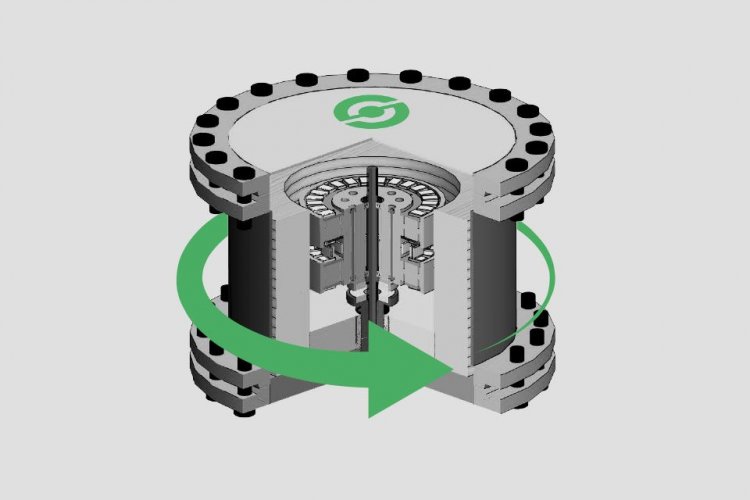
In March 2024, the R&D center of the COR-Energy engineering company successfully tested a working prototype of the E-NER-COR flywheel energy storage device.
The development was created for long-term energy storage and for a wide range of tasks. The storage device uses the kinetic energy of rotating motion to store certain amounts of electricity based on the principle of converting kinetic energy into electricity.
As for the level of technological readiness, the development is currently at the TRL 4 stage.
Main characteristics of energy storage
The 3-phase storage device has a capacity of 1 kWh and a charging capacity of 2 kWh. The system weighs 90 kilograms. The maximum speed of the rotating disk reaches 3,000 revolutions per minute (RPM), ensuring stability in energy storage.
High efficiency of energy transfer to the grid – more than 97% for direct current (DC) and alternating current (AC).
Hermetic E-NER-COR housing protects the device from external influences such as dust, rain and temperature changes. This is an important aspect to ensure the reliability of the device for a long period of operation, even in harsh weather conditions.
Features of the E-NER-COR drive
Talking about the tests of the drive, specialists from the R&D center focused on the universality of the use of the equipment and compliance with the stated technical characteristics.
"E-NER-COR is a full-fledged electricity storage system that performs several tasks at the same time: solving the problem of limited charge cycles, long-term electricity storage, as well as smoothing the peak load of power networks," the company says.
E-NER-COR has a long service life, which, unlike traditional electrochemical batteries, does not depend on the number of charging cycles.
The main advantages of the E-NER-COR drive:
- effective conservation of electricity with almost no losses;
- backup power supply;
- ensuring balancing of energy systems;
- the accumulator is charged many times faster than electrochemical systems of electricity;
- use of magnetic levitation technology;
- absence of fire risk;
- simple management through a mobile application;
- the drive is made of environmentally neutral components that do not harm the environment;
- integration into a cluster together with wind power plants and solar power plants;
COR-Energy develops energy storage solutions for households and industrial enterprises.
Due to the increasing use of renewable energy sources such as solar, wind and hydropower, innovative energy storage solutions are becoming increasingly important, especially because of the possibility of their integration with traditional power generating facilities (CHP, TPP, NPP).