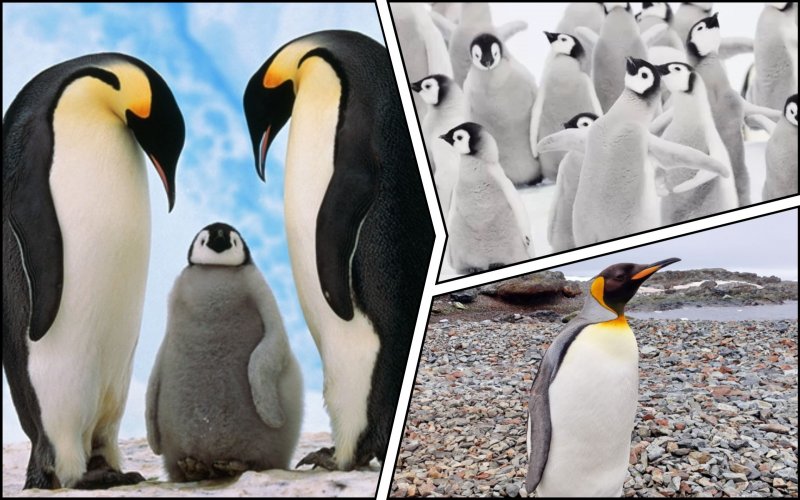
In Antarctica, about 10,000 emperor penguin chicks died at the end of 2022 due to climate change, namely the abnormal melting of sea ice.
The ice on which the penguin colonies were located melted before the chicks had the waterproof feathers necessary for swimming in the ocean, reports BBC.
It is noted that the ice usually melts around December-January, when young birds grow smooth feathers for swimming in the ocean. However, in 2022 it happened in November. Because of this, for four of the five colonies in the Bellingshausen Sea, except for the northernmost one on Rothschild Island, the breeding season became a complete failure.
Dr Peter Fretwell of the British Antarctic Survey (BAS) said the penguin deaths were a harbinger of things to come. According to forecasts, more than 90% of emperor penguin colonies may die by the end of the century.
"The breeding cycle of emperor penguins depends on the sea ice, which is a stable platform that they use to raise their young. But if that ice is not as big as it should be, or breaks up faster, these birds are in trouble," he said.
Fretwell added that rapid reductions in carbon emissions are needed to save the penguins.
Recall that in Antarctica, the area of sea ice is shrinking at an unprecedented rate and, despite the middle of winter, some areas have become exposed in places where this had not been observed before. During 2007-2022, satellite studies show a constant decrease in the amount of subpolar ice, and since 2016, such trends have become increasingly unpredictable.
As previously reported by EcoPolitics, scientists of the Space Research Institute named after Goddard (GISS) of NASA in New York recognized this year's July as the hottest in the entire history of observations.