Ukraine's waste market keeps growing because of the full-scale war. Destruction alone has added about 17.2 million tonnes of construction waste. As it turns out, the companies earning the most in this segment are mainly those that sort non-hazardous waste and return it to circulation as secondary raw materials. There are far fewer legal entities in the hazardous waste sectors due to strict regulatory requirements. Separately, the humanitarian demining segment is growing.
This is according to an analysis provided by YouControl.
The study used information on 6,529 legal entities. The financial analysis drew on 2025 data from 5,000 companies across six main types of economic activity in waste management, including collection, sorting, recycling and even demining.
Big turnover, small profits
The total revenue of the companies last year reached 48.8 billion UAH. This is an annual drop of almost 38%: in 2024, the figure stood at 78 billion UAH.
At the same time, 2024 brought 7 billion UAH more in losses, while last year the sector posted a profit of 178.3 million UAH. This can hardly be called high profitability, as the overall profit margin was only 0.4%.
More companies collect waste, but those that recover it earn more
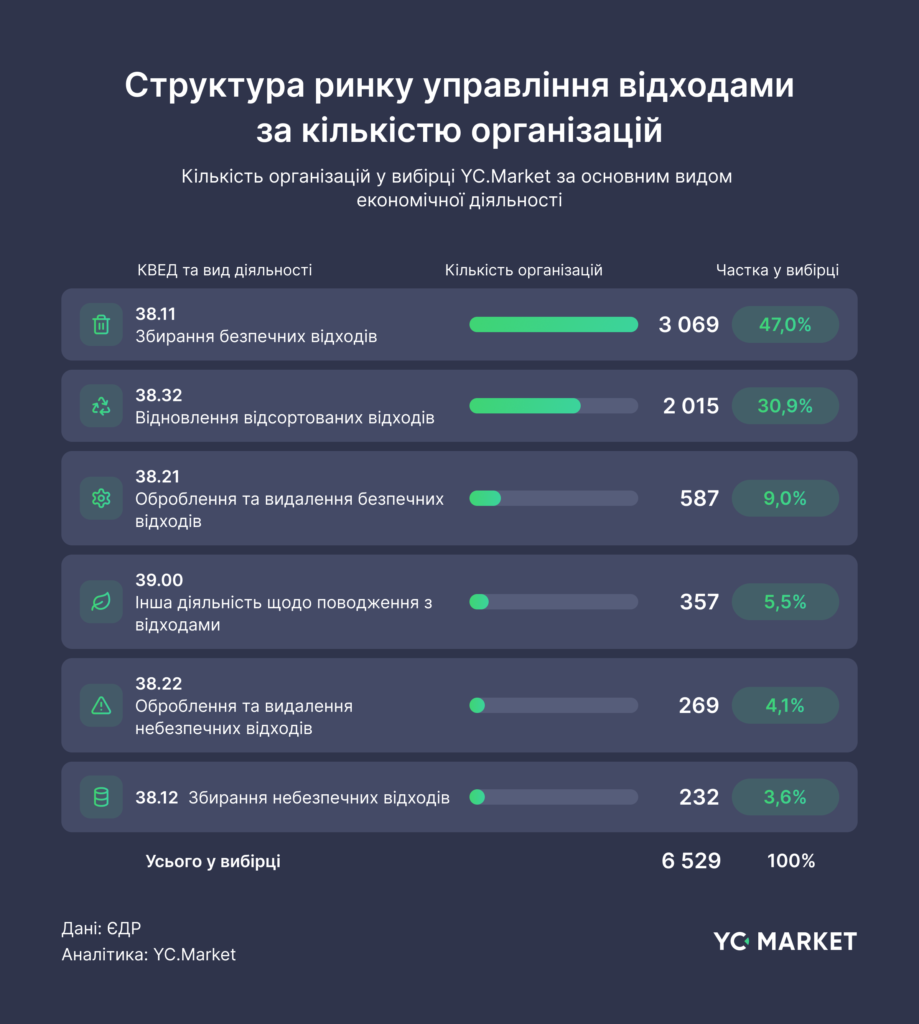
More than 3,000 companies in the sample, or 47%, have the collection of non-hazardous waste as their main type of economic activity. Second place, with 2,015 companies and 31%, goes to those engaged in the recovery of sorted waste.
Source: YouControl
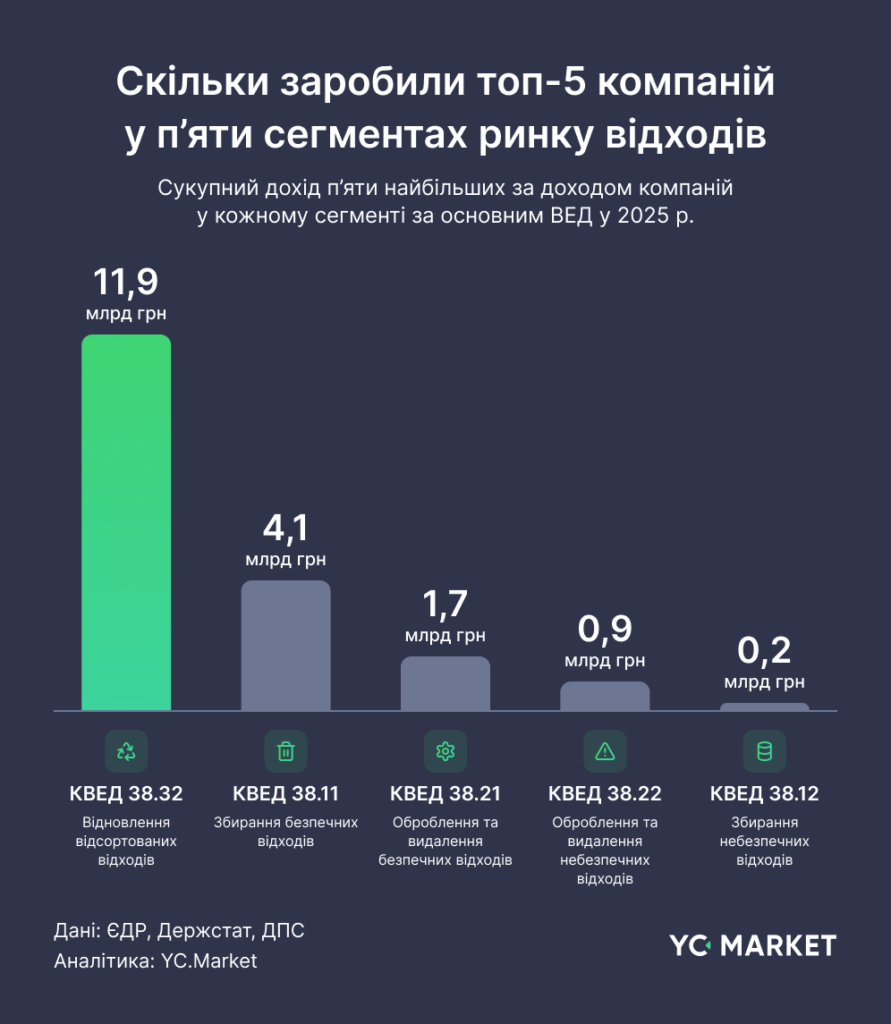
However, the situation with turnover is the opposite. Companies whose main activity is the recovery of sorted waste received the largest revenue in 2025, at 11.9 billion UAH. Meanwhile, the "collectors" showed a figure of 4.1 billion UAH.
Source: YouControl
YouControl clarifies that this block does not reflect the total revenue of the segment, only that of the five highest-earning companies.
Hazardous waste
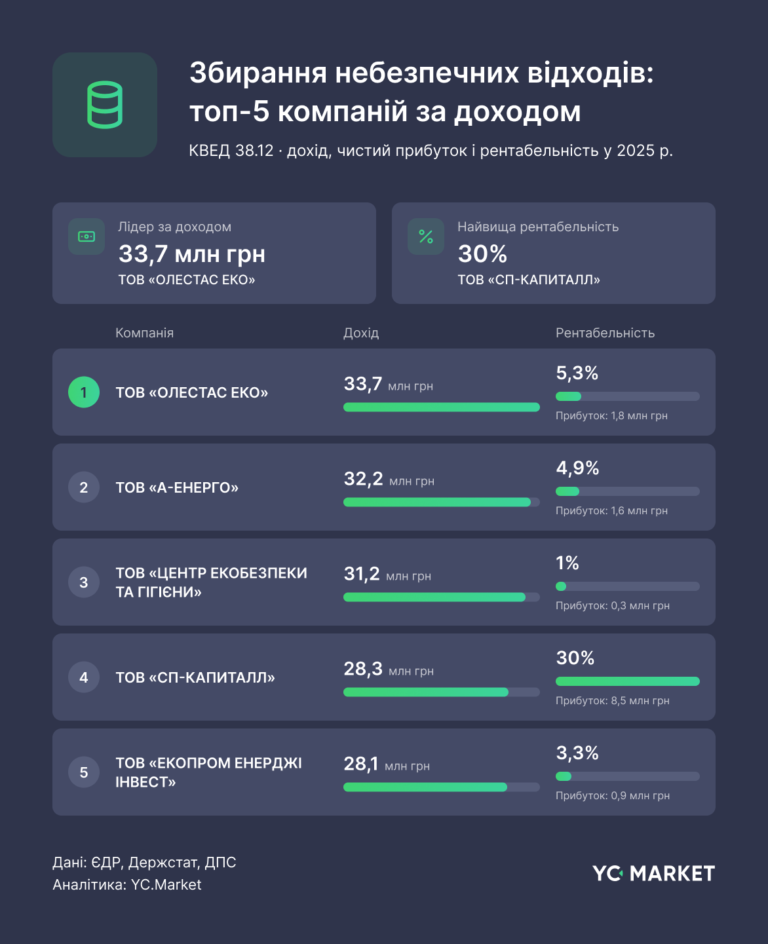
There are only 232 legal entities in the hazardous waste collection segment. Analysts suggest that this is due to the high regulatory barrier associated with obtaining a special licence. Revenues of the top five here are noticeably lower, ranging from 28.1 million UAH to 33.7 million UAH.
Source: YouControl
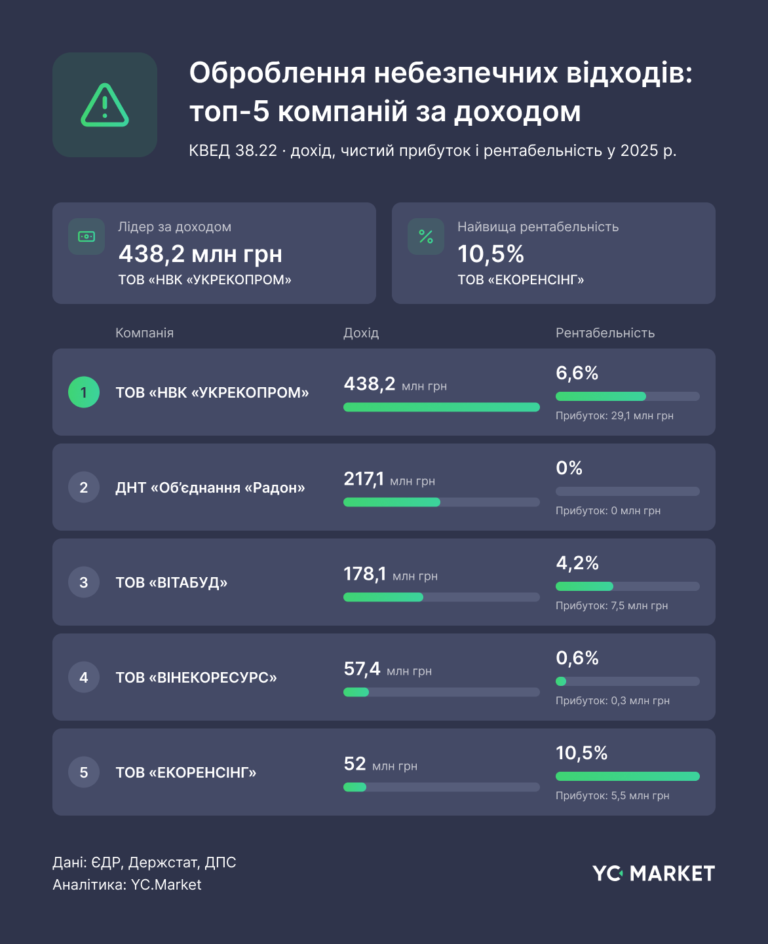
There are 269 legal entities engaged in the treatment of hazardous waste. The revenue leader is twice ahead of the second company in the ranking, but does not have the highest profitability.
Source: YouControl
Demining
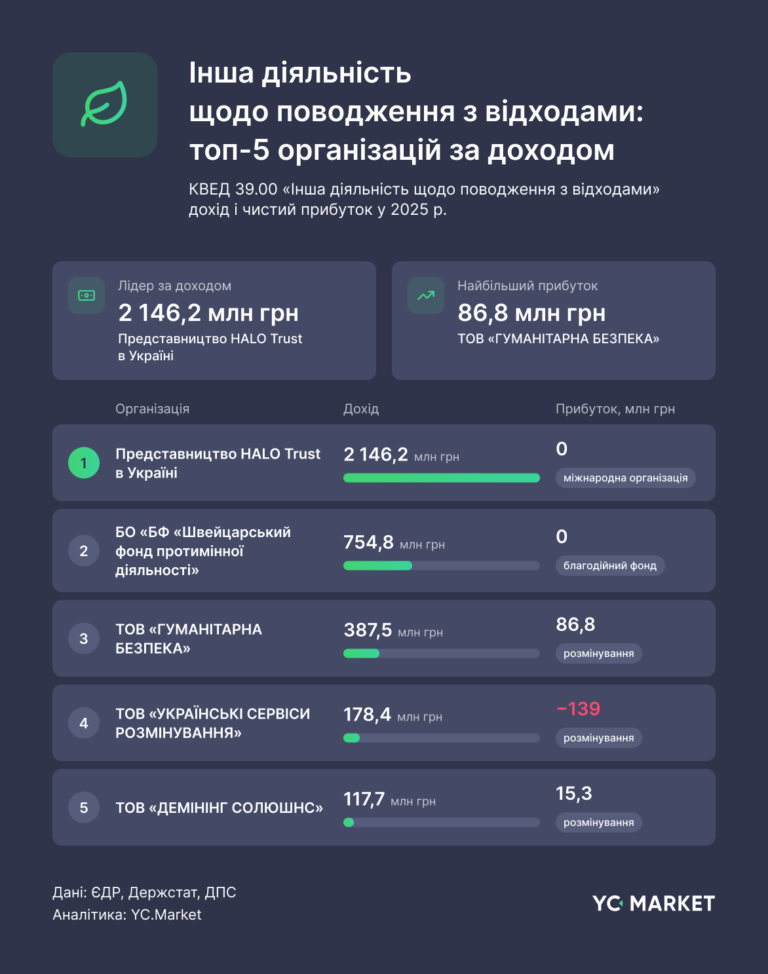
Another 357 enterprises have "Other waste management activities" as their main activity code. This is the group that includes demining companies. The top places here are held by charitable foundations and international organisations, so their financial performance should not be assessed in the same way as that of conventional operators.
Source: YouControl
Destruction waste
As of September 2025, Ukraine already had 17.2 million tonnes of destruction waste. This is according to a UNDP study.
Of this amount, 11.7 million tonnes still need to be cleared and processed, and 8.2 million tonnes of it are potentially suitable for reuse in construction. They could become raw materials for cement, concrete products and around 50 types of products in total.
However, there is a key obstacle: logistics. The heavy weight of this waste makes transportation extremely expensive, which may offset the income from recycling.
As a reminder, a two-year government experiment to simplify obtaining permits for waste treatment ended in September. Only 10% of the enterprises that are required to obtain an environmental impact assessment (EIA) conclusion have completed or at least started this procedure. The project's shortcomings include the mixing of waste during landfilling and the lack of accurate reporting.
Despite the high potential of the construction waste segment, Ukraine reuses only 10% of it. This is nine times less than in the European Union.