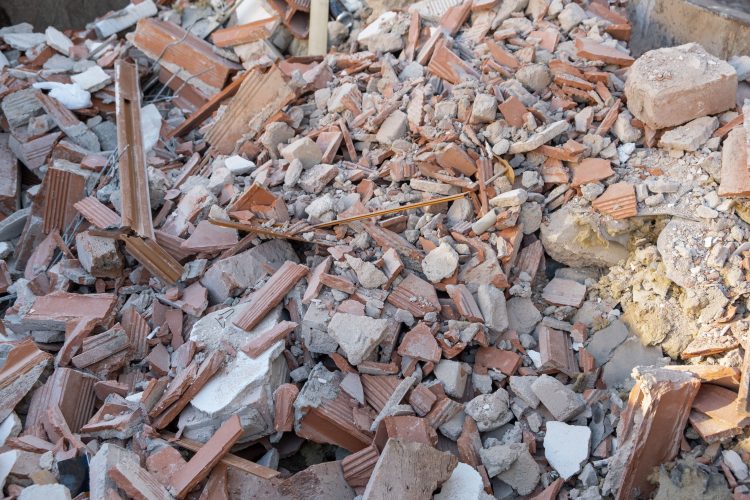
Millions of tonnes of waste from demolition and the ‘peaceful’ dismantling of buildings and structures fill Ukrainian landfill sites every year. Despite the significant potential for recycling – which the European Union has long been exploiting – Ukraine still predominantly opts for landfill rather than recycling.
This was reported by Ukrinform, citing a speech by analyst Dmytro Synko at the presentation of the Green Paper ‘Management of Construction and Demolition Waste in Ukraine’.
According to his estimates, the volume of construction and demolition waste in Ukraine in 2024 is expected to range from 42 to 56 million tonnes. The estimated volume of mineral waste within this total is 15 million tonnes.
“Currently, only about 10% of mineral demolition waste is being returned to circulation in Ukraine compared to an average of 91% in the EU, and the share of C&DW in the total waste mass is 0.25% versus 41% in Europe,” Synko explained.
Discrepancies in the figures
The reported indicators vary depending on the source, and this is a substantial problem for the sector. Thus, according to the analyst, in 2021, the amount of demolition waste according to the State Statistics Service was 3.7 million t, while the World Bank reported 37.5 million t-ten times more.
This means there is no clear and transparent data accounting in the sector, which may hinder investors from developing materials recycling projects.
“To build recycling plants, investors need clear regional figures on waste generation by oblasts and communities to calculate logistics. No one will create capacities 'in the fog',” emphasized the analyst.
Regulatory gaps
The development of the recycling sector is also held back by systemic shortcomings in regulatory policy. Among them:
- lack of an effective procedure for material sorting during building demolition;
- specific recycling obligations are not linked to demolition or construction permits in any way;
- the environmental tax on landfilling is set at too low a rate, making recycling economically less viable;
- shortage of national criteria for ending waste status and technical standards for recycled materials;
- no integration between the "EcoSystem" and the Unified State System in the field of construction (EDESSC).
“Today, construction or demolition permits in Ukraine are issued without any obligations regarding waste management, and the sector-specific law does not provide for either a pre-demolition audit or a waste management plan on site. At present, construction waste management is mistakenly regarded solely as an environmental issue,” confirmed the existence of these gaps Olena Shuliak, Chairwoman of the Verkhovna Rada Committee on State Power Organization, Local Self-Government, Regional Development and Urban Planning.
The full implementation of recycling principles in the country’s reconstruction requires many changes. These include raising the eco-tax rate on landfilling and introducing mandatory separate collection of construction waste by fractions.
EcoPolitic previously reported on the large-scale problem of accounting for demolition waste. By the end of 2024, 600,000 t had been recorded, but there is no official data on either the composition or the share of recycled material.