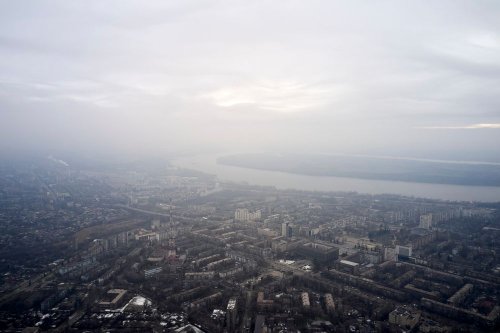
On the night of March 18–19, Odesa came under another large-scale drone attack. This did not significantly affect air quality—moderate pollution levels are being observed across the city on average.
Data on air quality in the coastal city was recorded by the Swiss platform IQAir.
In total, equipment at five locations in Odesa is connected to the international air quality monitoring system.
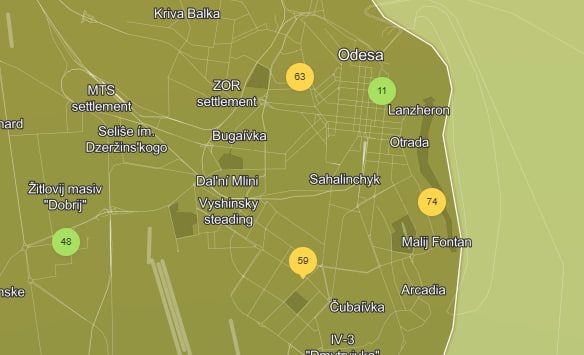
As of 11:00 a.m., two sites report their pollution danger level as “green”, meaning the air is safe. Monitoring stations providing these readings are located on Spreysa Street and Hretska Street.
The remaining three locations report a moderate level of air pollution. This is indicated by sensor data from equipment on Pishonivska Street, Malynovskoho Street, and also on Frantsuzkyi Boulevard.
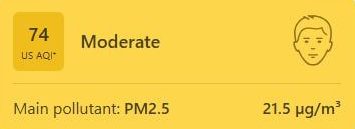
At the latter site, the air quality index according to the IQAir methodology is the worst – 74. The main pollutant on the boulevard is fine particulate matter PM2.5. Its content in the near-surface atmospheric layers reaches 21.5 µg per 1 m3. It is worth noting that the World Health Organization recommends this concentration should not exceed 5 µg/m3.
Overall, during the past day at this location, the index did not drop below 64.
The cleanest air is on Hretska Street. There, the index is only 11, and the dust pollution level is just 2 µg per 1 m3.
Throughout the day, the air pollution index there did not rise above 11.
EcoPolitic previously reported that Ukrainian scientists for the first time studied the impact of war, particularly attacks on cities, on air quality. According to their data, missile and drone attacks cause a short-term deterioration of air quality, sometimes up to 10 times above the norm.