The team of the Ministry of Environmental Protection and Natural Resources has finished work on the draft law "On packaging and packaging waste", which regulates the concept of extended producer responsibility (EPR).
The new regulations will oblige companies to recycle the packaging waste of their goods, the Ministry of Environment reports.
It is noted that the EPR system transfers the obligations regarding waste management, when the product loses its consumer properties and passes into the category of waste, from the public sector to the private sector, namely to producers.
"The EPR system was invented in the EU and today it is used internationally in hundreds of countries around the world and for many streams/types of waste," says the explanatory note to the draft law.
The message emphasized that the document is designed to define the legal, economic and organizational principles in the field of packaging and its waste management for:
- reducing their negative impact on human health and the environment;
- creation of a collection and recycling system;
- promoting the transition to a circular economy.
It is noted that the document will introduce new norms and requirements regarding:
- definition of the range of subjects and their obligations in the field of packaging and its waste management;
- establishment of basic requirements for introduction of packaging, goods in packaging, labeling of packaging in order to reduce the level of hazardous substances in it and promote recycling;
- creation, activities of organizations of extended responsibility of producers (EPR), their obligations and grounds and the procedure for termination of activity;
- minimum targets for the recycling of such waste by type of packaging material and categories of packaging (household/commercial) with a gradual increase as the packaging waste management system develops;
- creation of registers of producers of goods in packaging and ORVV, registration procedure;
- gradual coverage of the entire territory of the country with systems for the separate collection of packaging waste, interaction of local authorities with EPR;
- specifics of EPR contracts with business entities;
- control and responsibility for violations of legislation in the field of packaging and packaging waste management.
The explanatory note to the draft law also states that its implementation will not require additional financial costs from the state or local budgets.
In addition, the implementation of the document will have a positive impact on the environment, because:
- will ensure a reduction in the use of natural resources;
- will reduce the level of atmospheric air, water and land pollution due to the reduction of waste generation and disposal;
- will lead to an improvement in the health of the population.
It is noted that the public can send comments and proposals to the draft law for public discussion within a month, i.e. until May 21, to the postal address of the Ministry of Education and Culture: Kyiv, str. Metropolitan Vasyl Lypkivskyi, 35; and email address: info@mepr.gov.ua.
The environmental community reacted positively to the publication of the draft law.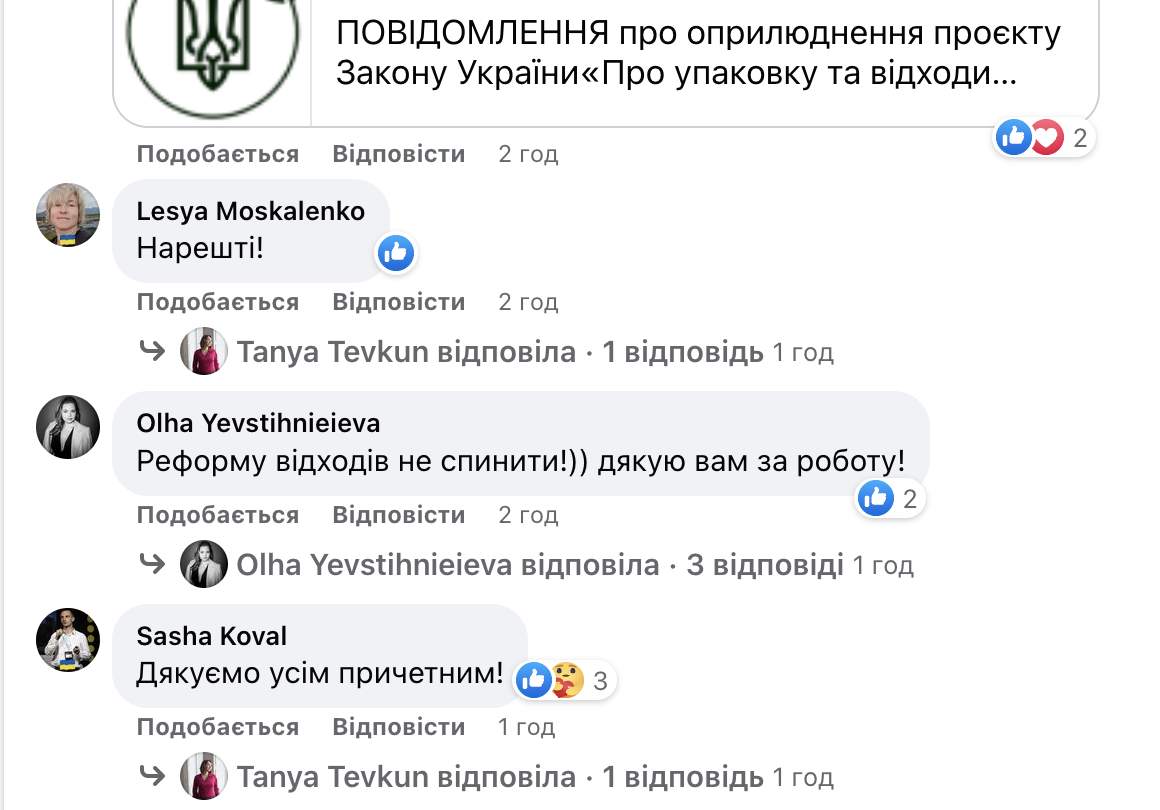
Earlier, EcoPolitic wrote, that on July 7, 2022, the President of Ukraine Volodymyr Zelenskyi signed the long-awaited Law "On Waste Management". On June 20, the Verkhovna Rada of Ukraine adopted the document in the second reading and in general, which for the first time introduced the concept of extended producer responsibility.
As EcoPolitic previously reported, in March 2023, the Ministry of Environment began actively working on the implementation of extended producer responsibility.