The Verkhovna Rada of Ukraine has registered draft law No. 13364, which provides for a 30-40-fold increase in fines for violations of water protection and water facility regulations.
The text of this draft law, entitled “On Amendments to the Code of Ukraine on Administrative Offenses with a View to Strengthening Responsibility in the Field of Protection and Rational Use of Water and Restoration of Water Resources,” is available on the parliament's website.
The document has already been submitted for consideration to the main committee—the Verkhovna Rada Committee on Law Enforcement. The text of the draft law was prepared by the Ministry of Environmental Protection and Natural Resources of Ukraine. It provides for amendments to six articles of the Code of Ukraine on Administrative Offenses (KUAP): Articles 48, 59, 59-1, 60, 61, and 77-1.
The draft act expands the list of offenses for which liability is established by Article 110 of the Water Code of Ukraine and which are not reflected in the Code of Ukraine on Administrative Offenses. In particular, regarding:
- failure to comply with the terms of a permit or violation of the rules of special water use;
- destruction of river beds, streams, and watercourses or violation of natural surface runoff conditions during the construction and operation of roads, railways, and other engineering communications;
- violation of the regime of economic activity in water protection zones and on water fund lands;
- distortion or entry of inaccurate information in state statistical reporting documents on state water accounting.
Why the changes were needed
In the explanatory note to draft Law No. 13364, the Ministry of Environment notes that it is necessary to eliminate the imbalance between the actual amount of damage caused to the environment and the amount of existing fines.
"The fines for violating the requirements of legislation in the field of protection and rational use of water and reproduction of water resources, provided for by the Code of Ukraine on Administrative Offenses, do not correspond to current economic conditions. They have ceased to be an incentive to comply with established environmental requirements, which in turn leads to legal nihilism in society and negates the state's efforts to preserve the environment and ensure an adequate level of environmental safety," the ministry explained.
What size of increased fines should be expected
The amounts of fines in the Code of Administrative Offenses are indicated in non-taxable minimum incomes (NTMI). Currently, this minimum is 17 UAH.
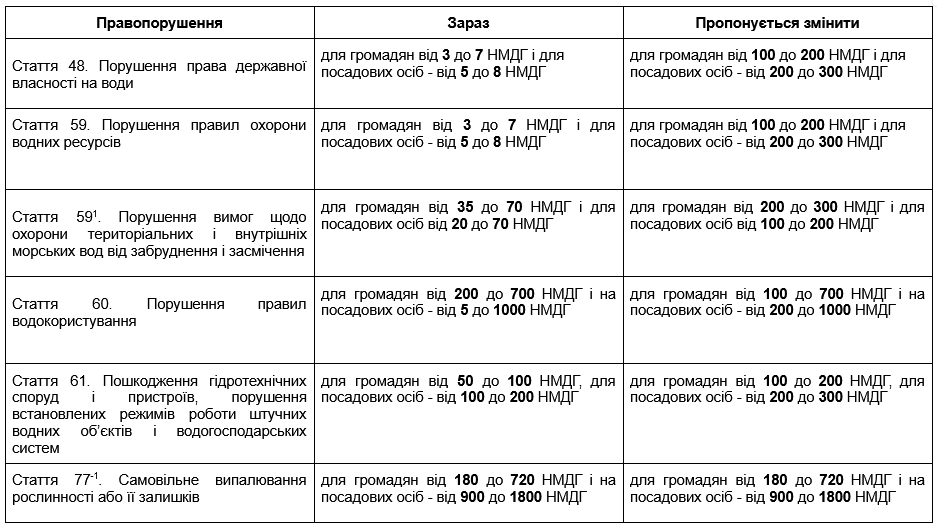
That is, the maximum fine that a citizen can receive for the specified offenses is 12,240 UAH, and for an official – 30,600 UAH.
On April 29, the Ukrainian parliament adopted draft law No. 11309, which strengthens administrative responsibility for offenses in the territories and facilities of the nature reserve fund.
EcoPolitic also reported that the Ministry of Environment had prepared a draft law that provides for a multiple increase in fines for offenses in the field of waste management.