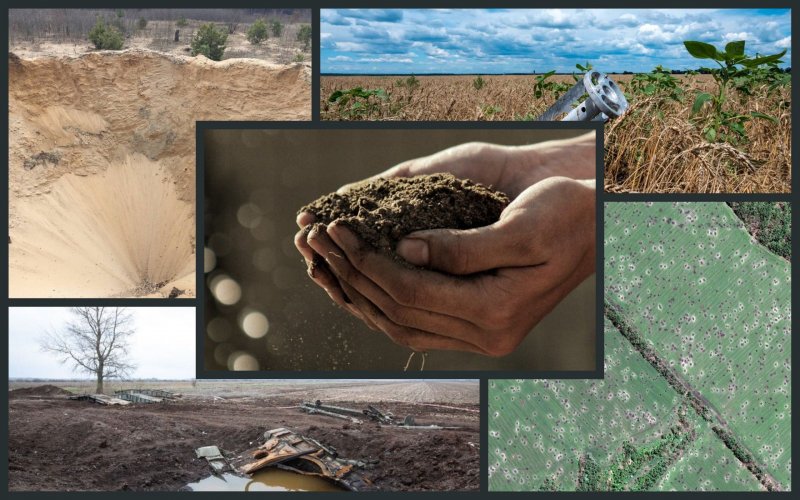
Anatoliy Razgon, a consultant on land issues at the Academy of Agrarian Sciences of Ukraine, said that in the area of active hostilities, the levels of heavy metals in the soil exceed the norm by 30 times.
The content of mercury, zinc, cadmium, copper, lead, phosphorus, sulfuric acid and other toxic substances in these areas is systematically 10-18 times higher, Ukrinform reports.
"In places of combat, heavy metals exceed background values in some places by 30 times. These substances enter the soil, migrate to groundwater and, as a result, enter the food chain, affecting both animals and people. That is, soil poisoned by explosions will slowly kill us in the future," Razgon noted during a round table discussion on the topic: "Environmental security of Ukraine: national and international dimensions."
He explained that similar problems were faced in Belgium and France after the First World War. Thus, Europe lost 23% of cultivated land and is still overcoming the consequences of the war.
In his opinion, the loss of arable land, which awaits Ukraine after the end of hostilities, is still difficult to predict.
Earlier, EcoPolitic wrote, that marine biologist Yevhen Dykyi stated that due to Russian military aggression tons of heavy metals and other toxic substances, including from sunken ships and downed missiles, entered the Black Sea.
Earlier, EcoPolitic analyzed how hostilities affect Ukrainian soil.