A study by economists from the World Inequality Lab found that the richest 10% of the world's population, the so-called polluting elite, create about half of annual carbon emissions.
A small part of the world's population is to blame for the acceleration of global warming, it is reported Earth.Org.
It is noted that the research was carried out by specialists of the Paris School of Economics with the support of the UN.
"The difference in emissions between rich and poor people is currently greater than the difference in emissions between countries," the study says.
According to the authors of the Climate Inequality Report 2023, which examined the origins of greenhouse gas emissions worldwide, carbon inequality within countries accounts for nearly two-thirds of the total, a complete reversal from 1990.
They also suggested that reducing carbon consumption at the highest level could free up the carbon budget needed to eradicate poverty below the $5.50 a day poverty line, meaning the world's poorest could increase the greenhouse gas emissions needed to achieve prosperity.
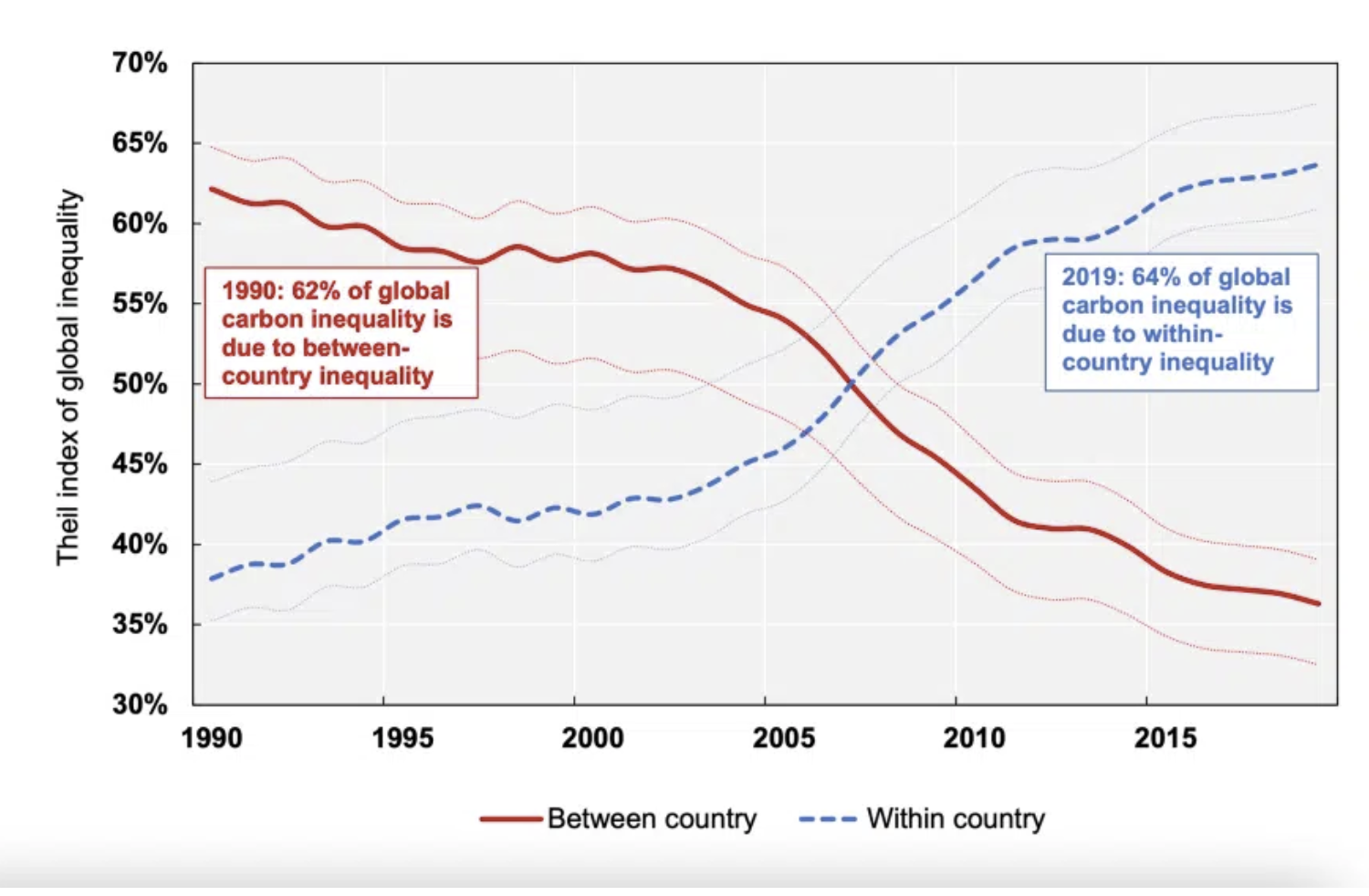
Global inequality of individual emissions: between within-country inequality, 1990-2019
As the research showed, a small part of the world's population is responsible for the acceleration of global warming. One of the authors of the paper is Thomas Piketty, who after the 2008 financial crisis helped form the idea of the "1%," a term that refers to a group of wealthy people whose high-carbon lifestyles are contributing to the climate crisis.
The 2022 analysis found that it would take 26 years for the lowest-income person to produce the same amount of carbon dioxide as the richest person in a year.
“Poverty is also closely related to vulnerability to climate change. It is known that low-income countries are more vulnerable to extreme weather events and other consequences of global warming, such as droughts, which are one of the biggest threats to food security," the article says.
Earlier, EcoPolitic wrote, that a study by climatologists with the help of artificial intelligence showed that the world cannot avoid warming by 1.5°C, which will happen between 2033 and 2035.
As EcoPolitic previously reported, according to forecasts, the Pacific island state of Tuvalu due to sea level rise and climate change may to sink completely by the end of the century.