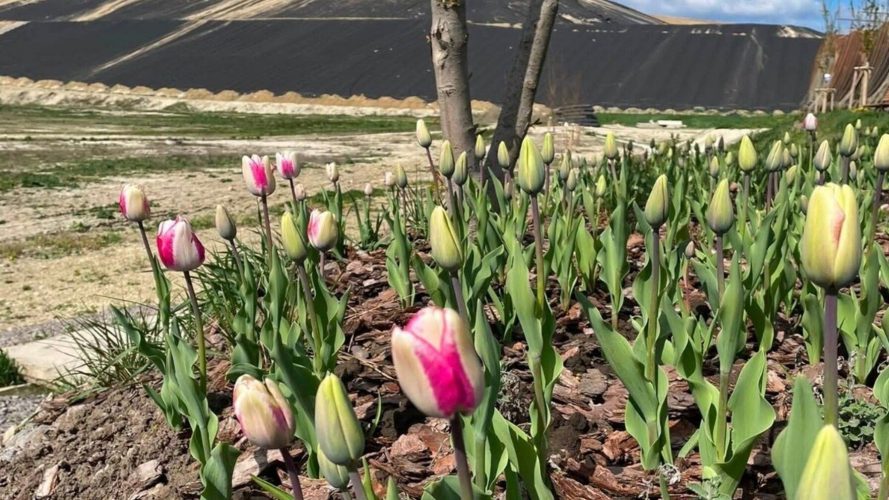
The second phase of the reclamation of the former Hrybovychi landfill site near Lviv is nearing completion. A new landscape is gradually taking shape on the site of the landfill—featuring trees, shrubs, and flowers. Currently, colorful spring tulips adorn the area where waste once lay.
This was reported by the press center of the Lviv City Council, citing the municipal enterprise "Green City."
In addition to the trees planted here in 2025 by Mayor Andriy Sadovyi, European Commissioner for Enlargement Marta Kos, and First Deputy Minister of Development Alona Shkrum, over 300 plants are growing here. Specifically, these include yarrow, Vichi grapes, aronia, miscanthus, ivy, and tulips.
"This is yet another reminder that, step by step, we are transforming the former landfill into a safe and green area," the municipal enterprise emphasized.
Restoration through nature
The second phase of the landfill’s reclamation—the biological phase—began in early 2025. It involves a series of measures to restore the site of the former landfill in order to minimize its impact on the environment.
As of April 2026, approximately 90% of the work has been completed. Specifically, the following measures have been implemented:
- a drainage layer has been installed;
- topsoil has been applied;
- landscaping has been completed;
- reservoirs have been installed;
- the groundwater monitoring system has been modernized.
The final step to complete the bioremediation is to apply a soil layer to another 20 hectares of the site and plant vegetation. Weather permitting, the biological phase of the landfill’s restoration will be completed by the end of June 2026.
In the next phase of the third stage of reclamation for the former landfill site, the plan is to develop an overall concept for a recreational area. This will give the site a new purpose—without negatively impacting the environment and with minimal ecological risks.
Recall that on May 28, 2016, a large-scale fire occurred at the Hrybovychi landfill, claiming the lives of four people.
Since 2020, reclamation work has been underway at the dump. However, even after its closure and land restoration, the landfill still poses environmental risks. Measures to minimize the impact were reported by Lviv’s Communal Enterprise "Green City" ahead of public hearings on the environmental impact assessment (EIA) procedure.
To address waste problems in Lviv, a waste processing plant was started. However, the project faced difficulties and stoppages due to violations by the contractor. In March 2026, the Lviv City Council announced the termination of the contract with the Polish company.