China accounts for more than 70% of the current construction of industrial solar and wind power plants in the world – more than 416 GW.
This data is contained in the Global Energy Monitor (GEM) report. It is a non-governmental organization that catalogs fossil fuel and renewable energy projects around the world.
Its analysts have researched promising industrial-scale solar and wind power plants – projects that have been announced, are under construction, or are already under construction.
What is the situation at the end of last year?
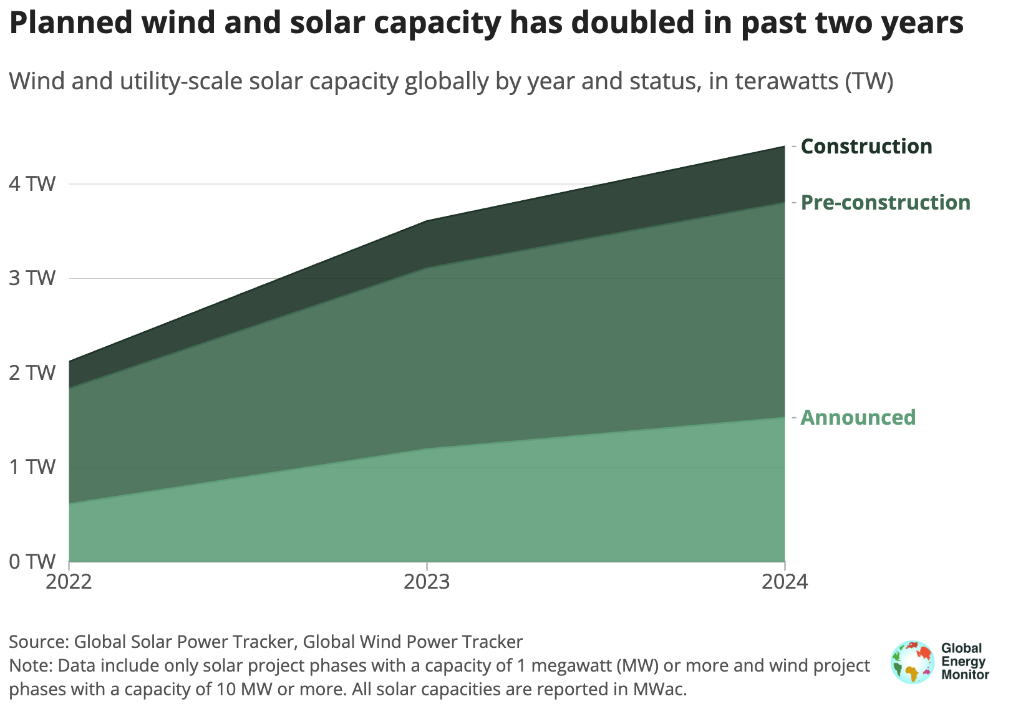
GEM found that worldwide, promising capacity in 2024 increased by more than 20% – from 3.6 TW to 4.4 TW. But researchers note that this figure is only half of what is needed to achieve the global goal of tripling renewable energy capacity. This is the goal set by countries at the UN Climate Change Conference COP28.
Over the past two years, the capacity of planned solar and wind power plants has doubled in the world:
Source: globalenergymonitor.org.
Global operating capacity increased by 14% last year, as at least 240 GW of commercial-scale SPPs and WPPs came online.
China is a global leader
According to GEM experts, China has the largest potential capacity in both solar and wind energy – more than 1.3 TW in total, which is more than a quarter of all potential capacities in the world. 36% of the projects planned in China are already under construction, while the global average is 7%.
China is followed by Brazil (417 GW), Australia (372 GW), the United States (218 GW), and Spain (144 GW).
China not only leads the world in terms of the number of projects implemented, but also plans to build more than two-thirds (70%) of all solar and wind power plants in the coming years.
Meanwhile, India, with the fifth largest GDP in the world and 30% of projects under construction, plans to add nearly 130 GW of promising solar and wind capacity in the coming years. 35 GW of this capacity is planned to be connected to the grid by March 2025. Last year, promising solar and wind capacities in India increased by 50%, which, according to GEM experts, indicates changes in planning for renewable energy development.
Imbalance in the development of renewable energy
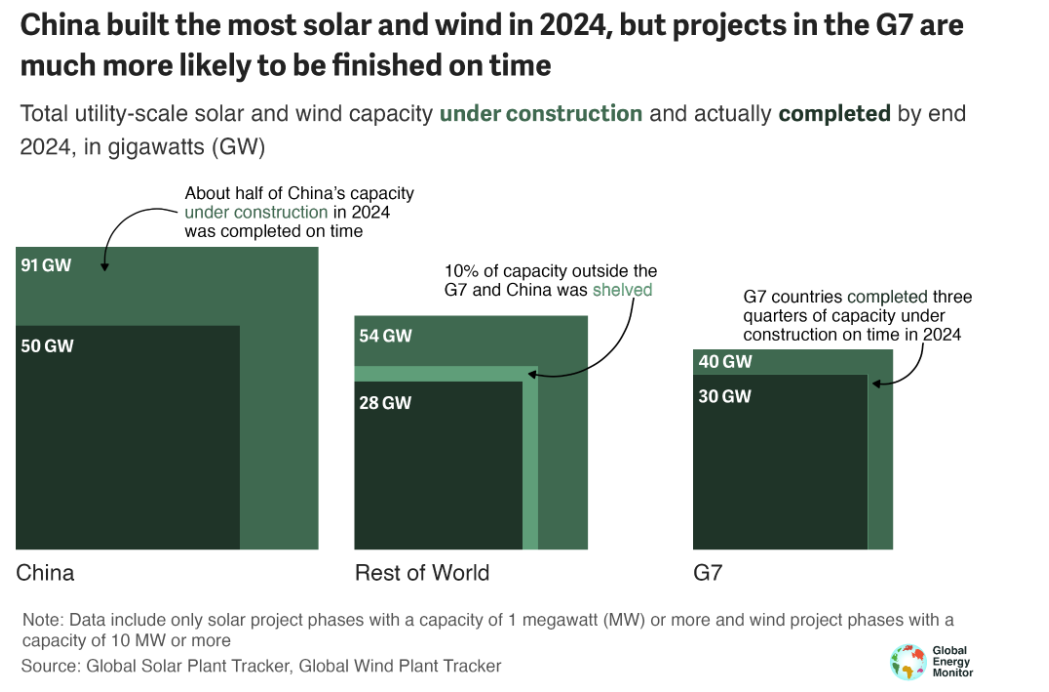
Outside of China and the wealthy G7 countries, only half of the solar and wind projects scheduled to be launched in 2024 were actually completed on time.
Despite their 45% share of the world's gross domestic product (GDP), the G7 countries are building only 10% of the planned solar and wind projects – 59 GW. This figure is eclipsed by China, which accounts for more than 416 GW of current construction of industrial solar and wind power plants in the world.
Meanwhile, outside of China, the amount of solar and wind capacity under construction remains low – currently only 7% of potential capacity (226 GW). According to GEM analysts, the inability to launch renewable energy projects could jeopardize the pace and scale needed to achieve the goal of tripling renewable energy capacity by 2030.
According to GEM, only 59% of renewable energy projects worldwide started producing electricity on time.
Source: globalenergymonitor.org.
The analysts stated that China built the most SPP and wind farms, but for the G7 countries, in their opinion, the likelihood of timely completion of projects is higher. They showed in the graph that in 2024, the G7 countries completed 75% of their capacities on time (30 out of 40 GW), while in China this figure was about 55% (50 out of 91 GW).
Earlier, EcoPolitic wrote that the Chinese solar generation industry is breaking records in terms of productivity.