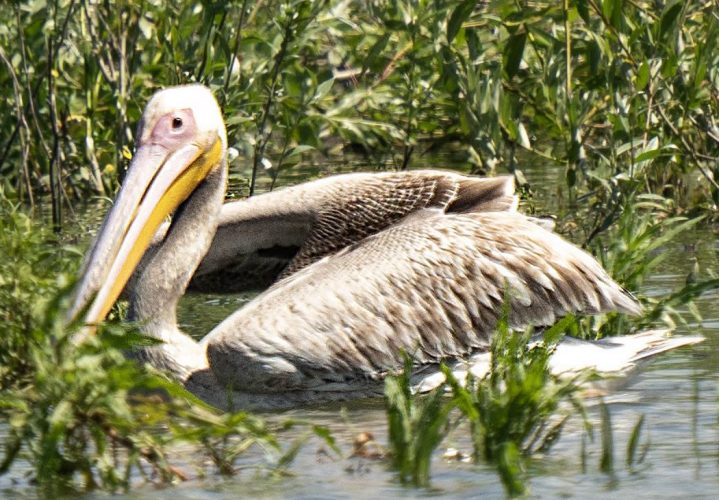
A pink pelican has been spotted in the floodplain of Khortytsia Island. This is a rare bird listed in Ukraine’s Red Book. However, scientists consider its appearance in these waters to be a natural development — it is part of the Dnipro’s ecosystem recovering following the destruction of the Kakhovka Hydroelectric Power Station dam.
This was reported on the Facebook page of the ‘Khortytsia’ National Nature Reserve.
Not a visitor, but a long-standing resident
Pelicans on Khortytsia may seem like a sensation. In reality, however, the presence of these birds on the lakes of Khortytsia was commonplace before the creation of the Kakhovka Reservoir. Locals used to call this inhabitant of the floodplain systems of the Great Meadow the ‘old woman bird’.
The national park cites data from the work of historian and naturalist Adrian Kashchenko, *The Great Meadow of Zaporizhzhia*. In it, the local floodplains are described as veritable oases for birds, including pelicans. They found places to rest and find plentiful food in the shallow waters of the Khortytsia.
A Return to the Sources
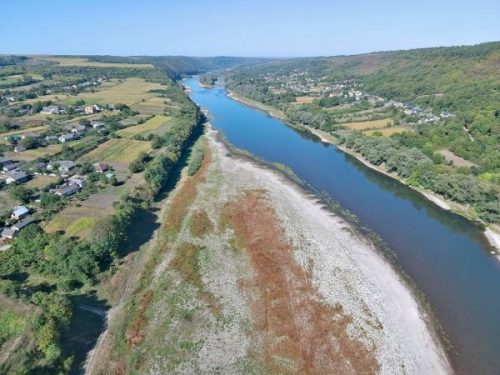
The national park attributes the appearance of the pelican in the Zaporizhzhia region to global ecological changes linked to the natural restoration of the territory of the former Kakhovka Reservoir.
Numerous natural processes are currently taking place, including the ‘restoration’ of the historic riverbed, the formation of sandbanks and sandbars, and the sprouting of young willows. Gradually, the Dnipro’s ecosystem is beginning to take on its former appearance, as it was before human intervention.
New generations of pelicans are now migrating from the Black Sea region in search of food. It is therefore only natural that the restored Velykyi Lug has once again become an attractive hunting ground for them.
“This sighting is an important indication that, despite decades of anthropogenic pressure, the nature of Khortytsia and the Lower Dnipro is recovering rapidly, regaining its historical biopotential,” stated Mykhailo Mulenko, Head of the Nature Department at the National Reserve “Khortytsia”.
About a hundred civil society organizations, scientists, and activists have called for the Great Meadow to be recognized as UNESCO heritage. They emphasize both the historical value of the cradle of the Cossacks and the unique regeneration processes of the floodplain ecosystem.
EcoPolitica also reported that the Chernobyl area has become a site for the recovery of the Przewalski's horse population, which in 1969 was declared extinct in the wild.