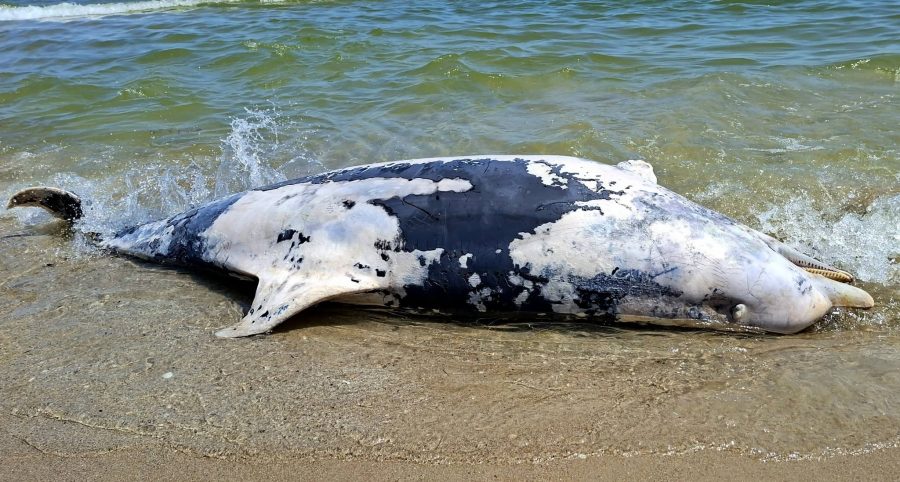
Since the start of the full-scale war, the Black Sea has become the site of the deaths of over 100,000 cetaceans. These preliminary expert estimates are borne out by incidents in recent months — 83 carcasses have been recorded on the coast of the Tuzly Estuaries National Park in the Odesa region alone.
Ivan Rusev, head of the research department at the Tuzly Estuaries National Nature Park, spoke about this on Espreso TV.
“In two months and ten days, we have found 83 cetacean carcasses. This is a very alarming figure, as even in 2022, when the impact of the war on marine ecosystems was extreme, we did not observe such a situation,” noted Ivan Rusev.
Causes of death
Staff at the nature reserve continue to uncover the consequences of military operations, which are directly affecting the integrity of the marine ecosystem.
Among other things, scientists have found traces of fuel oil. This entered the waters back in December 2024 following an accident involving Russian barges in the Kerch Strait.
Ivan Rusev reported that ocean currents act as pathways through which pollutants are periodically carried by the water to the coastline controlled by Ukraine.
Therefore, one of the causes of the dolphins’ deaths is chemical pollution. The scientist emphasised that the blowing up of the Kakhovka hydroelectric power station dam, the sinking of the cruiser ‘Moscow’, and accidents involving oil spills — all of these have their consequences.
Another factor is physical in nature. Specifically, this refers to the use of sonar, the detonation of anti-ship mines and explosions at sea.
The Scale Is Much Larger
The number of animals washed ashore by the currents is only a tiny fraction of the real scale of the disaster. Research by North American scientists indicates that bodies found on the shore usually represent just 5% of the total number of marine animal fatalities. The others remain on the sea floor.
“From the beginning of the war in 2022 until now, we estimate that at least 100,000 cetaceans of three species have died in the Black Sea. The actual number could be even higher,” the researcher pointed out.
The loss of such a large segment of the population may negatively affect the preservation of the unique Black Sea fauna as a whole. According to Rusev, even before the war, the number of cetaceans here was low, so the consequences will be long-lasting.
EcoPolitic previously reported that as of July, scientists reported about 20,000 dead dolphins just since the start of 2026.
In April, approximately 6,500 tons of oil entered the sea after a Russian attack destroyed storage tanks in the port of Chornomorsk. The substance “migrated” through the waters and contaminated, in particular, the coast of Tuzlivski Lymany.