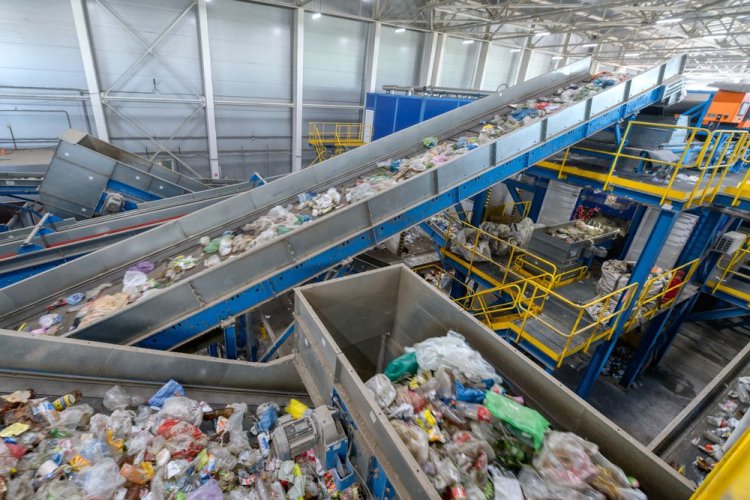
The management of packaging waste in Ukraine still falls to local authorities and the general public, although in the EU, manufacturers have borne the financial responsibility for this for decades. The Extended Producer Responsibility (EPR) scheme has the potential to provide Ukraine with additional resources for recycling and even boost the country’s GDP. However, the draft legislation is currently stalled at the relevant ministry
Oleksandr Lymar, a waste management expert at the Ukrainian Institute of the Future, discussed this in his column for the publication *Dzerkalo Tyzhnia*.
A fundamentally different model
EPR is based on the ‘polluter pays’ principle. More specifically, in this case, it applies to manufacturers and importers of packaged goods. It is they who bear the financial burden of waste collection, sorting and recycling, as they are the ones who put it into circulation.
In Ukraine, however, local budgets and residents who pay for household waste management services still foot the bill. This amounts to around 10–12 billion hryvnias annually from the public.
According to an expert, over 2.5 million tonnes of packaging enter the market every year. Once the main product has been used, all this wrapping, boxes and containers become rubbish. If the EPR scheme were to operate at full capacity, manufacturers would have to pay up to 16 billion hryvnias annually for the management of such a vast amount of waste.
“Implementation of EPR will make it possible to bring additional financial resources into the waste management system, surpassing current citizens’ payments for household waste removal. These funds will be directed toward the development of infrastructure for separate collection, sorting, and recycling of waste, instead of being covered by local budgets or increasing the tax burden on citizens,” added Oleksandr Lymar.
Private investment without burdening the budget
An effective waste management system requires additional infrastructure and recycling capacity. All of this represents substantial investment, which can be attracted from private sources through EPR implementation without straining the state budget.
The expert estimates that Ukraine needs to build more than 400 sorting stations, install over 110,000 containers for separate waste collection, acquire special vehicles, and develop recycling facilities and digital monitoring systems. Altogether, this calls for investments in the range of €1.5–2.5 billion.
Impact at the GDP level
Packaging waste management is not only about environmental protection and European standards. With proper EPR implementation, a significant economic effect can also be achieved.
Oleksandr Lymar provides forecasts indicating that EPR could deliver an additional 0.8–1.5% boost to GDP, increase the country’s gross domestic product by $2.5–5 billion, and create up to 80,000 jobs.
“In fact, EPR creates a new sector within the circular economy that operates inside the country and generates added value. This effect is achieved by establishing new enterprises, developing the recycling industry, manufacturing products from secondary raw materials, expanding logistics infrastructure, and attracting investment to the regions,” the expert explained.
Одночасно, the EPR is capable of bringing to light numerous processes that are currently taking place off the books and essentially illegally. Legalizing just 5% of the market would add about UAH 80 billion to the official turnover, while fiscal payments would increase by approximately UAH 35 billion annually.
Why EPR Still Does Not Work in Ukraine
In addition to the obvious economic and environmental effects, EPR is part of Ukraine’s commitments within the framework of European integration. However, according to specialists, the implementation of this system has been sabotaged for over 25 years. They claim that the realization of EPR has stalled at the level of the Ministry of Economy and Environment and the Environmental Committee of the Verkhovna Rada.
“While officials continue to argue, Ukraine loses billions of hryvnias in potential investment, tens of thousands of future jobs, and the opportunity to create a modern processing industry every year. At the same time, millions of tonnes of valuable waste continue to be buried in landfills or feed the economies of other countries,” said Lymar.
EcoPolitic reported that a working version of the draft law “On Packaging and Packaging Waste” was presented back in February 2026. By March 23, the Committee on Environmental Policy had collected proposals and comments. A brief overview of the document is available at this link.
Back in November 2025, a pilot project for the implementation of EPR was launched. For this, the Ministry of Economy and Environment signed memoranda of cooperation with the “REKOPAK” Association and the Ukrainian Packaging and Environmental Coalition (UKRPEK)