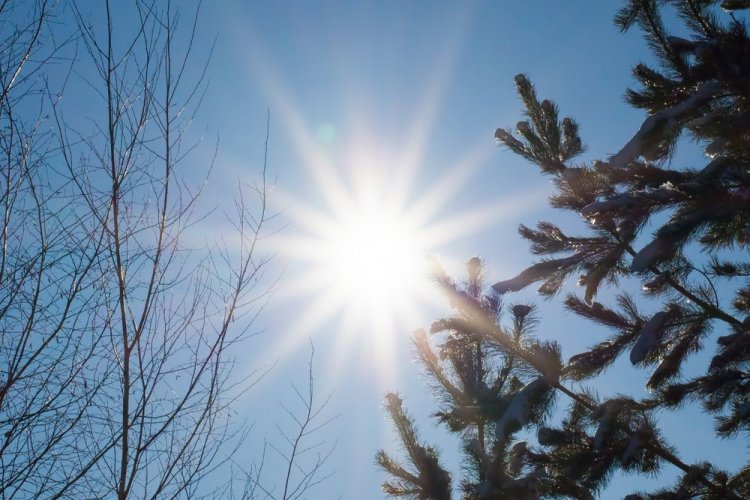
The Arctic cold spell in January brought Ukrainians back to the feeling of "real winter." However, in terms of global climate trends, this is rather an exception. In the future, winter will become shorter and shorter, and temperatures will become higher and higher.
Vira Balabukh, head of the Department of Applied Meteorology and Climatology at the Ukrainian Hydrometeorological Institute, said in an interview with RBC-Ukraine that we should not expect consistently harsh winters.
A dry and warm December
The first month of the winter season was actually abnormal. The average air temperature was 1–4 °C higher than normal. There was also a precipitation deficit, which reached as much as 20% in some regions.
Therefore, according to the climatologist, it is too early to talk about an average cold winter in 2025–2026.
Cold snap as a weather whim
In early January, the weather in Ukraine was dramatically affected by an Arctic invasion. It brought frost and heavy snowfall, but not across the entire country. The south and southeast remained abnormally warm. The scientist emphasizes that the precipitation there was not snow, but ordinary rain.
Then the Asian anticyclone intensified, spreading real winter frosts throughout Ukraine. The cold was so severe that in some places it was even lower than the climatic norm.
This is also an anomaly, emphasizes Vira Balabukh. Sharp temperature fluctuations are evidence of climate instability and the uncertainty of a return to a "traditional" winter.
What’s Next?
The “warming trend” will not disappear from the global climate agenda, and Ukraine will be affected as well.
“It is expected that air temperatures will continue to rise, including in winter. As a result, winters will become warmer and shorter,” the climatologist said.
At the same time, abrupt cold snaps will not disappear. Arctic intrusions will remain possible. Moreover, the higher the winter temperature becomes, the more striking these contrasts will be for people, causing economic losses and infrastructure damage.
EcoPolitic previously reported that scientists forecast an increase in the duration of the summer season across all European countries. By the end of the century, summer will last up to eight months.