Water levels in rivers across a number of western regions continue to fall to their lowest levels since records began. According to meteorologists’ forecasts, the decline in water levels will continue until at least 15 September. In some places, water levels may fall to an all-time low, whilst some small rivers may dry up completely.
This is evidenced by data from the Ukrainian Hydrometeorological Centre.
Water crisis
The warning of critical water shortages applies to certain rivers in the Dniester basin, as well as the San and Tisa sub-basins. The regions of Lviv, Volyn, Zakarpattia, Ternopil, Ivano-Frankivsk and Khmelnytskyi are at risk of facing the consequences of reduced water levels.
Water levels may fall below the low-water criteria. This applies primarily to sections of rivers where the riverbeds are overgrown with aquatic vegetation. Certain sections of small rivers may cease to have any flow at all. In the long term, this threatens to complicate the operation of the water management system.
"In Ukraine, particularly in the west, there was a significant shortfall in rainfall. For example, in central and southern Ukraine, rainfall amounted to around 80–100 per cent – in other words, it can be said to be within the normal range. This is for the half-year period. As for western Ukraine, between 50 and 60 per cent of the usual amount fell there this year,” said Ilya Perevozchikov, deputy head of the Hydrological Forecasting Department at the Ukrainian Hydrometeorological Centre.
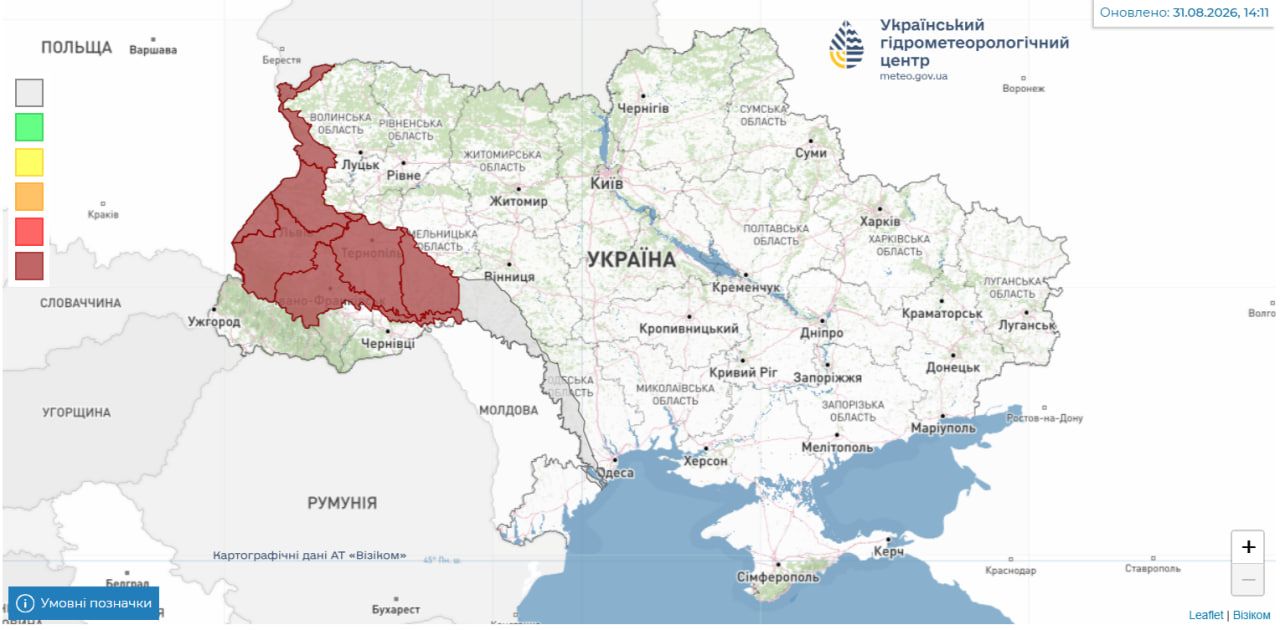
Source: Ukrainian Hydrometeorological Centre
According to data from the Lviv Regional Centre for Hydrometeorology, water levels in most of the region’s rivers remain close to their long-term minimum values. In some places, levels are 1–10 cm below the minimum, notably on the Dniester near the village of Rozdil and on the Stryi near Zavadivka.
The water shortage is already prompting intergovernmental action. As reported by the Ministry of Economy and Environment, Ukraine and the Republic of Moldova have agreed to reduce the water discharge from the Dniester Integrated Hydropower Complex to 60 m³/s for the next 14 days.
"We are facing an unprecedented situation regarding the water levels in the Dniester. The severe low water levels have persisted for several months now, so today we must take the most responsible decisions possible regarding every cubic metre of water in order to preserve the reservoir and, first and foremost, meet the needs of the population," said Iryna Ovcharenko, Deputy Minister of Economy and Environment of Ukraine.
EcoPolitics reported that, over the past 30 years, 30 per cent of rivers in Ukraine — around 20,000 — have disappeared or been significantly fragmented.
The problem also affects lakes. For example, the largest lake in the Khmelnytskyi region — Lake Sviate — recently dried up. This threat is also being observed for Lake Velykyi Supii in the Kyiv region.