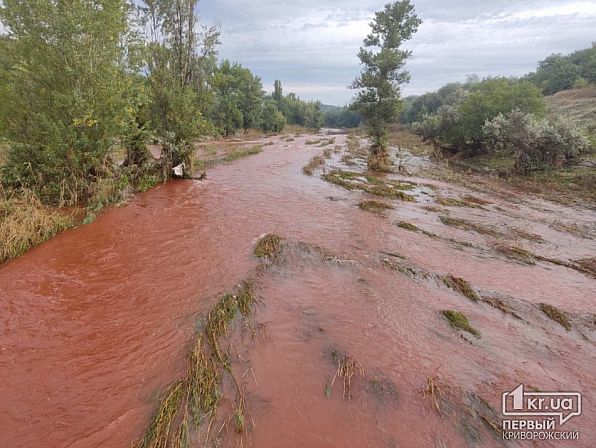
In Kryvyi Rih, environmental activists of the DTKR took water samples from the Ingulets river, which turned red the other day after the russians shelled the hydraulic structure. The water was considered relatively safe.
This is stated on the organization's Facebook page.
"There is no reason to panic because of the red water in Ingulets. The "Enough to poison Kryvyi Rih" team took samples in Ingulets near the Karachuny microdistrict, the rocks of MODRu and in the Mershavtseva park after the russians cynically shelled the hydraulic structures in the city. To eliminate the accident, the structures were reinforced with rubble and later the river turned red," said the message.
In the analysis, the activists relied on the method of ecological assessment of the quality of surface water according to the relevant categories, developed by the Kharkiv Institute of the Ministry of Environment.
"The water in all samples according to the classification belongs to the II and III categories: good and mediocre. There are seven categories in total, water is considered dangerous starting from the 5th. Therefore, the water in Ingulets can be called relatively safe. In the samples we selected, the content of soluble iron did not exceed the permitted norms. The concentration of total iron in the water will be higher. The hardness was slightly increased, but not critical, considering the liquidation of the accident in the conditions of an emergency situation. There are no heavy metals in the samples taken," reported the DTKR.
In particular, the water was checked for dissolved oxygen content.
"Saturation in all samples was higher than 90%. This means that there will be no oxygen starvation among the fish and river vegetation. And therefore, precisely because of the redness of the water, the river inhabitants will not die. The thing that most confused people, the red color of the river is obviously particles of loam and hematite, which will settle to the bottom. And the color of the river will eventually return to its usual one," the ecoactivists explained.
It is also noted that all water samples of the III category were precisely based on the content of phosphates and nitrites. According to DTKR, this could have happened due to the flooding of private bypasses, engineering networks and cesspools. However, eco-activists noted that they are unable to analyze the water according to sanitary-epidemiological indicators. Therefore, they cannot assess its safety.
"There is no reason to panic about the redness of the water. But shelling and the destruction of the dam still have consequences for the environment. And for creating an emergency situation, attempts to leave a large city without water supply, loss of water from storage and attempts to create a catastrophe, Russia must answer, as well as for other crimes," the organization concluded.
As EcoPolitic reported earlier, on September 14, russian troops bombarded the city of Kryvyi Rih with 8 Kinzhal and Iskander cruise missiles, which damaged the dam Karachuny reservoir. On the morning of Friday, September 16, local residents of Kryvyi Rih noticed that the water in the Ingulets River turned red.
Later, the Ministry of Environment informed that water quality in Ingulets returns to normal, in particular, the red pigment settles and washes out and should disappear in a few days.