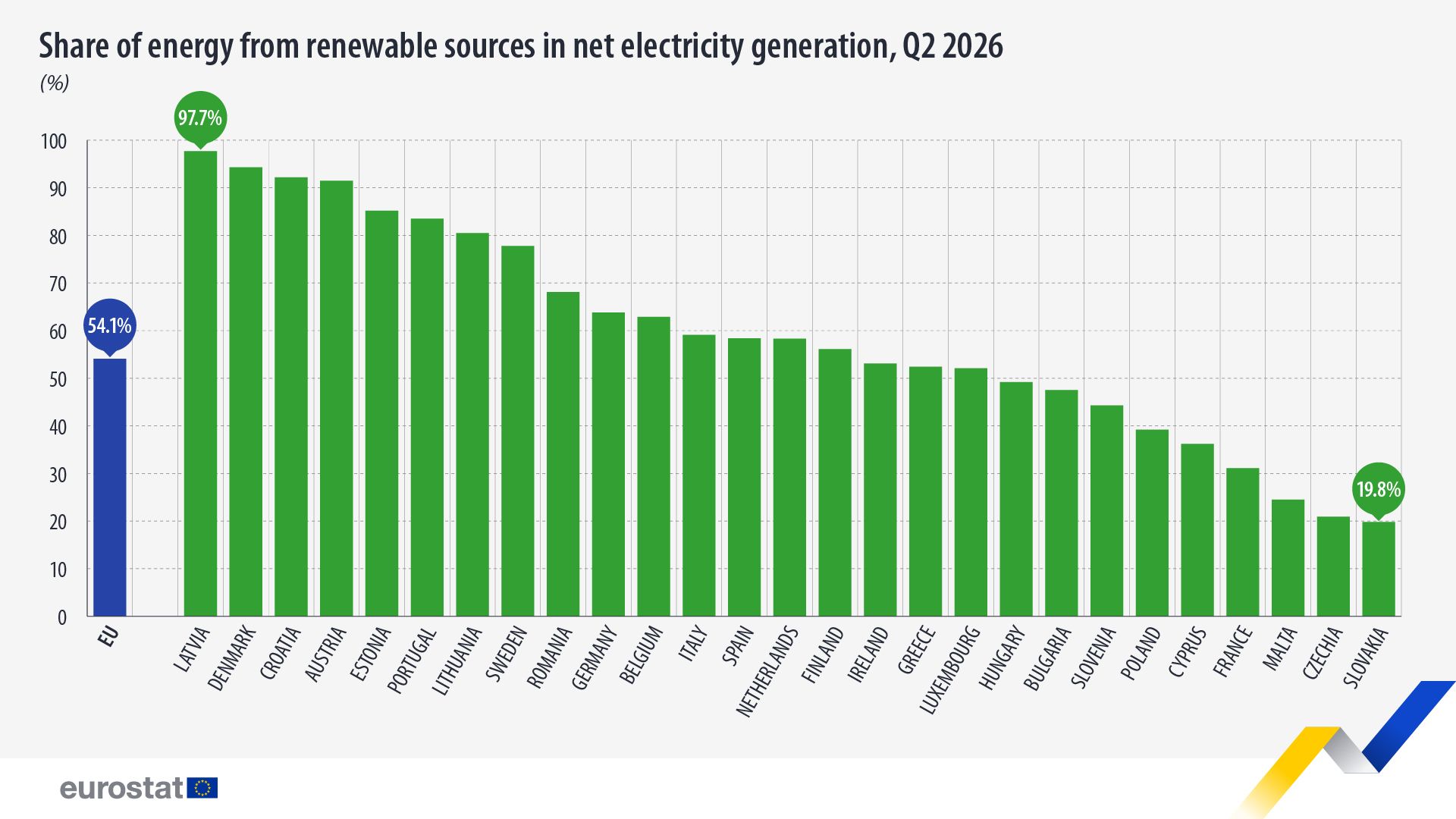
From April to June 2026, the share of ‘green’ energy in the total energy generated in the EU stood at 54.1%. Overall, there has been a slight year-on-year decline – in the second quarter of 2025, renewable energy sources accounted for 54.3% of Europe’s energy supply.
This is evidenced by new data from Eurostat.
The most productive segments of power generation
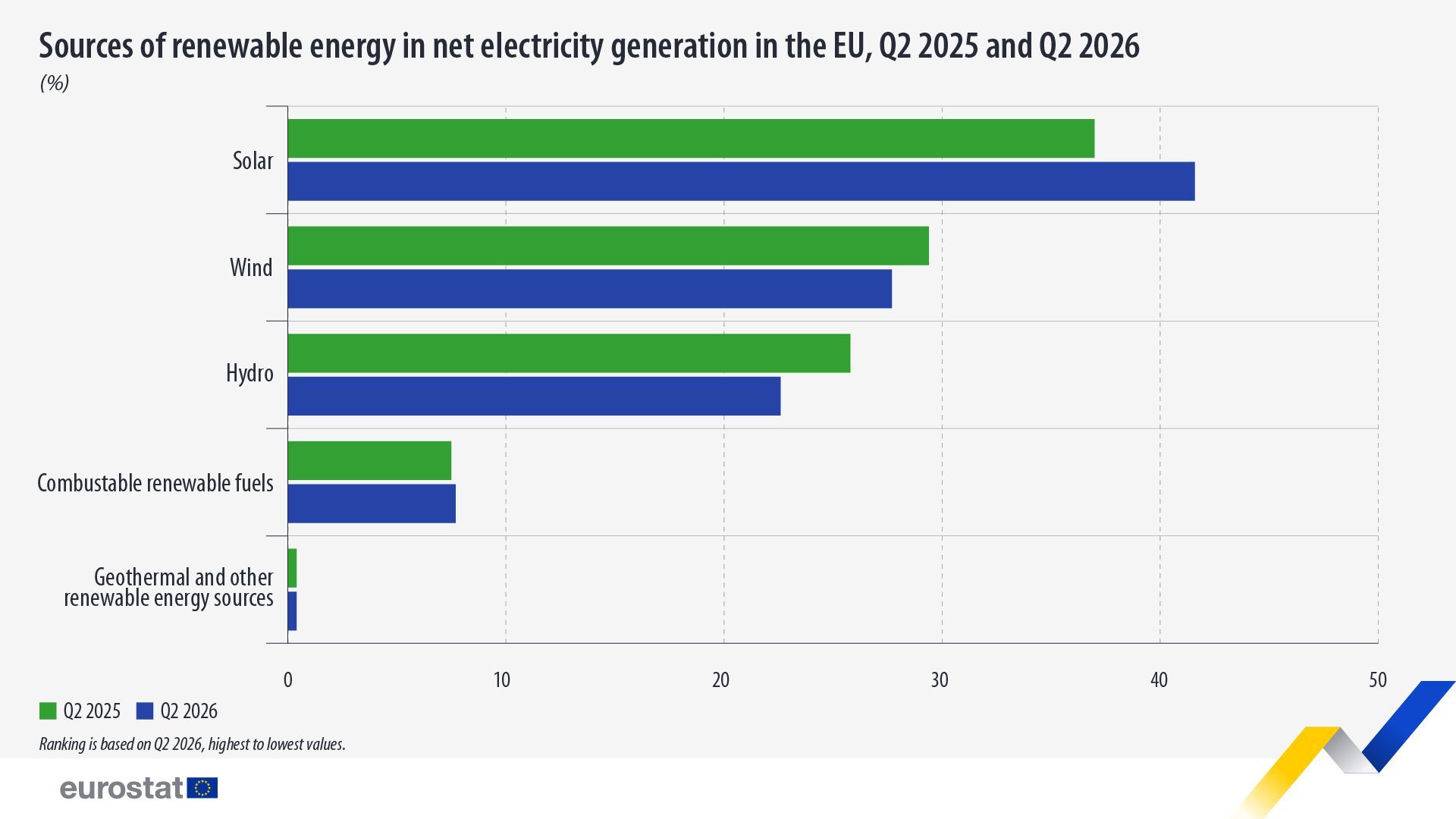
Solar power has become the undisputed leader in terms of generation volumes. It accounted for 41.6% of all clean energy produced in the EU. In the second quarter of last year, its share stood at 37%.
Wind power follows solar power, accounting for 27.7%. Hydropower ranked third in terms of generation volume, at 22.6%. EU countries obtained 7.7% of their energy from renewable solid fuels.
Source: Eurostat
Leaders and anti-leaders
The sources of ‘green’ energy generation vary slightly amongst the leading countries. Latvia had the highest share of clean energy – 97.7 per cent. This was mainly provided by hydropower and solar energy. Denmark took second place with a share of 94.3 per cent, where wind power predominates. Croatia rounds off the top three with 92.2 per cent renewable energy, largely supplied by hydropower.
At the very bottom of the ranking of countries by share of electricity generation from renewable energy sources were Malta, the Czech Republic and Slovakia, with 24.5 per cent, 20.9 per cent and 19.3 per cent respectively.
Source: Eurostat
EcoPolitics previously reported that, for the whole of 2025, renewable energy sources accounted for 47.3 per cent of the EU’s energy consumption. On an annual basis, wind farms provided the most energy – 37.5 per cent – whilst solar power came second – 27.5 per cent.
By way of comparison, in Ukraine, the share of clean energy stood at 10.7 per cent in the same year. Wind power generation added 324.4 MW of capacity over the year, whilst solar power generation added 1.5 GW.