Since 2018, the State Energy Efficiency Fund has been operating as a tool to support the eco-modernisation and renovation of Ukrainians’ homes. During this period, over 5.2 billion UAH in grants has been disbursed under the Fund’s programmes for the implementation of energy-saving projects.
This was reported on the website of the state agency, which has summarised the results marking the eighth anniversary of its establishment.
Fund statistics
The Energy Efficiency Fund currently runs three programmes — ‘EnergoDim’, ‘VidnoviDIM’ and ‘GreenDIM’ — under which around 2,100 projects have been implemented since 2018.
These initiatives have had a direct impact on the lives of over 770,000 people across various regions of Ukraine. Among the positive effects are reduced energy costs and greater self-sufficiency for homes in the face of an unstable energy supply.
In his comments marking the Fund’s ‘anniversary’, its head, Yegor Farenyuk, thanked the chairpersons of homeowners’ associations for their active involvement, as well as the international partners who provided financial support for the programmes.
It is worth noting that the Energy Efficiency Fund made no mention of the overall environmental impact of implementing these projects. Whilst periodically highlighting successful case studies, the organisation occasionally points to reductions in emissions resulting from lower energy consumption. In particular, thanks to the comprehensive thermal modernisation of the ‘Edelweiss 24’ housing association, emissions have been reduced by over 320 tonnes of CO₂ annually.
However, even on the Fund’s website, we can see that in its work the organisation takes into account the reduction in carbon dioxide emissions with a view to fulfilling the Paris Agreement. Why this figure is not stated separately remains an open question.
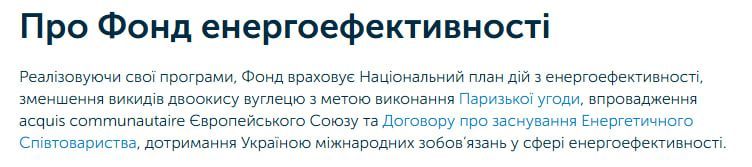
Screenshot from the Energy Efficiency Fund website
Recall that in November 2025, the government increased the Fund’s authorized capital by UAH 240 million. As EcoPolitic reported, these funds were intended to help implement more than 300 projects for energy modernization and housing restoration. The 2026 state budget includes UAH 630 million for the Energy Efficiency Fund, with an additional €18 million from donors.
In this article, we analyzed why the current energy efficiency policy in Ukraine fails to deliver the expected results.