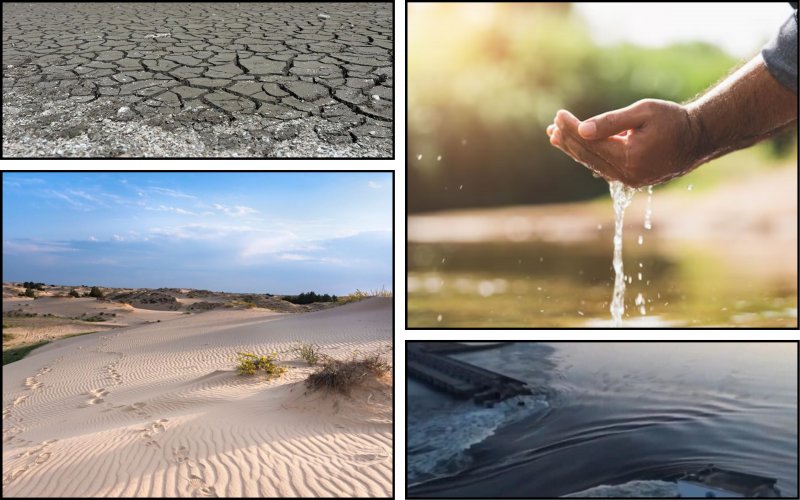
Vladyslav Dudar, an officer of the Main Department of Mine Action, Civil Defense and Environmental Security of the Ministry of Defense of Ukraine, said that the draining of the Kakhovsky Reservoir could increase the desertification (aridification) trends of the south of Ukraine.
He spoke about the consequences of Russians undermining the Kakhovskaya HPP during a briefing, Ukrinform reports.
According to him, the majority of specialists are not inclined to the fact that this Kherson Region will become a desert. After all, the total amount of precipitation in the region reaches approximately 400 millimeters per year, and in the deserts of Spain – 200 millimeters per year.
"But there are some negative forecasts that speak of the possibility of an increase in the process of aridization of the Kherson region," Dudar emphasized.
He added that the ecosystem of the Kherson region is mainly anthropogenic. Therefore, due to the lack of agriculture, the draining of the Kakhovsky Reservoir can negatively affect the process of desertification in the south of Ukraine.
Earlier, EcoPolitic wrote, that on June 6, the Russian occupiers blew up the dam at the Kakhovskaya HPP. According to OSINT researchers, the ecological and economic consequences of the destruction of the Kakhovskaya HPP can be equated to the consequences of the use of tactical nuclear weapons 5-10 kilotons.
Previously, EcoPolitic spoke with the head of the ecomonitoring committee of the Association of Environmental Professionals PAEW Maksym Soroka about the complex environmental consequences of the detonation of the Kakhovskaya HPP.