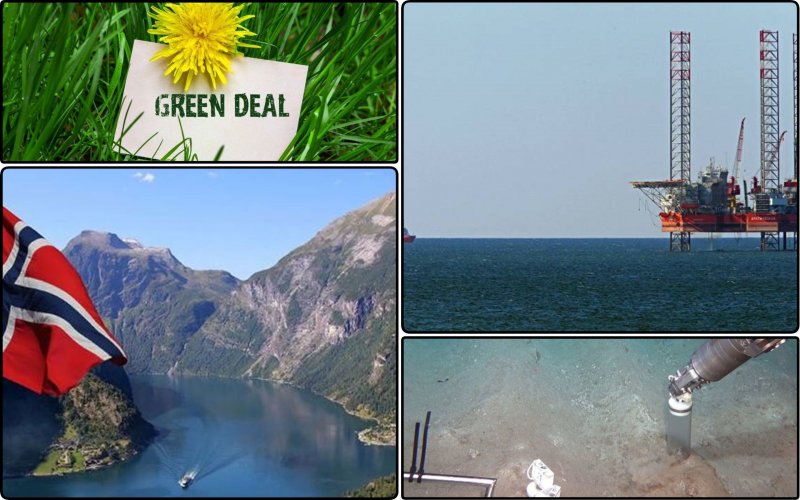
Norway's government plans to start mining base metals for batteries from the ocean floor near the Svalbard archipelago in the Arctic.
The fishing and environmental communities have opposed such an initiative due to the likely negative impact of deep-sea mining, MINING.COM reports.
The material said that the zone of potential production would be the size of Germany. There is a risk of disputes with other countries, as the Svalbard Treaty gives Norway mining rights in the area, along with Denmark, France, Ireland, Italy, Japan, the Netherlands, Sweden, Russia, Great Britain and the United States.
However, Norway claims it has exclusive mining rights over a larger area than Russia, the UK and the EU claim. In this territory, volcanic springs contain about 38 million tons of copper, that is, more than the world's annual production of this metal.
It is noted that currently a number of countries and companies are paying attention to minerals in the ocean, which are necessary for the production of electric cars, smartphones and other equipment. Cobalt, nickel, and other precious metals are found in potato-sized rocks called polymetallic nodules.
Norwegian Prime Minister Jonas Haar Støre said that deep-sea mining can be carried out without harming life in the ocean. However, ecologists and scientists refute this claim.
More than 5,000 species, most of which are unknown to science, have been found in the Clarion-Clipperton Zone (CCZ) in the Pacific Ocean between Hawaii and Mexico, the study found. 30-40% of them live on nodules. Therefore, mining will destroy the very environment of their existence.
It is noted that the International Seabed Authority, a structural unit of the UN, must prepare regulatory documents by July 9 before mining can begin.
As EcoPolitic reported before, researchers from Leiden-Delft-Erasmus University, the Netherlands, argue that the focus of the EU's energy transition should be transition from fossil fuels to critical metals.