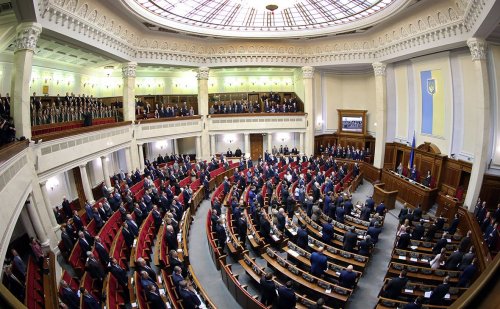
On December 26, the Verkhovna Rada Committee on Environmental Policy and Nature Management considered amendments to the draft law No. 12131 prepared for the second reading with the revised title “On Amendments to Certain Laws of Ukraine on the Restoration of Monitoring, Reporting and Verification of Greenhouse Gas Emissions” and recommended that the Parliament adopt it in the second reading and as a whole as a law. It provides for the submission of reports for the current year until December 31, 2025.
A report on the results of the meeting was published on the committee's website.
Its members decided to take into account the amendments and proposals submitted by the Committee's chairman, MP Oleh Bondarenko, to add to the comparative table additions concerning the final version of the text of the document's articles.
The Ministry of Environmental Protection and Natural Resources of Ukraine also spoke about the details of the draft law:
- the draft law allows operators not to submit reports for the 2021, 2022 and 2023 reporting years;
- submission of the report for 2024 will be mandatory. At the same time, the submission deadline is extended: the deadline will not be March 31, 2025, as before, but December 31;
- the document details the requirements for submitting documents for partially destroyed installations and installations that are located in the territory where hostilities are being conducted or are located in temporarily occupied territories.
The department is confident that the adoption of this draft law will allow:
- restore the mandatory system of monitoring, reporting and verification (MZV) of greenhouse gases, which will meet European and international standards;
- ensure transparency and accuracy of greenhouse gas emission calculations;
- to create conditions for the introduction of a system of trading quotas for greenhouse gas emissions, as an effective mechanism for reducing emissions.
The head of the Ministry of Environment, Svitlana Grynchuk, also reminded that this bill is an indicator of receiving funding within the Ukraine Facility program.
During the meeting of the eco-committee, business representatives from the European Business Association (EBA) and the National Association of the Extractive Industry of Ukraine (NADPU) voiced their comments and suggestions regarding draft law No. 12131.
Firstly, they noted that there are differences in CO2 emissions calculations based on the MIA methodology and the data used to obtain emission permits. Companies say that this raises questions about taking into account such discrepancies in reporting and when calculating the environmental tax. Therefore, they propose to unify the methods to simplify the process.
Secondly, industry representatives had practical questions regarding the reporting of MIA for large installations of category B. In particular, whether they need to submit reports already for 2024. They asked for official clarification to clearly understand the requirements for them.
Thirdly, companies expressed their desire to use the methodology of the Ministry of Foreign Affairs in the process of obtaining emission permits. In their opinion, such an approach could help to harmonize calculations and reduce the administrative burden.
As Ecopolitic reported earlier, November 7 the ecocommittee supported draft law No. 12131 on amendments to some legislative acts of Ukraine regarding the restoration of the Ministry of Foreign Affairs before the first reading. And November 21 Verkhovna Rada approved this bill is the basis.