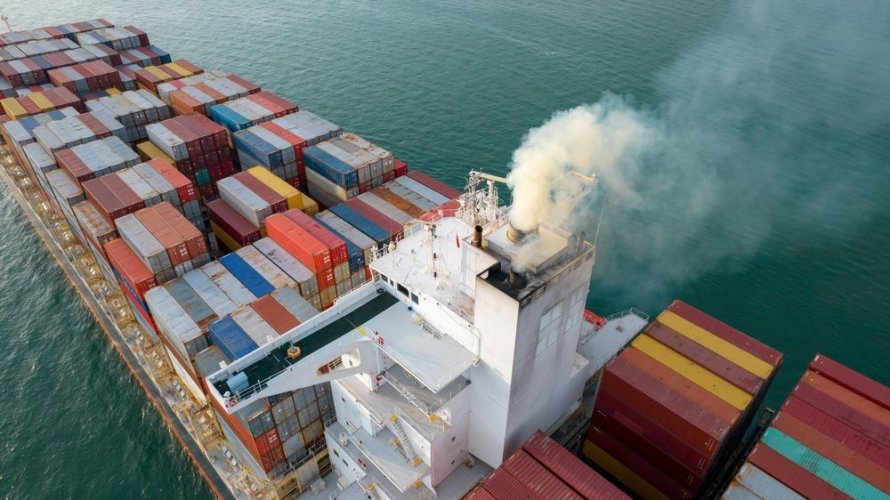
The International Maritime Organization (IMO) has approved a draft regulation that establishes mandatory marine fuel standards and a global greenhouse gas emissions pricing mechanism for this transport sector.
This was reported on the organization's official website.
Stakeholders emphasized that they have taken another important step towards creating a legally binding framework for reducing greenhouse gas emissions from ships around the world to achieve zero emissions by 2050. They noted that the IMO Net-zero Framework is the first in the world to combine binding emission limits and greenhouse gas pricing for an entire industry sector.
Measures to implement the program are due to be formally adopted in October 2025 and will come into force in 2027. From that moment on, they will be mandatory for large ocean-going vessels with a gross tonnage of more than 5,000 tons, which are responsible for 85% of the total CO2 emissions from international shipping.
Key elements of the IMO Net-Zero Framework concept
This concept will be included in the new Chapter 5 of Annex VI, “Prevention of Air Pollution from Ships” to the International Convention for the Prevention of Pollution from Ships (MARPOL).
Its objectives:
- achieving the climate goals set out in the IMO Strategy for Reducing Greenhouse Gas Emissions from Ships by 2023;
- accelerate the adoption of fuels, technologies and energy sources with zero and near-zero greenhouse gas emissions;
- support a fair and equitable transition.
According to the draft rules:
- ships must reduce their annual greenhouse gas intensity (GFI) over time – that is, how much greenhouse gas emissions are produced for each unit of energy used;
- ships that emit more than the GFI thresholds will be forced to purchase renewable energy plants to balance the emissions deficit. At the same time, those using technologies with zero or near-zero greenhouse gas emissions will be eligible for financial rewards;
- there will be two levels of compliance with the greenhouse gas intensity targets: Baseline Target and Direct Target, upon achieving which ships will be eligible to earn “excess units”;
- ships that emit more than the established thresholds can balance their emissions deficit by: transferring excess units from other ships, using excess units they have already accumulated, or using offsets purchased through contributions to the IMO Net-Zero Fund.
IMO Net-Zero Fund
This fund will be created to accumulate revenues from emissions allowance payments. These funds will then be distributed to:
- rewarding ships with low emissions;
- support for innovation, research, infrastructure and just transition initiatives in developing countries
- funding training, technology transfer and capacity building in support of the IMO Greenhouse Gas Strategy;
- mitigating negative impacts on vulnerable states such as small island developing states and least developed countries.
David Cruz, a CBAM specialist at the Norwegian company CEMAsys, adds that ships that exceed certain thresholds will pay a minimum carbon tax of $100 per ton of greenhouse gas emissions. According to IMO estimates, this will bring in $11 billion a year to finance the shipping industry's path to net zero by 2050.
The expert noted that there is a global shift from voluntary reporting to tariffed emissions.
“These measures are no longer regional. They are turning into global trade-related taxes with real economic consequences,” he emphasized.
Recently, EcoPolitic reported that the EU has finalized a new microplastics regulation. We explained what exactly will change for manufacturers with the adoption of this document.