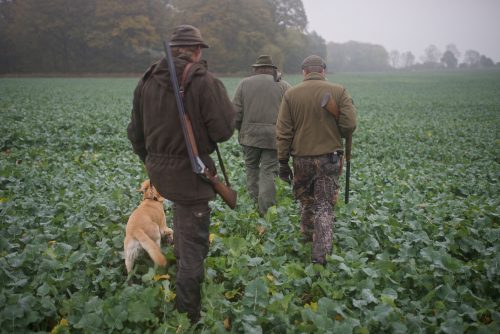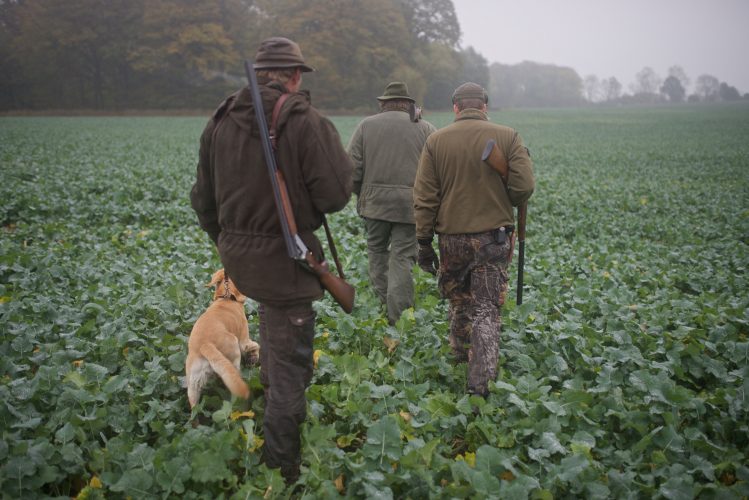
Lawmakers are set to update the regulations governing hunting, but the draft bill they have proposed has already sparked outrage among environmentalists. They have identified a number of harmful provisions and relaxations of existing bans in document No. 15431, and regard it as paving the way for the destruction of animals to become a form of entertainment.
Arguments against the new draft bill have been set out by the Kyiv Ecological and Cultural Centre (KECC).
Document No. 15431, ‘On Game Management, Hunting and the Sustainable Use of Game Animals’, was received by the Verkhovna Rada on 20 July. Since 23 July, it has had the status ‘Submitted for review’. The bill was initiated by a group of MPs led by Ihor Marchuk.
“This draft bill cannot be rectified through amendments. It cannot be ‘refined before the second reading’. It is fundamentally flawed, as it is based on the belief that a wild animal is a commodity, its death a service, and Ukrainian forests a venue for paid entertainment,” environmental activists maintain.
Shooting animals as a tourist attraction
The draft bill introduces the term ‘hunting tourism’. The authors define it as ‘a form of active leisure involving travel for the purpose of hunting wild animals in their natural habitat and/or in semi-free conditions, as well as photo-hunting’.
The document also defines what constitutes semi-free conditions. Animals cannot move freely beyond an artificially isolated area. In other words, these are animals raised by humans that cannot escape from them. At KECC, hunting such animals is described as especially disgraceful, recalling the term "canned hunting."
"Ukrainian enterprises will raise victims, a foreign client will come and shoot them for money, and the state will call this tourism and (possibly) collect a tax from it," environmentalists write.
Ignoring the quiet season
During this period, from April 1 to June 15, shooting is prohibited in Ukraine as a source of noise. This is established by Article 39 of the Law "On the Animal World." During the quiet season, animals give birth and care for their young.
However, the new bill ignores this. KECC points out, for example, that the bill allows hunting of male roe deer from May 1 through December. May is arguably the most vulnerable time for animals, as fawns still cannot run and birds are incubating eggs in their nests.
"The entire forest hears the shot. A pregnant female panics and abandons her offspring. The fawn dashes off and dies. A bird takes flight from its clutch, leaving it to chill. Every hunter knows this. At least, they should. And yet they included May," the organization protests.
Eco-activists remind us that the prohibition on hunting during the breeding season is a direct requirement of Directive 2009/147/EC and the decision of the Court of Justice of the European Union in case C-435/92.
Blatant exceptions among prohibitions
The new document, in Article 31, allows night hunting for animals that are difficult to find during the day – wolves, foxes, raccoon dogs, wild boars, jackals. KECC believes this measure is included not for safety, but for the efficiency of animal extermination.
Another nuance is hunting within populated areas. The same article prohibits it, but allows for exceptions. All that is required is the appropriate decision of the regional, Kyiv, or Sevastopol city councils.
Wider Range of Hunting Tools
Art. 1 of Draft Law No. 15431 provides a rather extensive list of hunting tools:
"firearms, pneumatic weapons, cartridges, knives, bows, crossbows, arrows, hunting spears, traps, vehicles and floating devices, unmanned aerial vehicles, electrical equipment, optical devices, thermal imagers, night vision devices, sound reproduction equipment, etc."
Environmental advocates note not only the abstract “etc.”, which theoretically allows the addition of other devices and tools to the list, but also the inclusion of drones and thermal imagers. And they are not designated as prohibited.
The document already selectively removed some of the current prohibitions:
- there is no longer a ban on the use of sound reproduction equipment;
- the draft mentions thermal imagers among hunting tools but does not list them as prohibited devices. Only night vision devices fall under the ban;
- artificial light is now formally allowed on firearms when hunting beaver and wild boar, although it is currently completely prohibited;
- night hunting was not previously allowed, but the draft introduces exemptions for five animal species.
Not Poaching, Just a ‘Rules Violation’
The new draft law sorts prohibitions into two articles. Art. 31 indicates that “Violations of the prohibitions stipulated in this article of the Law are considered violations of hunting regulations and are not classified as poaching.”
Environmental groups have observed that a significant list of actions previously considered poaching have been reclassified as hunting rules violations. Among them are:
- finishing off animals escaping fires or floods;
- destroying animal dens, beaver dams, bird nests;
- flooding burrows;
- shooting from vehicles while in motion.
Two typest of dogs
If a stray mongrel dog is found in hunting grounds, it may simply be “taken as part of the regulation of wild animal populations,” that is, killed.
Only purebred dogs found unattended are subject to capture and notification of authorities.
Questionable ‘Pests’
Although modern science does not classify animals as beneficial or harmful, the authors of the draft law have decided to revive the outdated Soviet doctrine of ‘harmful animals.’ These are described as “undesirable for game management animals.” The culling list now includes wolves, jackals, foxes, raccoon dogs, “feral domestic animals, including household animals found on grounds without an owner,” hooded crows, magpies, jays, and invasive species.
The Environmental Center for Environmental Citizen Control (KEKC) pointed out that the draft does not explain what feral animals are, but it does give hunters the right to ‘take’ them.
Forests for Free
The rules on payment and lease of grounds particularly outraged environmentalists. According to Art. 17, the draft law sets the cost of using 1 ha of forest at 0.2% of the subsistence minimum, and 0.05% for 1 ha of field grounds.
The right to use grounds will be granted for 20 years with automatic extension. If the official does not respond, it is considered tacit consent.
The minimum area of forest grounds has been reduced from 3,000 hectares to 500.
Controversial Agency Duties
The draft law proposes the establishment of an Agency that would simultaneously perform rather controversial functions. Among them are the formation of hunting grounds, promotion of hunting, development of the trophy industry, and organizing competitions. At the same time, the body would be responsible for overseeing the sector.
The Center for Environmental Control (CEC) considers this quite strange, as it creates an internal conflict of interest within a single institution.
EcoPolitic previously reported that Ukrainian activists are calling for a complete ban on hunting wild animals.
Animal rights activists managed through the courts to have the decision of the Khmelnytskyi Regional Military Administration, which allowed 241 hunters to shoot animals in the “Podilski Tovtry” National Nature Park, declared illegal.