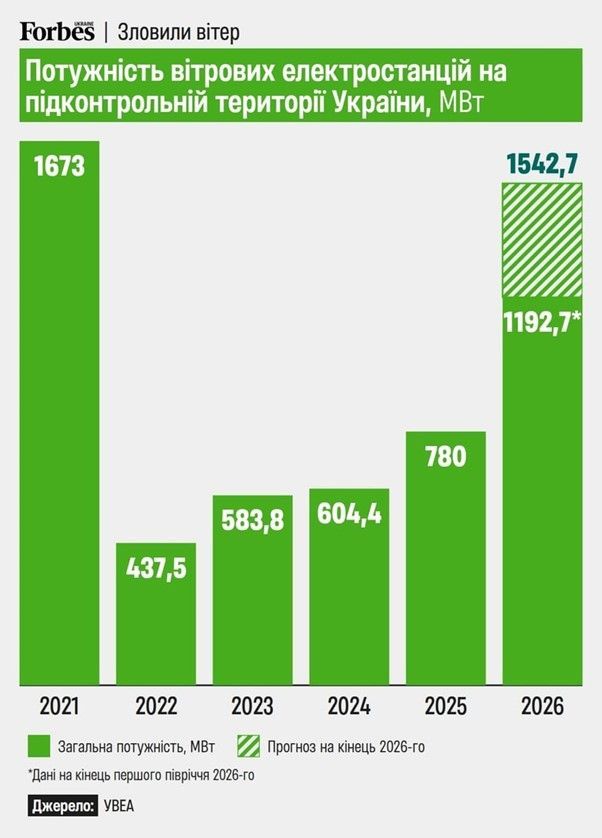
Throughout 2026, Ukraine’s wind energy sector could gain 765 MW of additional capacity. Total investment in the sector exceeds $1.15 billion. This is likely to offset the war-related losses in wind power generation and bring the sector’s total capacity closer to the levels seen at the start of 2022.
Forbes has analysed who is leading the way in terms of investment in the wind energy sector and what is driving the wind energy boom.
Catching up with the past
At the start of the full-scale invasion, Russia occupied territories where around 74 per cent of Ukraine’s total wind power generation capacity is located. This represents a total capacity of 1.3 GW.
However, since 2022, 836 MW of wind power stations have already been commissioned. Around half of this volume represents growth in the first half of 2026 alone. These figures are provided by the Ukrainian Wind Energy Association (UWEA).
Experts attribute this surge in new generation capacity to the completion of projects that began in previous years. An additional incentive is the need to establish distributed generation in the face of constant enemy attacks on energy infrastructure.
However, this growth could have been even more significant. According to responses from representatives of the largest investors in wind power (DTEK, OKKO, Elementum Energy), Forbes reports that the key obstacle is funding. Credit limits imposed by Ukrainian banks prevent the sector from reaching the required scale, so companies are turning to foreign financing.
Source: Forbes
Wind power leaders
As of July 2026, wind power capacity on Ukraine-controlled territory totals 1.2 GW.
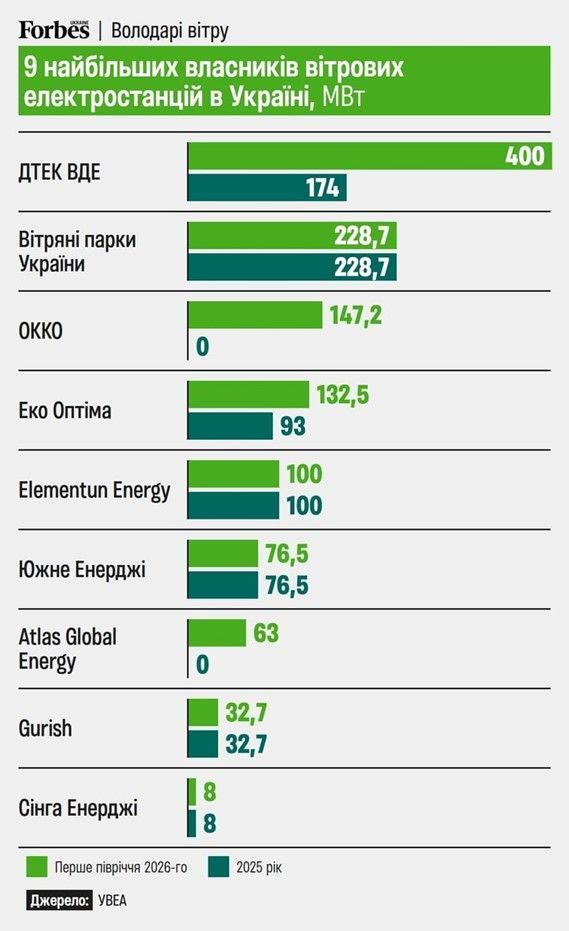
The top wind power plant (WPP) owners are as follows:
- DTEK Renewables – 400 MW of generating capacity. The company suffered the largest losses during the occupation, namely over 500 MW in the Zaporizhzhia region. A 650 MW project in central Ukraine is in its final stage. Investments in this project amount to $1.4 billion.
- "Wind Parks of Ukraine" – 228.7 MW of generation. The company’s war-related losses amounted to 135 MW due to occupation and 13.5 MW from attacks on their WPP in Kramatorsk. This company is now developing wind farms in the Carpathians.
- OKKO has 147.2 MW of wind power plants. The company launched its first wind farm only in 2026. Its future plans include commissioning a 190 MW wind power plant and building a 320 MW facility. OKKO’s investment plans in wind energy total $1.15 billion.
Source: Forbes
Earlier, EcoPolitic reported that during just the first half of 2026, Ukraine added 414.8 MW of new wind generating capacity. For comparison, throughout the previous year, power plants with a total capacity of 324.4 MW were commissioned. Moreover, this figure exceeds the total for the previous three years.