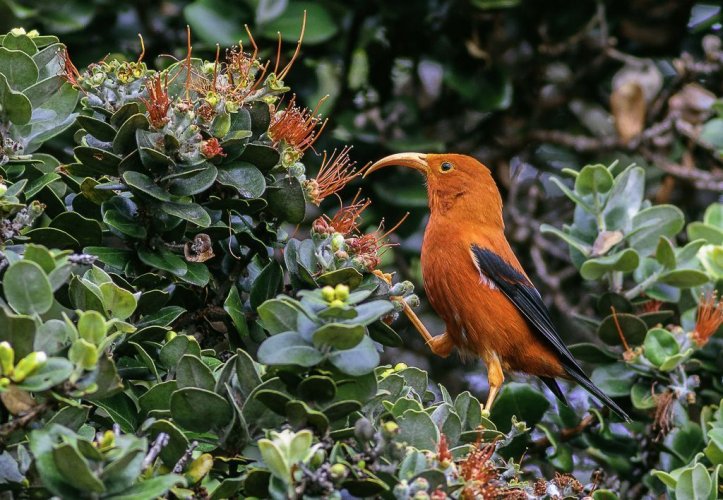
In Hawaii, millions of mosquitoes are being released from helicopters to save rare endemic birds, the Hawaiian honeycreeper, from extinction due to malaria.
The Guardian reports on this unusual way to save the birds.
The birds are dying from malaria carried by mosquitoes first introduced on European and American ships in the 1800s. Since Hawaiian honeybees did not have time to evolve along with the malaria virus, they have very little immunity to it.
The publication reports that 33 native honeybee species have gone extinct, and many of the 17 remaining species are endangered, with fears that some could disappear within a year if no action is taken.
Conservationists say the population of one honeybee species, the kauaiki, has declined from 450 in 2018 to 5 in 2023, with only one bird left in the wild on Kaua'i Island, according to the National Park Service.
In order to save endemic birds, scientists use the method of incompatible insects. It consists of releasing male mosquitoes infected with Wolbachia bacteria, which prevent the eggs of wild females they mate with from hatching. This bacterium naturally lives in most insects, which can only produce viable offspring with partners that share the same strain of Wolbachia.
Since female mosquitoes mate only once, using infected male mosquitoes reduces the population size.
Scientists release 250,000 insects from helicopters every week. Thus, 10 million males with the bacterium Wolbachia were settled on remote islands of the archipelago.
Scientists say that there is experience of successful application of this method in China and Mexico. Similar programs are held in California and Florida. Scientists hope to see the effectiveness of this program in the summer, when mosquito populations typically peak.
In May, EcoPolitic reported that the war in Ukraine has had a significant impact on its birdlife: some species of birds may disappear forever, and eagles whose migration routes pass through our country have changed them to avoid the war zone.