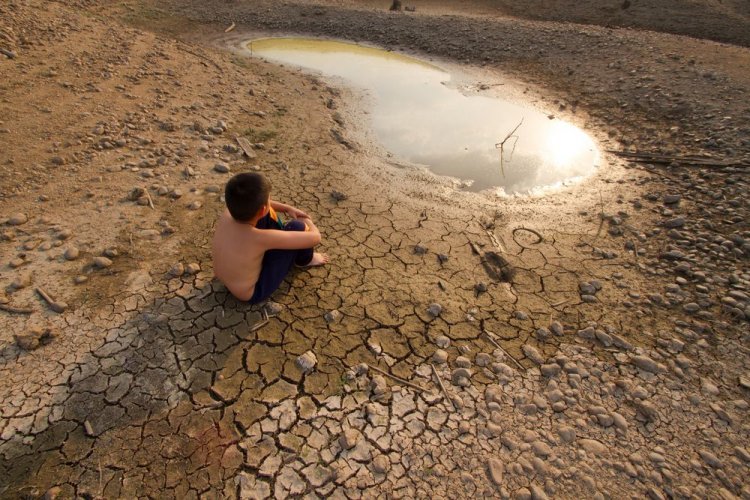
Europe is suffering from a severe drought that may appear the worst in the last 500 years, which leads to drying up of rivers.
This could have negative consequences for industry, freight transport, energy and food production, as well as biodiversity, reports Guardian.
Thus, France's longest river, the Loire, can now be crossed on foot in some places, and its flow has slowed down significantly. In Germany, the Rhine River is quickly becoming impassable for barges, and in Italy, the Po level is 2 meters below normal, damaging crops.
"Driven by climate breakdown, an unusually dry winter and spring followed by record-breaking summer temperatures and repeated heatwaves have left Europe’s essential waterways under-replenished and, increasingly, overheated," the article says.
Meteorologists say the drought could be the continent's worst in more than 500 years, as no significant rainfall has been recorded in western, central and southern Europe for nearly two months and is not expected to occur in the near future.
However, scientists cannot fully analyze such a climatic event, because it is still ongoing.
"In the last 500 years, there have been no other events like the drought of 2018. But this year, I think, is worse," said Andrea Toreti of the European Commission's Joint Research Centre.
He added that there was a very high risk of dry conditions over the next three months. Without effective mitigation, the intensity and frequency of droughts will increase dramatically over Europe, both in the north and in the south.

Many barges, which carry coal for power plants and vital raw materials for industrial giants such as steelmaker Thyssen and chemical giant BASF, are already operating at about 25% capacity to reduce their draft, raising shipping costs up to fivefold.
A complete stoppage of barge traffic on the Rhine will hit the economy of Germany and Europe hard. So a six-month suspension in 2018 cost around €5 billion, and low water levels would cost Germany 0.2 growth points in 2022.
France’s rivers might not be such key freight arteries, but they do serve to cool the nuclear plants that produce 70% of the country’s electricity. As prices hit all-time highs, power giant EDF has been forced to reduce output because of the drought.
The Garonne, Rhône and Loire rivers are already too warm to discharge cooling water, but France's nuclear regulator has allowed five power plants to temporarily break the rules.

In Italy, the flow of the parched Po, Italy’s longest river, has fallen to one-tenth of its usual rate, and water levels are 2 metres below normal. With no sustained rainfall in the region since November, corn and risotto rice production have been hard hit.
The Po valley accounts for between 30% and 40% of Italy’s agricultural production, but rice growers in particular have warned that up to 60% of their crop may be lost as paddy fields dry out and are spoiled by seawater sucked in by the low river level.

In the river's delta wetlands near Venice, its high temperature and slow flow have reduced the oxygen content of the water to such an extent that about 30% of the lagoon's molluscs have already been destroyed.
Low river levels and high water temperatures can be fatal for many species. The Danube reached 25°C in Bavaria last week and could reach 26.5°C by the middle of the month, meaning the oxygen content will drop below six parts per million, which is fatal for trout.
Freight traffic on 2,850 km of the Danube was also severely disrupted, prompting authorities in Serbia, Romania and Bulgaria to begin dredging the canals.
Even Norway, which depends on hydropower for about 90% of its electricity generation, has said its extremely low reservoir levels may eventually force it to limit power exports.
Earlier, EcoPolitic wrote, that in Germany falling water level in the Rhine due to the heat has led to an increase in shipping costs to about €94 per ton, from €20 per ton in June 2022.
As EcoPolitic reported earlier, Italy declared a state of emergency in five regions as more intense droughts and heat damage agriculture and energy supplies.