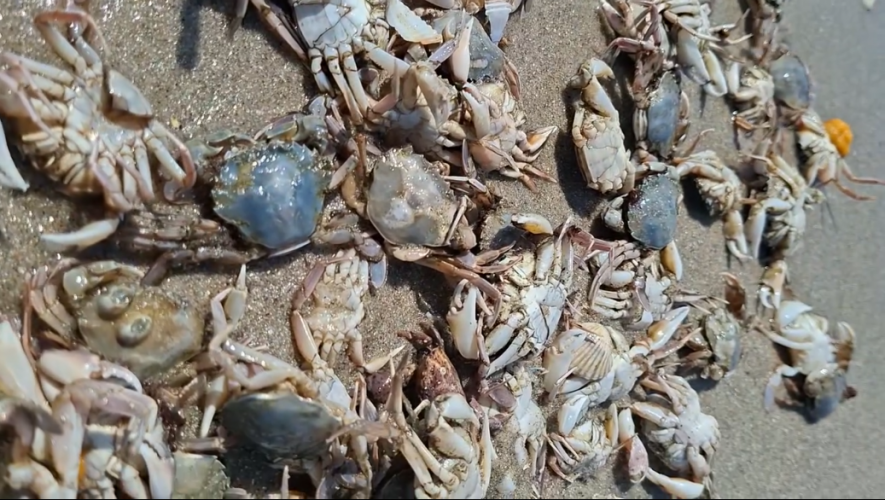
Tens of thousands of swimming crabs have washed up on the shore of the Tuzlivski Limany National Nature Park in the Odesa region due to a rather rare phenomenon that experts call upwelling.
This was reported by Ivan Rusev, head of the park's research department, on his Facebook page.
The ecologist explained that the crabs were carried by cold water from the depths. This phenomenon, upwelling, is associated with changes in water temperature and wind currents that bring cold deep layers of water to the surface. Such a phenomenon does not occur often.
According to Rusev, it was this mass of water that “washed” the swimming crabs ashore. The scientist said that they usually live at depths of hundreds or even thousands of meters. National park employees and concerned local residents tried to save as many live crabs as possible by helping them return to the water. According to the expert's estimates, about 10% of these arthropods returned to the sea on their own.
Video: facebook.com/ivan.rusev.215723.
These crabs are excellent swimmers. Their fourth pair of legs is perfectly adapted for movement in water, as it resembles oars.
In early June, EcoPolitic reported that environmentalists had again found fuel oil from Russian tankers on the coast of Odesa.