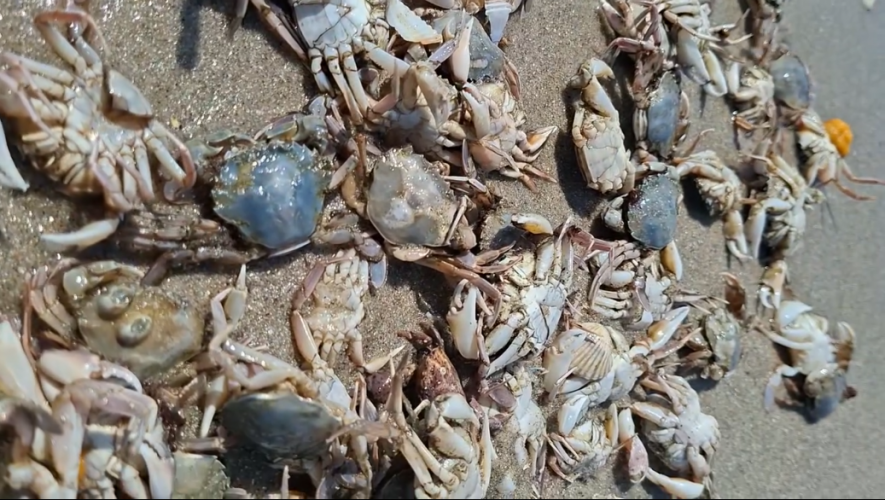
Hundreds of thousands of crabs washed ashore in Odesa region: what's the reason?

Hundreds of thousands of crabs washed ashore in Odesa region: what's the reason? facebook.com/ivan.rusev.215723
Hanna Velyka

There are many females with caviar among them

Tens of thousands of swimming crabs have washed up on the shore of the Tuzlivski Limany National Nature Park in the Odesa region due to a rather rare phenomenon that experts call upwelling.

This was reported by Ivan Rusev, head of the park's research department, on his Facebook page.

The ecologist explained that the crabs were carried by cold water from the depths. This phenomenon, upwelling, is associated with changes in water temperature and wind currents that bring cold deep layers of water to the surface. Such a phenomenon does not occur often.

According to Rusev, it was this mass of water that “washed” the swimming crabs ashore. The scientist said that they usually live at depths of hundreds or even thousands of meters. National park employees and concerned local residents tried to save as many live crabs as possible by helping them return to the water. According to the expert's estimates, about 10% of these arthropods returned to the sea on their own.

Video: facebook.com/ivan.rusev.215723.

These crabs are excellent swimmers. Their fourth pair of legs is perfectly adapted for movement in water, as it resembles oars.

In early June, EcoPolitic reported that environmentalists had again found fuel oil from Russian tankers on the coast of Odesa.
Related
Roe deer, deer, wild boars: the population of wild animals has grown in the Polissya forests of Ukraine

Foresters attribute this to natural factors, systematic feeding, and semi-free breeding

Which animals could be on the brink of extinction in 2026?

Pangolins and stingrays, spiders and snakes, wild cats and relict pangolins – human activity threatens many species in different parts of the world

Animals are unable to keep up with the warming climate: a white ermine was spotted in the Odessa region

Natural color change exposes animals due to snowless winters and makes them vulnerable

Poland has banned animal breeding for fur

The country is the world's second largest fur producer, but has decided to abandon this industry based on animal welfare principles