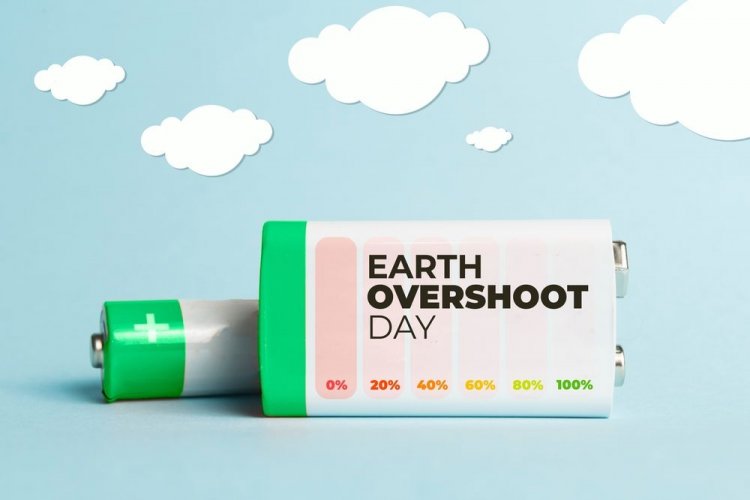
The world is facing the worst ecological debt situation in the history of research: by July 24, the global population will have used up all the renewable resources that the Earth is capable of reproducing in a year.
This is according to data from the international research organization Global Footprint Network, which measures how many resources humanity uses and compares this with how much the planet can reproduce. They calculate the ecological footprint and determine the date of Earth Overshoot Day each year. To calculate the indicator, the ecological footprint — the amount of resources consumed by a country or humanity as a whole — is compared with the planet's biocapacity, i.e., the Earth's ability to produce natural resources and absorb waste.
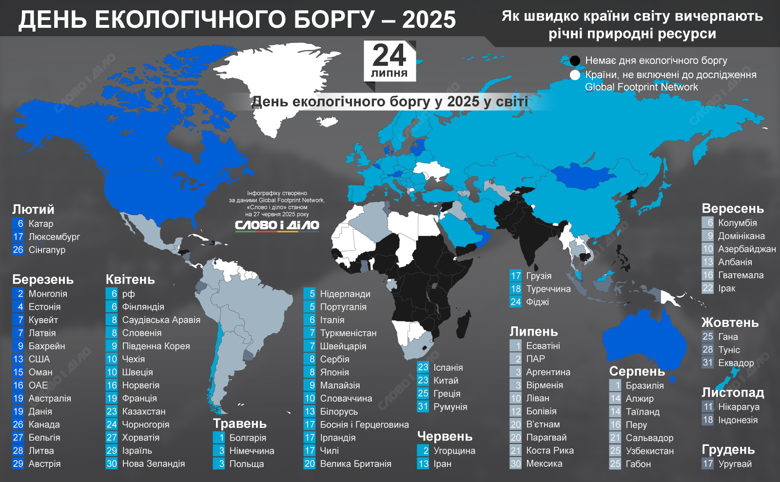
Based on this information, analysts from the publication Slovo i Dilo studied the situation with this indicator in different countries around the world. Here is the infographic they produced:
Infographic: slovoidilo.ua.
Qatar, Luxembourg, and Singapore turned out to be the most “wasteful,” having exhausted their limits back in February, while the most economical countries will be those that will not reach their ecological debt day this year. These are most African countries, India, Pakistan, and several other countries in Asia and Latin America. They are marked in black on the infographic.
Ukraine, like a number of other countries, was not included in the study. They are marked in white.
The European Union as a whole has a high level of consumption. Earth Overshoot Day for the bloc was April 29 this year. Specifically, in France, it was April 19, in Germany and Poland, May 3, in Italy, May 6, and in Spain, May 23.
Analysts have noted that the anti-leaders remain countries where high levels of resource consumption are not offset by any sustainable development policies. They also point to a general deterioration of the situation across the planet, as Earth Overshoot Day is shifting to earlier dates every year.
EcoPolitic recently reported that in 2024, the world set a new record for electricity demand and CO2 emissions.