Following the dissolution of the government in Ukraine, a new structure for the Cabinet of Ministers is being hastily ‘reworked’. According to sources in parliament, the Ministry of Economy, Environment and Agriculture – which was merged a year ago – is set to be split up after all. However, the Ministry of Environment is not expected to be separated into a standalone institution.
This inside information was revealed by MP Yaroslav Zheleznyak on his Telegram channel.
According to the MP, the future composition and structure of the government were discussed at a meeting of the parliamentary group of the presidential party, ‘Servant of the People’.
The “mega-ministry” is likely to be split into two – the Ministry of Economy and Ecology, and the Ministry of Agrarian Policy. The latter is provisionally set to be headed by Taras Vysotskyi, who previously served as deputy minister in the merged ministry.
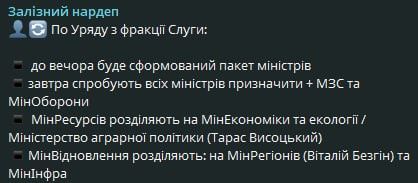
Source: Telegram channel “Zaliznyi Nardep”
Overall, the “ministerial package” may be formed as early as tonight. Tentatively, this will be discussed with President Volodymyr Zelensky during a new faction meeting at 18:00.
According to Zhelezniak, the appointment of new ministers will take place on Thursday, July 16. It remains unknown who will head the Ministry of Economy and Environment.
Persistent reluctance to correct the institutional mistake
Amid reports of the upcoming resignation of Prime Minister Yulia Svyrydenko and the Cabinet reshuffle, environmental organizations and civic experts have once again called for state environmental policy to be managed by a standalone authority. This was also the case after a major official corruption exposure in the “Midas” case, and at the very beginning of the merging of competing agencies.
As we can see from insider information, the authorities have once again ignored this.
Over the past year, arguments from the public have accumulated and are supported by undeniable facts – from the risk of failing to meet EU integration commitments to institutional incapacity. Still, the most acute problem is the internal conflict of the ministry’s functions. While its economic component involves development, investment, and, overall, financial matters, the environmental component is about preserving what might be lost in pursuit of that capital.
EcoPolitic provided more details about the systemic problems caused by the merger of ministries in a separate article here.