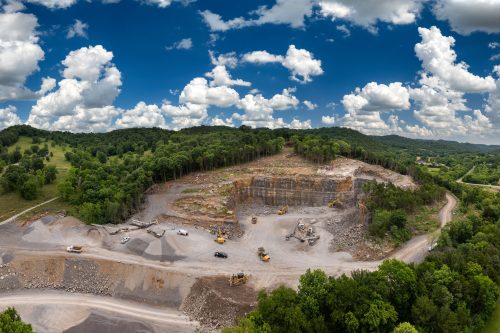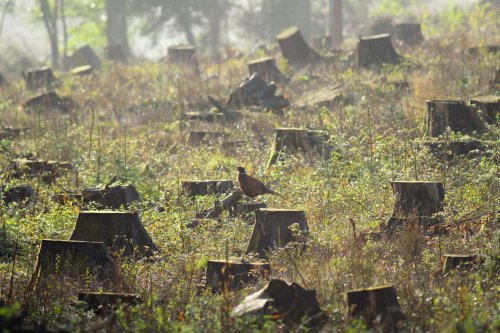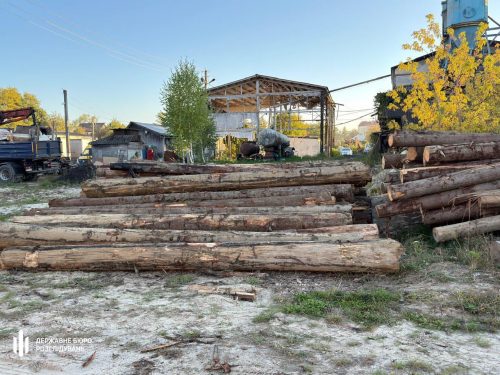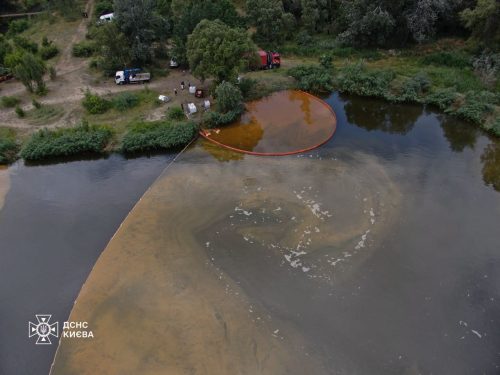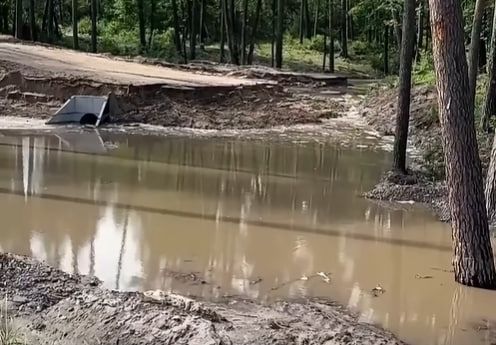
On Tuesday, June 9, it became known that a dam constructed to divert water from the National Military Memorial Cemetery (NMMC) construction site had burst. As activists and experts have repeatedly pointed out, the Markhalivsky Forest, where the project is being implemented, is swampy and not intended for such activity.
This was reported by the Espreso media outlet, citing local journalist Yuliya Senyk.
“When you ignore the warnings of ecologists, hydrologists, the community, and simple common sense for years, nature will have its say. And its arguments are much stronger,” the journalist notes in a video published by the Kyiv Ecological and Cultural Center (KECC).
Why the location chosen to honor heroes is unsuitable?
The Markhalivsky Forest, where the NMMC is being built, features swampy terrain with natural watercourses. The area contains a whole chain of lakes, wetlands, and rivers. Specifically, the rivers Petil, Siverka, and Prytvorka originate in the forest near Markhalivka.
The journalist also noted that the drainage system, whose efficiency is touted by authorities, will last a maximum of 15 years in operation. Therefore, this solution is also temporary.
According to Yuliya Senyk, water from the drainage system is discharged into the natural riverbed, which has begun to overflow and is undermining the road.
“What did they do? They started blocking the river’s course, creating an internal pipe to divert the river into it. They covered it with a sand embankment, built an artificial dam, blocked the river’s course, and forced the river through a pipe. But after heavy rains, this dam could not withstand the load, and this is the result,” explains Yuliya Senyk.
Environmental threat
The woman also draws attention to the fact that water from the burial site area is being discharged into the natural watercourse.
“Ultimately, not only have many building codes been violated here, but there is also an ecological threat: all these contaminants being diverted from the burial zone end up in the river – and from there, it flows across the entire southern region of Kyiv Oblast,” notes a local resident.
EcoPolitic reported that Markhalivsky Forest is part of the European Emerald Network. The Supreme Court has already confirmed that constructing a memorial cemetery there is illegal.
However, despite the decision of the highest judicial authority, the work on creating a mass burial site for defenders continues. This has already attracted international attention, and the Bureau of the Standing Committee of the Bern Convention is demanding explanations and plans from Ukraine regarding how it intends to address this situation.