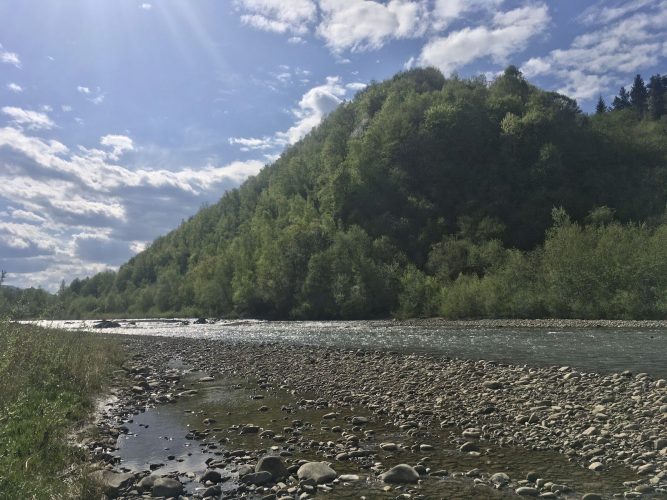
The Bystrytsia-Nadvirna River may soon be transformed into a series of regulated ponds. Citing the country’s difficult energy situation, the Pasichnyanska Village Council in Ivano-Frankivsk Oblast plans to build three small hydroelectric power plants (HPPs) on the river. According to environmental activists, this will lead to a deterioration of the river’s hydromorphology and the destruction of the habitat of rare fish species.
This was reported by the Ukrainian Nature Conservation Group (UNCG).
Artificial barriers spell doom for the river
Environmental experts emphasize that the construction of HPPs on free-flowing rivers causes extremely negative ecological consequences.
Currently, since the Bystrytsia-Nadvirna River has no man-made obstacles, the water body is in good ecological condition. This is evident from the water quality and hydromorphological indicators, and creates favorable conditions for aquatic biodiversity. In particular, the river is home to the European grayling, the common dace, and the common minnow—species listed in the Red Book.
“The riverbanks are protected natural habitats of the Emerald Network. The project’s own strategic environmental assessment report states that HPP construction will flood and destroy these areas,” emphasize the UNCG.
Activists are calling on the Ministry of Economy, Environment and Agriculture of Ukraine and the Ivano-Frankivsk Regional Administration to prevent the construction of the power plants.
Contradicting European practice
In contrast to the intentions of the Ukrainian community, Europe is actively dismantling artificial structures that hinder river flow. As reported by The Guardian, in 2025 alone, over 600 dams, locks, and culverts were dismantled in the EU, restoring the natural state of 3,740 km of rivers.
Currently, there are still over one million barriers on Europe’s waterways. Tens of thousands of these structures are considered obsolete and subject to mandatory removal. These requirements were enshrined in the EU’s nature restoration law, which came into force in 2024.
EcoPolitic previously reported on the consequences of unauthorized construction of a crossing in Zakarpattia. The temporary structure became an obstacle to ice flow during the thaw, posing a flooding threat to surrounding settlements. State Emergency Service workers were forced to urgently dismantle the structure.