Environmentalist Anna Kuzemko has warned that Ukraine may lose valuable habitats, including chalk mountains, steppe foothills, and desert steppes in the coastal zone, due to Russian aggression.
Ukraine should adopt the European experience of preserving habitats to save nature, because in order to preserve animals and plants, it is necessary to preserve their habitats, the NGO UAnimals reports on Facebook.
Kuzemko emphasized that in the occupied territories, soil, water, animals and plants suffer irreparable damage from shelling, fires and neglect and may be lost forever.
According to her, Ukraine may lose:
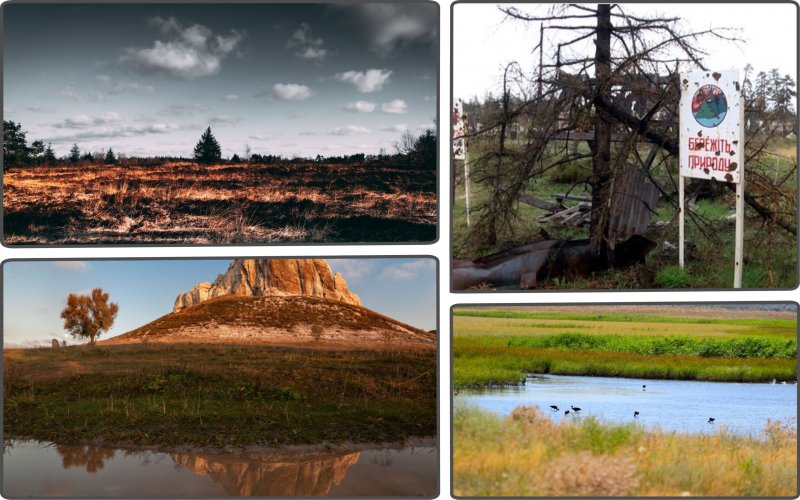
- Chalk mountains in the Don basin, in the Kharkiv, Luhansk and Donetsk regions. Places with such chalk outcrops are protected throughout Europe in accordance with the Berne Convention, which has also been ratified in Ukraine. Red book plants usually grow in such biotopes;
Kuzemko emphasized that due to the war, the pine forests on the chalk mountains, for example in the national natural park "Holy Mountains" in Donetsk region, have already been destroyed.
"In May 2023, scientists visited the village of Bogorodichne, where fierce battles had previously taken place, and saw that the pine forests were cut down by shelling and burned by fires. Whether these areas will be restored is currently a big question. There is a possibility that they will be lost forever," she said.
- Steppe undergrowth , i.e. a depression where flood waters flow in the spring. These zones have a special soil structure and can be both a steppe and a water body at the same time. Such areas are home to many species of red-listed plants and a resting place for migratory birds. The most famous pit is located in the occupied Biosphere Reserve "Ascanii-Nova" – Velikiy Chapelskyi Pit.
- Desert steppes, which are formed on heavy saline soils in the area of the coastal strip. They are mainly represented on the territory of the occupied Azov-Syvas National Park.
Earlier, EcoPolitic wrote, that in the Kherson region due to the actions of the occupiers about 300 hectares of steppe were burned in the unique biosphere reserve "Askania-Nova".
As EcoPolitic previously reported, Russian scientists have confirmed the rapid increase in the salinity of the Sea of Azov, which has almost equaled the indicators of the Black Sea.