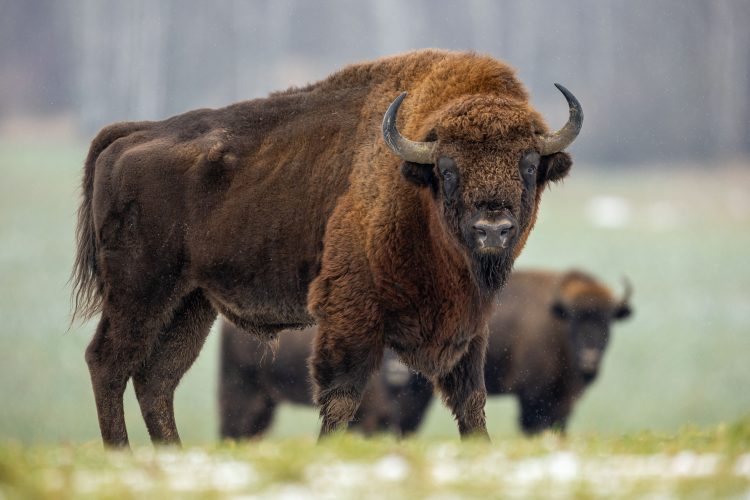
A century after the complete eradication of wild bison in Europe, their population is being restored. Herds now roam freely in the United Kingdom, Germany, Poland, Romania, and other countries. The revival of this species has a comprehensive ecological impact—thanks to the bison, entire ecosystems are now being restored.
Euronews reported on the impact of these majestic animals on the environment.
A history of extinction and revival
The bison inhabited Europe for a long time. However, unregulated hunting led to the destruction of this majestic animal’s population.
The last wild bison was shot in the Caucasus nearly 100 years ago—in 1927. At that time, fewer than 60 individuals of the species remained in the world—they were kept in private collections and zoos.
As early as the 1950s, bison began to be gradually reintroduced into the wild, and this had an unexpectedly positive outcome. In just the last ten years, the number of wild bison has grown from 2,579 to 7,000.
The largest herds of bison roam freely across Lithuania and Belarus. Over 100 individuals live in the Southern Carpathians of Romania. The population in Bulgaria is gradually growing—for the first time since the Middle Ages.
A significant positive impact
This animal, through its return, stimulates a range of ecological processes that positively affect ecosystems.
In the United Kingdom, this large mammal promotes biodiversity and the restoration of natural habitats. Bison graze, strip tree bark, and take dust baths–in doing so, they reshape the landscape and create habitats for other species.
“Walking there, we see much more light on the forest floor, through which species grow that could not exist there before, as previously it was dense thickets of trees, ferns, and brambles,” said conservationist Hannah Makins.
In Romania, bison were reintroduced to the Carpathians in 2014. After ten years, Yale University published a study that confirmed these herbivores can play an important role in mitigating the effects of climate change. A herd of just 170 animals can store and capture as much greenhouse gas as is emitted by 84,000 average gasoline-powered cars.
This effect is achieved through even grazing, nutrient cycling, fertilization of the soil, and seed dispersal. Additionally, large bison compact the soil, which prevents excessive carbon release.
Bison presence in the Netherlands has yielded unexpected effects. There, songbirds collect the mammals’ hair and use it to build nests. The birds give this material a special preference-it is soft and provides good thermal insulation.
EcoPolitic previously reported about the threats facing wild animals in Ukraine. Besides the full-scale war, threats include highways without fencing and chemicals that are widely used by farmers.