
Due to the war in the Middle East, the price of ‘conventional’ marine diesel fuel continues to rise. At the same time, the price of environmentally friendly biodiesel has fallen to a record low, which may help accelerate the industry’s transition to a ‘green’ alternative.
This was reported by the Financial Times.
In Rotterdam, home to the world’s biodiesel production hub, the price fell to a record low of $985 per metric tonne in September. By way of comparison, as recently as July it was priced at $1,388. According to Argus, producers are cutting prices not only to boost sales, but also to help the EU meet its emissions targets.
Following a record slump, the price has recovered slightly to $1,240 per tonne. Meanwhile, the price of diesel has reached $1,528.5 per tonne. Even before the war in Iran began, a tonne of this fuel cost $714.5.
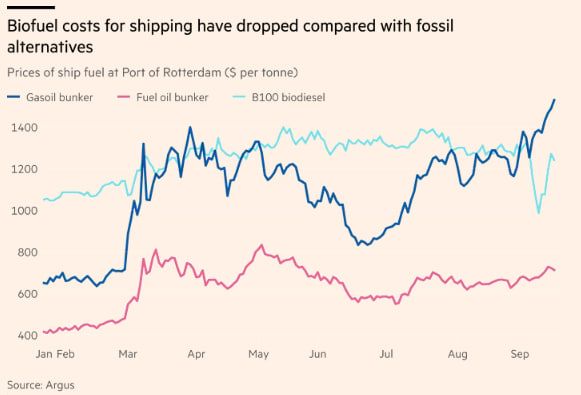
Джерело: Argus / Financial Times
Taking into account the costs of implementing the European Union’s climate policies and purchasing emissions allowances, biodiesel has proved to be cheaper than virtually all conventional fuels.
Analysts believe that such an unexpected price imbalance could encourage the shipping industry to switch to more environmentally friendly alternatives. Regulatory pressure to reduce emissions provides a further incentive, as shipping accounts for 3 per cent of global greenhouse gas emissions.
How to use
Biodiesel can be used as fuel for most modern vessels — either on its own or blended with conventional fuel. However, this requires a few minor modifications. These include, for example, separating the fuel tanks for different types of fuel or adjusting on-board procedures. But these are not particularly complicated or expensive.
Organic waste and agricultural residues are used to produce environmentally friendly fuel. However, biodiesel has a slightly lower energy density. As a result, ships will consume 7–10 per cent more fuel per voyage.
Overall, biodiesel has a significant advantage over other alternatives when it comes to integration into modern shipping. Experts describe it as a ‘practically ready-made solution’.
At the same time, the share of ‘green’ marine fuel worldwide remains negligible — around 0.6 per cent. This is despite an increase in usage since 2021.
Experts attribute this to competition for biofuels with other sectors, such as aviation. At the same time, there are EU restrictions on raw materials, as the EU is wary of crops being diverted from the food sector to the energy sector.
However, according to Argus estimates, demand for high-quality, unblended biodiesel in Rotterdam could rise to 250,000 tonnes this year. Global production stands at just over 4 million tonnes, although biodiesel is more commonly used in other sectors.
EcoPolitic previously reported that, due to the war in the Middle East, global biofuel production could increase by 70 per cent as early as 2030. At the same time, experts are warning about the demand for new land to grow raw materials for biofuel