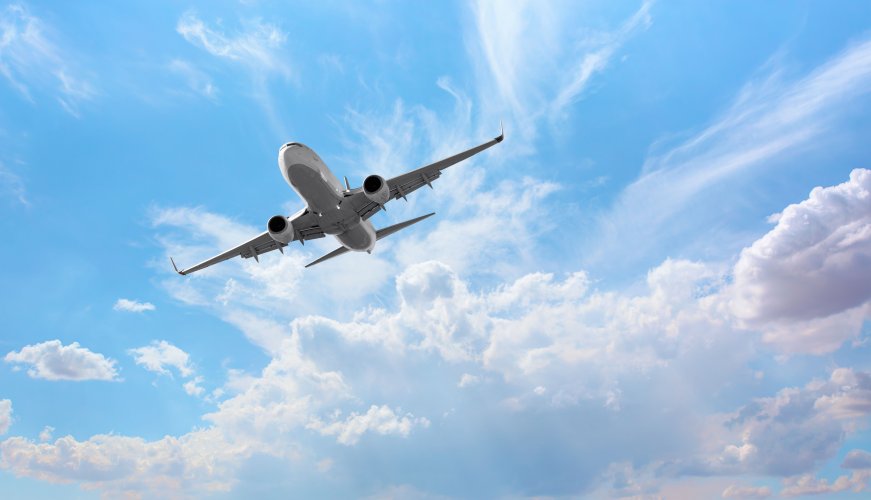
Global warming and the powerful El Niño climate phenomenon are intensifying unpredictable atmospheric threats to civil aviation: turbulence, aircraft icing and extreme heat.
How exactly climate change affects flight safety and what technologies are being developed to forecast these risks is discussed in a CNN article.
Why this is being discussed now
On November 1, a private Learjet 60 flying from Austin (Texas) to the Bahamas crashed in Florida. All nine people on board were killed. According to CNN, shortly before the crash, the co-pilot reported light icing and moderate turbulence. Investigators are still establishing the causes of the crash, but they are closely examining weather factors, as icing and turbulence are among the most serious aviation hazards.
Invisible turbulence and the El Niño factor
One of the most dangerous types of turbulence is clear-air turbulence, which occurs suddenly due to a sharp change in wind speed or direction at an altitude of about 8-11 km and is invisible to standard onboard radars.
According to a 2023 study, due to climate change, which increases the temperature difference between the poles and the equator in the upper atmosphere, cases of severe clear-air turbulence over the North Atlantic have increased by 55% since 1979.
Paul Williams, Professor of Atmospheric Science at the University of Reading in the UK, warns that over the next few decades, the frequency of such turbulence could triple in some regions.
An additional risk comes from the natural El Niño phenomenon: during its super-strong phases, wind shear at aircraft cruising altitude increases by about 20%, which inevitably leads to more cases of moderate and severe turbulence.
At the same time, CNN stresses that the risk of injury on large airliners remains low: aircraft are designed to absorb turbulence, in particular thanks to their flexible wings. Williams advises keeping your seat belt fastened and sitting closer to the middle of the cabin, avoiding the rear, where the plane "bounces" up and down the most.
Warming = more icing?
Another critical threat is aircraft icing, which occurs when an aircraft encounters supercooled water droplets in clouds. Freezing instantly on the fuselage, ice changes the aircraft's aerodynamics, reduces lift, blocks sensors and can cause engine failure.
Scientists do not yet know how warming will affect icing. In a recent report, the European Union Aviation Safety Agency (EASA) notes that early research points to possible changes in the frequency, altitude, severity and areas of icing. There is no complete picture yet, but according to an EASA spokesperson, "a warmer planet does not automatically mean less aircraft icing."
Heat forces airlines to remove passengers from flights
Extremely high temperatures also complicate air travel. When air heats up, it expands and becomes less dense, making it harder for aircraft to generate the lift needed for takeoff.
This is especially acute at airports with short runways, where on hot days, carriers have to reduce aircraft weight by offloading some passengers or leaving cargo behind. For example, at Italy's Florence airport, where the runway is about 1.5 km long, 20 passengers were removed from a flight to London last year due to heat of +35°C. In the Middle East, where temperatures exceed +51°C, long-haul flights are usually scheduled for the morning or late at night.
However, climate change poses risks not only to air travel but also directly to life on Earth. Earlier, EcoPolitic reported how global warming has already affected Ukraine: water bodies are drying up, large-scale wildfires are becoming more frequent, and the traditional agricultural regions of the south are losing their potential due to the threat of desertification.